
Network Version
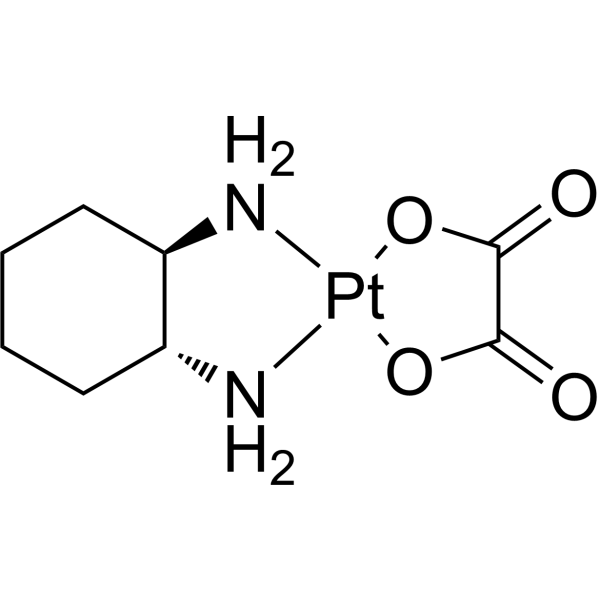
Oxaliplatin Data Sheet
| Product Name: | Oxaliplatin |
 |
|---|---|---|
| CAS No.: | 61825-94-3 | |
| Cat. No.: | HY-17371 | |
| MWt: | 397.29 | |
| Formula: | C8H14N2O4Pt | |
| Purity : | >98% | |
| Solubility: | H<sub>2</sub>O : 2 mg/mL (ultrasonic;warming;heat to 60°C);DMF : 1.67 mg/mL (ultrasonic);DMSO : 20.83 mg/mL (ultrasonic;warming) | |
| Mechanisms: | Target: Cancer Inflammation/Immunology | |
| Biological Activity: | ||
|
Oxaliplatin is a DNA synthesis inhibitor. Oxaliplatin causes DNA crosslinking damage, prevents DNA replication and transcription and induces apoptosis. Oxaliplatin can be used for cancer research[1][2][3].
IC50 & Target:IC50: DNA synthesis[1]
In Vitro:Oxaliplatin (24-72 hours; 2-128 μM; HCC, HCCLM3 and Hep3B cells) inhibits cell growth and induces apoptosis[1]. Oxaliplatin (10 μM; 15-240 mins; CEM cells ) induces primary and secondary DNA lesions, including DNA cross-links (ISC) and DNA-protein cross-links (DPC)[2]. Oxaliplatin (0.01 to 100 μM; 24 hours) potently inhibits bladder carcinoma cell lines RT4 and TCCSUP, ovarian carcinoma cell line A2780, colon carcinoma cell line HT-29, glioblastoma cell lines U-373MG and U-87MG, and melanoma cell lines SK-MEL-2 and HT-144 with IC50 of 11 μM, 15 μM, 0.17 μM, 0.97 μM, 2.95 μM, 17.6 μM, 30.9 μM and 7.85 μM, respectively[3]. In Vivo:Oxaliplatin (5-10 mg/kg; i.p.; for 32 days; nude mice) inhibits tumor growth[1]. Note:
1. Induction of acute chemotherapy-induced peripheral neuropathy (CINP)[10][11][12]
Background
Oxaliplatin induces acute neuropathic pain through a multifaceted mechanism involving disruption of voltage-gated ion channels, activation of TRP channels, suppression of DNA transcription, mitochondrial dysfunction, and increased generation of reactive oxygen species (ROS)[10].
Specific Modeling Methods
Rats: SD rats
Administration: Oxaliplatin (3, 5, 6 and 10 mg/kg) • i.p. • once Rats: SD rats Administration: Oxaliplatin (2 mg/kg) • i.p. • once Mice: Male CD-1 mice Administration: Oxaliplatin (10 mg/kg) • i.p. • once Mice: Male C57BL/6 mice Administration: Oxaliplatin (3 and 6 mg/kg) • i.p. • once Mice: Male BALB/c mice Administration: Oxaliplatin (5 mg/kg) • i.v. • once
Note
Oxaliplatin working solution is typically prepared in 5% glucose solution.
Modeling Indicators
Molecular changes: Activation of TRPA1/TRPM8 channels, voltage-gated Na⁺ channel dysfunction, and mild ROS elevation
Mechanical allodynia: Decreased paw withdrawal threshold (Von Frey test) Cold allodynia: Decreased paw withdrawal latency (acetone test) Motor function: No impairment (rotarod test), confirming pain specificity
2. Induction of chronic chemotherapy-induced peripheral neuropathy (CINP)[10][11][12]
Background
Oxaliplatin-induced activation of TRPA1 channels on dorsal root ganglion (DRG) neurons triggers Ca2+ influx, leading to the accumulation of ROS, mitochondrial DNA (mtDNA) damage, disruption of the electron transport chain, and opening of the mitochondrial permeability transition pore (mPTP). These alterations subsequently impede ATP synthesis and promote neurotoxicity[10].
Specific Modeling Methods
Rats: SD rats
Administration: Oxaliplatin (2.4 mg/kg) • i.p. • on days 1-3, 6-10, and 13-15 Rats: SD rats Administration: Oxaliplatin (2 and 4 mg/kg) • i.p. • on days 1, 2, 3, 4, 5 Rats: SD rats Administration: Oxaliplatin (6 mg/kg) • i.p. • on days 1,3, 5, 7 Rats: SD rats Administration: Oxaliplatin (2.4, 3.2, and 4 mg/kg) • i.p. • twice weekly for 4.5 weeks Rats: Wistar rats Administration: Oxaliplatin (4 mg/kg) • i.p. • twice weekly for 4 weeks Rats: Wistar rats Administration: Oxaliplatin (6 mg/kg) • i.p. • once per day for 6 days Rats: SD rats Administration: Oxaliplatin (2 mg/kg) • i.v. • once per day for 5 days Mice: C57BL/6J mice; BALB/c mice; ICR mice Administration: Oxaliplatin (0.3 and 3 mg/kg) • i.p. • 5 consecutive days, followed by 2 days of rest, for two cycles Mice: C57BL/6 mice Administration: Oxaliplatin (3 mg/kg) • i.p. • 3 times per week for 4 weeks Mice: CD-1 mice Administration: Oxaliplatin (2.4 mg/kg) • i.p. • 5 consecutive days each week for 2 weeks Mice: Swiss mice Administration: Oxaliplatin (6 mg/kg) • i.p. • every 3 days over 6 days
Note
Oxaliplatin is typically prepared in 5% glucose solution.
Modeling Indicators
Molecular changes: Increased ROS levels, activation of TLR4/NF‑κB pathway (TNF‑α, IL‑1β), decreased ATP, and TRPA1 sensitization
Histological changes: Significant loss of intraepidermal nerve fibers (IENF) in hind paw skin Mechanical allodynia: Decreased paw withdrawal threshold (Von Frey test) Cold allodynia: Decreased paw withdrawal latency (acetone test) Motor function: No impairment (rotarod test), confirming pain specificity Nerve conduction velocity: Decreased sensory nerve conduction velocity (SNCV); normal motor nerve conduction velocity (MNCV) |
||
1 Deer Park Dr, Suite F, Monmouth Junction, NJ 08852, USA
Tel: 609-228-6898 Fax: 609-228-5909 Email: [email protected] Web:www.medchemexpress.com