1. Anti-infection Autophagy
  2. Bacterial Autophagy Antibiotic
  3. Tigecycline

Tigecycline (GAR-936) is a broad-spectrum glycylcycline antibiotic. The mean inhibitory concentration (MIC) of Tigecycline for E. coli (MG1655 strain) is approximately 125 ng/mL. MIC50 and MIC90 are 1 and 2 mg/L for Acinetobacter baumannii (A. baumannii), respectively.

For research use only. We do not sell to patients.

CAS No. : 220620-09-7

Size Price Stock Quantity
Free Sample (0.1 - 0.2 mg)   Apply Now  
Solid + Solvent (Highly Recommended)
10 mM * 1 mL in DMSO
ready for reconstitution
In-stock
Solution
10 mM * 1 mL in DMSO In-stock
Solid
5 mg In-stock
10 mg In-stock
25 mg In-stock
50 mg In-stock
100 mg In-stock
200 mg In-stock
500 mg In-stock
1 g   Get quote  
5 g   Get quote  

* Please select Quantity before adding items.

This product is a controlled substance and not for sale in your territory.

Customer Review

Based on 43 publication(s) in Google Scholar

Other Forms of Tigecycline:

Top Publications Citing Use of Products

43 Publications Citing Use of MCE Tigecycline

Cell Proliferation/Viability Assay
WB
Microbiological Assay

    Tigecycline purchased from MedChemExpress. Usage Cited in: Nat Commun. 2024 Jun 28;15(1):5481.  [Abstract]

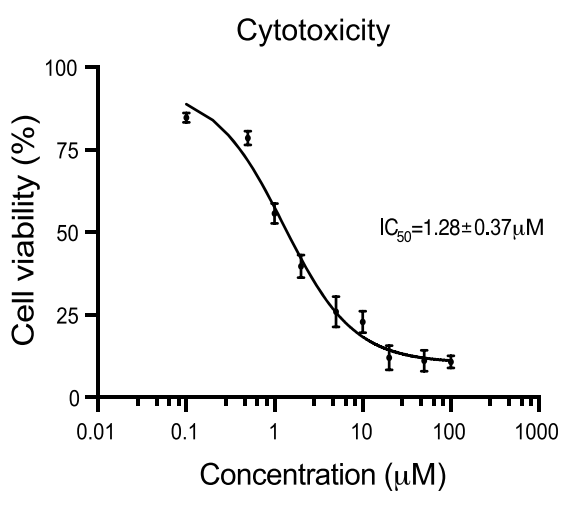
    Cell viability of HEK293T cells in the presence of increasing concentrations of Tigecycline (0.1-100 μM; 72 h), as measured by CCK-8 assay. Error bars (standard deviation) were calculated from three different experimental units (n = 3 independent experiments), and data were presented as mean values +/− SD.

    Tigecycline purchased from MedChemExpress. Usage Cited in: Nat Commun. 2024 Jun 28;15(1):5481.  [Abstract]

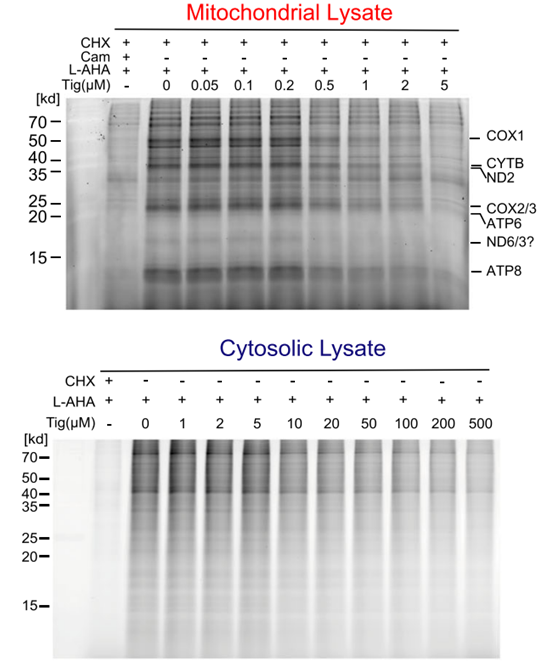
    De novo mitochondrial and cytoplasmic nascent protein synthesis were measured by L-AHA labeling, followed by visualization of Alexa Fluor 488 fluorescence signal conjugated to L-AHA by “click reaction”. The intensity of the corresponding lines in the SDS-PAGE was analyzed using the ImageJ software. To estimate the IC50 value of Tigecycline (Tig, 0.1-5 μM) on the 55S mitoribosome in the mitochondrial lysate (Mito) and 80S human ribosome in the cytosolic lysate (Cyto), the intensities of positive controls derived from chloramphenicol (Cam) and CHX-treated samples, respectively, were subtracted. Second, the resulting intensities were normalized to the intensities of the negative controls, which in both cases were from the samples not treated with Tigecycline. Note that Tigecycline cannot sufficiently inhibit cytoplasmic translation even at high concentrations.

    Tigecycline purchased from MedChemExpress. Usage Cited in: Microorganisms. 2024 Mar 13;12(3):575.

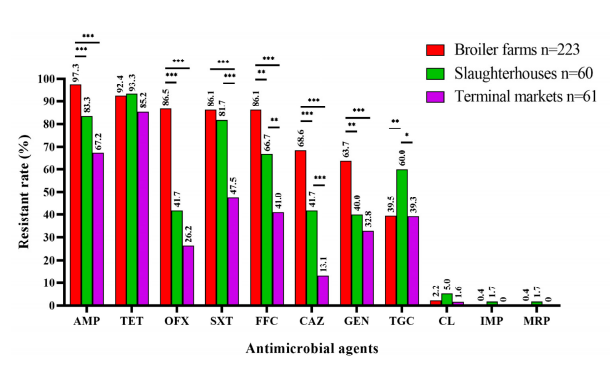
    Percentages of E. coli strains showing antimicrobial resistance to different antimicrobial agents. AMP, Ampicillin; CAZ, Ceftazidime; IPM, Imipenem; MRP, Meropenem; GEN, Gentamicin; OFX, Ofloxacin; SXT, Trimethoprim–sulfamethoxazole; TET, Tetracycline; TGC, Tigecycline; CL, Colistin; FFC, Florfenicol.

    Tigecycline purchased from MedChemExpress. Usage Cited in: EBioMedicine. 2022 Apr;78:103943.  [Abstract]

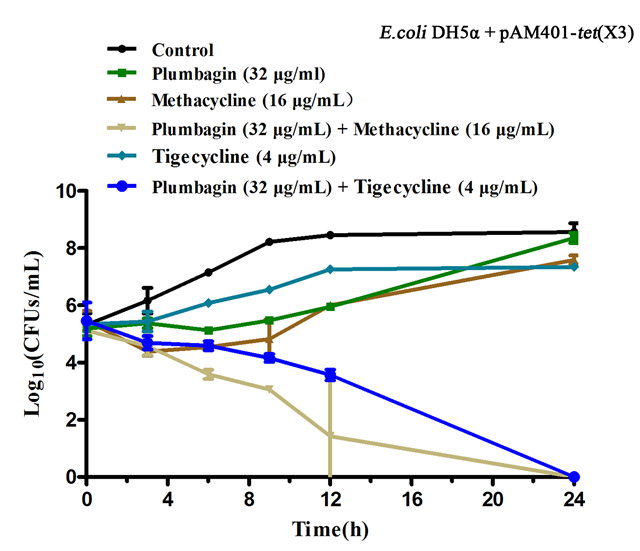
    Tigecycline (4 μg/mL). Time-killing curves of tet(X3)-positive strains (E. coli DH5α+pAM401-tet(X3)), E. coli 47EC, and A. baumannii 34AB) with the indicated treatment. The bacterial CFUs per mL at different time points over 24 h were determined by plating.

    Tigecycline purchased from MedChemExpress. Usage Cited in: Microbiol Spectr. 2023 Feb 14;11(1):e0323822.  [Abstract]

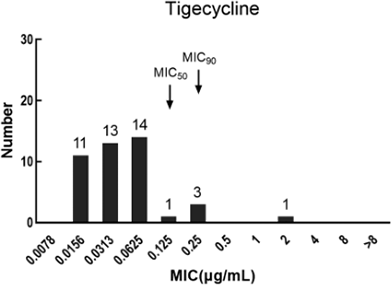
    The MIC distributions of Tigecycline against 43 M. fortuitum isolates (incubate for 24 h). The y axis shows the number of strains with each MIC value, with the specific numbers shown above the bars.

    Tigecycline purchased from MedChemExpress. Usage Cited in: Int J Antimicrob Agents. 2018 Aug;52(2):269-271.  [Abstract]

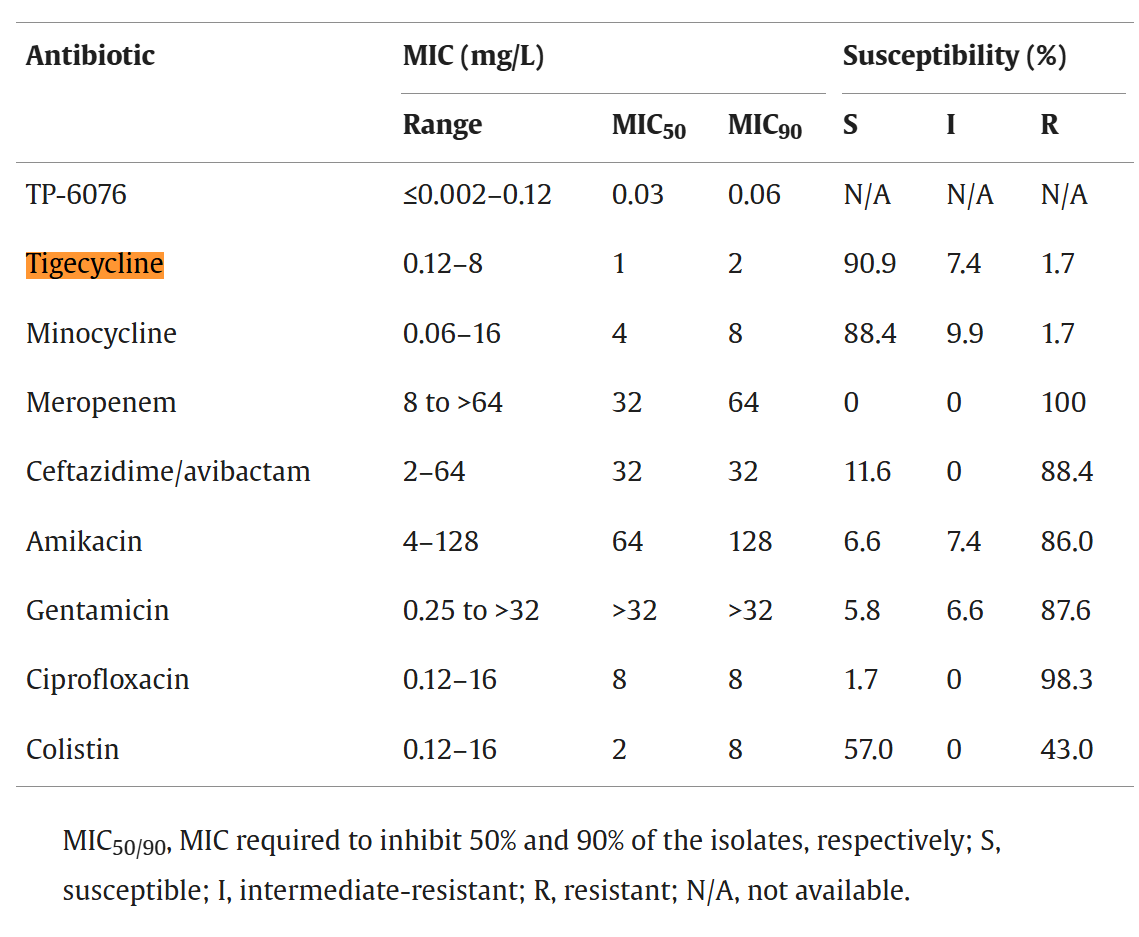
    Minimum inhibitory concentration (MIC) range as well as MIC50 and MIC90 values of the antibiotics tested against 121 Acinetobacter baumannii isolates from Greek hospitals.
    • Biological Activity

    • Purity & Documentation

    • References

    • Customer Review

    Description

    Tigecycline (GAR-936) is a broad-spectrum glycylcycline antibiotic. The mean inhibitory concentration (MIC) of Tigecycline for E. coli (MG1655 strain) is approximately 125 ng/mL[1]. MIC50 and MIC90 are 1 and 2 mg/L for Acinetobacter baumannii (A. baumannii), respectively[2].

    IC50 & Target

    Mean MIC: 125 ng/mL (E. coli)[1]
    MIC50: 1 mg/mL (A. baumannii)[2]
    MIC90: 2 mg/mL (A. baumannii)[2]

    In Vitro

    Tigecycline (0.63-30 μM, preincubated for 4 days, treated for 72 h) inhibits AML2 cells and HL-60 cells with IC50s of 4.72±0.54 and 3.06±0.85 μM (freshly prepared). Tigecycline inhibits AML2 cells and HL-60 cells with IC50s of 5.64±0.55 and 4.27±0.45 μM (1 day preincubation). Tigecycline inhibits AML2 cells and HL-60 cells with IC50s of 5.02±0.60 and 4.39±0.44 μM (2 day preincubation). Tigecycline inhibits AML2 cells and HL-60 cells with IC50s of 4.09±0.41 and 3.95±0.39 μM (3 day preincubation). After a 4 day preincubation of Tigecycline in saline, Tigecycline lost its ability to kill TEX human leukemia cells (from IC50~5 μM when freshly prepared to IC50>50 μM after 4 days preincubation) as measured by CellTiter Flour assay[1].

    MedChemExpress (MCE) has not independently confirmed the accuracy of these methods. They are for reference only.

    Cell Viability Assay[1]

    Cell Line: Human leukemic OCI-AML2, HL-60 (ATCC) and TEX cell lines
    Concentration: 0.63-30 µM
    Incubation Time: Preincubated for 4 days, treated for 72 hours
    Result: Inhibited AML2 cells and HL-60 cells with IC50s of 4.72±0.54 and 3.06±0.85 μM (freshly prepared).
    In Vivo

    Tigecycline (50 mg/kg; intraperitoneal injection; twice a day; for 11 days) reduces tumor volume and weight in NOD/SCID mice[1].
    The peak plasma concentration (Cmax), the terminal half-life (t1/2), area under the plasma concentration-time curve (AUC), clearance (CL) and volume of distribution (Vz) are 22.8μg/mL, 108.9 min, 1912.2min*μg/mL, 26.1 mL/min/kg, 4109.4 mL/kg for Tigecycline in saline, respectively. The peak plasma concentration (Cmax), the terminal half-life (t1/2), area under the plasma concentration-time curve (AUC), clearance (CL) and volume of distribution (Vz) are15.7μg/mL, 110.3 min, 2036.5 min*μg/mL, 24.6 mL/min/kg, 3906.2 mL/kg for Tigecycline in formulation (60 mg/mL pyruvate, 3 mg/mL ascorbic acid, pH 7 in saline) , respectively[1].

    MedChemExpress (MCE) has not independently confirmed the accuracy of these methods. They are for reference only.

    Animal Model: NOD/SCID mice with OCI-AML2 acute myeloid leukemia (AML) xenograft model[1]
    Dosage: 50 mg/kg
    Administration: Intraperitoneal injection; twice a day; for 11 days
    Result: Reduced tumor volume and weight.
    Animal Model: NOD/SCID mice[1]
    Dosage: 50 mg/kg
    Administration: Intraperitoneal injection; 360 minutes
    Result: The peak plasma concentration (Cmax), the terminal half-life (t1/2), area under the plasma concentration-time curve (AUC), clearance (CL) and volume of distribution (Vz) are 22.8 μg/mL, 108.9 min, 1912.2 min*μg/mL, 26.1 mL/min/kg, 4109.4 mL/kg, respectively.
    Clinical Trial
    Molecular Weight

    585.65

    Formula

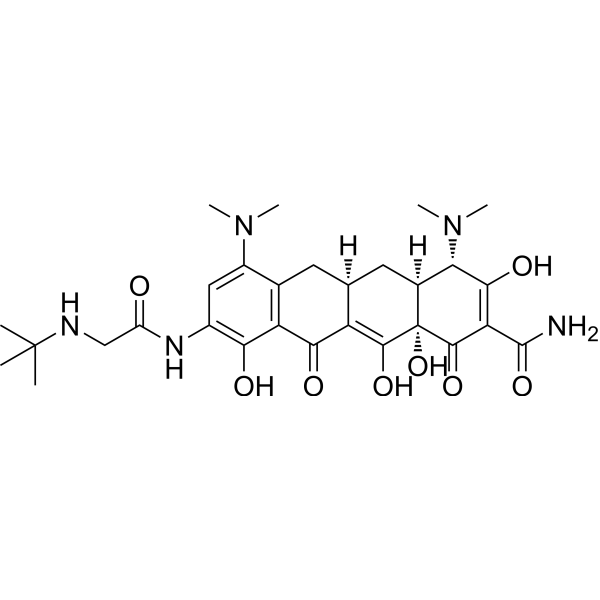
    C29H39N5O8

    CAS No.
    Appearance

    Solid

    Color

    Light yellow to orange

    SMILES

    O=C(C(C1=O)=C(O)[C@@H](N(C)C)[C@]2([H])C[C@]3([H])CC4=C(C(C3=C(O)[C@@]21O)=O)C(O)=C(NC(CNC(C)(C)C)=O)C=C4N(C)C)N

    Initial Source
    Shipping

    Room temperature in continental US; may vary elsewhere.

    Storage
    Powder -20°C 3 years
    In solvent -80°C 6 months
    -20°C 1 month
    Solvent & Solubility
    In Vitro: 

    DMSO : 25 mg/mL (42.69 mM; ultrasonic and warming and heat to 60°C; Hygroscopic DMSO has a significant impact on the solubility of product, please use newly opened DMSO)

    Preparing
    Stock Solutions
    Concentration Solvent Mass 1 mg 5 mg 10 mg
    1 mM 1.7075 mL 8.5375 mL 17.0750 mL
    5 mM 0.3415 mL 1.7075 mL 3.4150 mL
    View the Complete Stock Solution Preparation Table

    * Please refer to the solubility information to select the appropriate solvent. Once prepared, please aliquot and store the solution to prevent product inactivation from repeated freeze-thaw cycles.
    Storage method and period of stock solution: -80°C, 6 months; -20°C, 1 month. When stored at -80°C, please use it within 6 months. When stored at -20°C, please use it within 1 month.

    • Molarity Calculator

    • Dilution Calculator

    Mass (g) = Concentration (mol/L) × Volume (L) × Molecular Weight (g/mol)

    Mass
    =
    Concentration
    ×
    Volume
    ×
    Molecular Weight *

    Concentration (start) × Volume (start) = Concentration (final) × Volume (final)

    This equation is commonly abbreviated as: C1V1 = C2V2

    Concentration (start)

    C1

    ×
    Volume (start)

    V1

    =
    Concentration (final)

    C2

    ×
    Volume (final)

    V2

    In Vivo:

    Select the appropriate dissolution method based on your experimental animal and administration route.

    For the following dissolution methods, please ensure to first prepare a clear stock solution using an In Vitro approach and then sequentially add co-solvents:
    To ensure reliable experimental results, the clarified stock solution can be appropriately stored based on storage conditions. As for the working solution for in vivo experiments, it is recommended to prepare freshly and use it on the same day.
    The percentages shown for the solvents indicate their volumetric ratio in the final prepared solution. If precipitation or phase separation occurs during preparation, heat and/or sonication can be used to aid dissolution.

    • Protocol 1

      Add each solvent one by one:  10% DMSO    40% PEG300    5% Tween-80    45% Saline

      Solubility: ≥ 2.5 mg/mL (4.27 mM); Clear solution

      This protocol yields a clear solution of ≥ 2.5 mg/mL (saturation unknown).

      Taking 1 mL working solution as an example, add 100 μL DMSO stock solution (25.0 mg/mL) to 400 μL PEG300, and mix evenly; then add 50 μL Tween-80 and mix evenly; then add 450 μL Saline to adjust the volume to 1 mL.

      Preparation of Saline: Dissolve 0.9 g sodium chloride in ddH₂O and dilute to 100 mL to obtain a clear Saline solution.
    • Protocol 2

      Add each solvent one by one:  10% DMSO    90% (20% SBE-β-CD in Saline)

      Solubility: ≥ 2.08 mg/mL (3.55 mM); Clear solution

      This protocol yields a clear solution of ≥ 2.08 mg/mL (saturation unknown).

      Taking 1 mL working solution as an example, add 100 μL DMSO stock solution (20.8 mg/mL) to 900 μL 20% SBE-β-CD in Saline, and mix evenly.

      Preparation of 20% SBE-β-CD in Saline (4°C, storage for one week): 2 g SBE-β-CD powder is dissolved in 10 mL Saline, completely dissolve until clear.

    For the following dissolution methods, please prepare the working solution directly. It is recommended to prepare fresh solutions and use them promptly within a short period of time.
    The percentages shown for the solvents indicate their volumetric ratio in the final prepared solution. If precipitation or phase separation occurs during preparation, heat and/or sonication can be used to aid dissolution.

    • Protocol 1

      Add each solvent one by one:  PBS

      Solubility: 3.33 mg/mL (5.69 mM); Clear solution; Need ultrasonic and warming and heat to 60°C

    In Vivo Dissolution Calculator
    Please enter the basic information of animal experiments:

    Dosage

    mg/kg

    Animal weight
    (per animal)

    g

    Dosing volume
    (per animal)

    μL

    Number of animals

    Recommended: Prepare an additional quantity of animals to account for potential losses during experiments.
    Please enter your animal formula composition:
    %
    DMSO +
    +
    %
    Tween-80 +
    %
    Saline
    Recommended: Keep the proportion of DMSO in working solution below 2% if your animal is weak.
    The co-solvents required include: DMSO, . All of co-solvents are available by MedChemExpress (MCE). , Tween 80. All of co-solvents are available by MedChemExpress (MCE).
    Calculation results:
    Working solution concentration: mg/mL
    Method for preparing stock solution: mg drug dissolved in μL  DMSO (Stock solution concentration: mg/mL).
    The concentration of the stock solution you require exceeds the measured solubility. The following solution is for reference only. If necessary, please contact MedChemExpress (MCE).
    Method for preparing in vivo working solution for animal experiments: Take μL DMSO stock solution, add μL . μL , mix evenly, next add μL Tween 80, mix evenly, then add μL Saline.
     If the continuous dosing period exceeds half a month, please choose this protocol carefully.
    Please ensure that the stock solution in the first step is dissolved to a clear state, and add co-solvents in sequence. You can use ultrasonic heating (ultrasonic cleaner, recommended frequency 20-40 kHz), vortexing, etc. to assist dissolution.
    Purity & Documentation

    Purity: 99.95%

    References

    Complete Stock Solution Preparation Table

    * Please refer to the solubility information to select the appropriate solvent. Once prepared, please aliquot and store the solution to prevent product inactivation from repeated freeze-thaw cycles.
    Storage method and period of stock solution: -80°C, 6 months; -20°C, 1 month. When stored at -80°C, please use it within 6 months. When stored at -20°C, please use it within 1 month.

    Optional Solvent Concentration Solvent Mass 1 mg 5 mg 10 mg 25 mg
    DMSO 1 mM 1.7075 mL 8.5375 mL 17.0750 mL 42.6876 mL
    5 mM 0.3415 mL 1.7075 mL 3.4150 mL 8.5375 mL
    10 mM 0.1708 mL 0.8538 mL 1.7075 mL 4.2688 mL
    15 mM 0.1138 mL 0.5692 mL 1.1383 mL 2.8458 mL
    20 mM 0.0854 mL 0.4269 mL 0.8538 mL 2.1344 mL
    25 mM 0.0683 mL 0.3415 mL 0.6830 mL 1.7075 mL
    30 mM 0.0569 mL 0.2846 mL 0.5692 mL 1.4229 mL
    40 mM 0.0427 mL 0.2134 mL 0.4269 mL 1.0672 mL
    • No file chosen (Maximum size is: 1024 Kb)
    • If you have published this work, please enter the PubMed ID.
    • Your name will appear on the site.
    Help & FAQs
    • Do most proteins show cross-species activity?

      Species cross-reactivity must be investigated individually for each product. Many human cytokines will produce a nice response in mouse cell lines, and many mouse proteins will show activity on human cells. Other proteins may have a lower specific activity when used in the opposite species.

    Your Recently Viewed Products:

    Inquiry Online

    Your information is safe with us. * Required Fields.

    Product Name


    Requested Quantity *

    Applicant Name *


    Salutation

    Email Address *


    Phone Number *

    Department


    Organization Name *

    City

    State

    Country or Region *


    Remarks

    Bulk Inquiry

    Inquiry Information

    Product Name:
    Tigecycline
    Cat. No.:
    HY-B0117
    Quantity:
    MCE Japan Authorized Agent: