



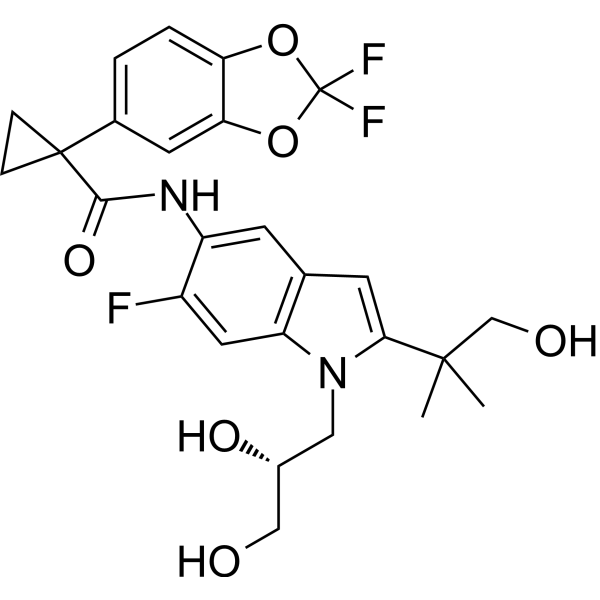
Tezacaftor
Based on 28 publication(s) in Google Scholar
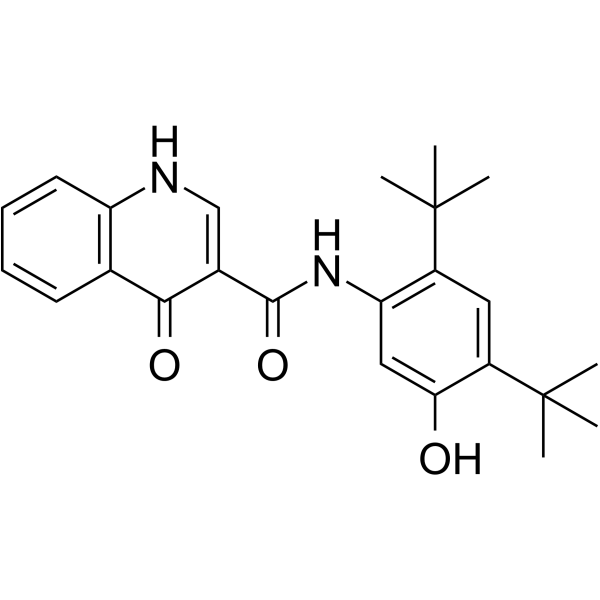
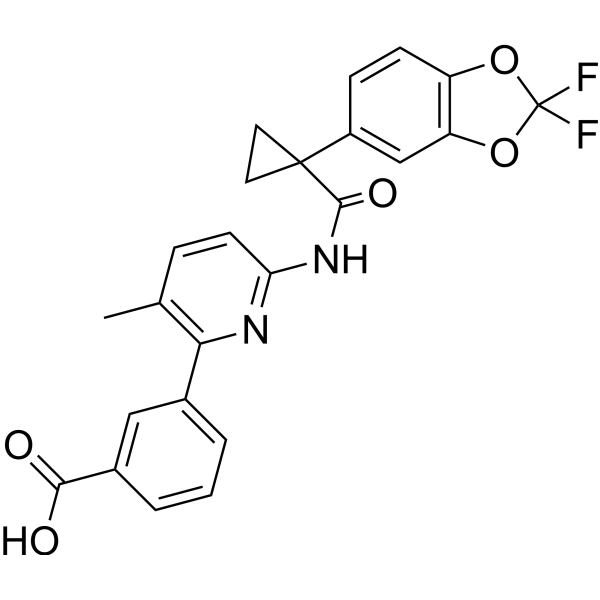
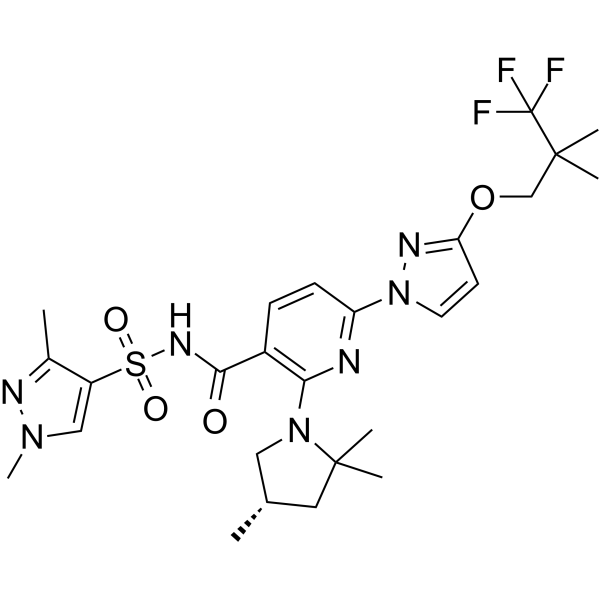
Tezacaftor (VX-661) is a F508del CFTR corrector. It helps CFTR protein reach the cell surface. However, Ivacaftor (VX-770, HY-13017), a CFTR potentiator, helps to prolong the opening time of cell surface CFTR protein channels. Tezacaftor combining with Ivacaftor, shows potent efficacy against cystic fibrosis and diseases with homozygous for the CFTR Phe508del mutation. Moreover, Elexacaftor (VX-445, HY-111772) is also a CFTR corrector. Elexacaftor-Tezacaftor-Ivacaftor aims at with cystic fibrosis (CF) with at least one Phe508del mutation, often avoids the indication for lung transplantation.
For research use only. We do not sell to patients.
- Purity : 99.85%
- CAS No.: 1152311-62-0
- Formula: C26H27F3N2O6
- Molecular Weight:520.50
-
Storage:
4°C, stored under nitrogen
* In solvent : -80°C, 1 year; -20°C, 6 months (stored under nitrogen)

To place orders, for customer services and technical support, please contact: MedChemExpress USA
Tel: 609-228-6898 E-mail: [email protected] [email protected]


-
 Biological Activity
-
Chemical Information
-
Solvent & Solubility
- Purity & Documentation
- References
-
 Help & FAQs


Publications Citing Use of MedChemExpress (MCE) Tezacaftor
More- Cell. 2022 Jan 6;185(1):158-168.e11. [Abstract]
- Am J Respir Crit Care Med. 2021 Nov 15;204(10):1231-1235. [Abstract]
- Nat Commun. 2026 Mar 15;17(1):4002. [Abstract]
- J Clin Invest. 2024 Jul 2;134(16):e176328. [Abstract]
- Mol Ther. 2026 Jul 1;34(7):4212-4225. [Abstract]
- J Med Chem. 2025 Feb 27;68(4):4596-4618. [Abstract]
- JCI Insight. 2026 Mar 23;11(6):e198846. [Abstract]
- Int J Mol Sci. 2026 Feb 23;27(4):2063. [Abstract]
- Int J Mol Sci. 2025 May 31;26(11):5306. [Abstract]
- Int J Mol Sci. 2020 Dec 31;22(1):344. [Abstract]
- J Cyst Fibros. 2026 Jun 16:S1569-1993(26)01643-7. [Abstract]
- J Cyst Fibros. 2025 Jan;24(1):164-174. [Abstract]
- Am J Respir Cell Mol Biol. 2025 Mar;72(3):308-319. [Abstract]
- Am J Physiol Cell Physiol. 2022 Oct 1;323(4):C1215-C1230. [Abstract]
- PNAS Nexus. 2025 Jul 4;4(7):pgaf211. [Abstract]
- J Physiol. 2025 May;603(9):2619-2632. [Abstract]
- Hum Gene Ther. 2024 Sep;35(17-18):695-709. [Abstract]
- iScience. 2024 Aug 9;27(9):110703. [Abstract]
- Microbiol Spectr. 2025 Sep 2;13(9):e0227524. [Abstract]
- J Biol Chem. 2024 Nov;300(11):107873. [Abstract]
- BMC Cancer. 2024 Mar 25;24(1):371. [Abstract]
- J Cell Sci. 2022 Mar 1;135(5):jcs259002. [Abstract]
- Glycoconj J. 2025 Feb;42(1):1-14. [Abstract]
- Mol Biol Cell. 2022 Nov 1;33(13):ar120. [Abstract]
- bioRxiv. 2026 Jun 8:2026.06.01.729306. [Abstract]
- bioRxiv. 2025 Sep 11:2025.04.03.647093. [Abstract]
- bioRxiv. 2024 August 16.
- University of Kentucky. 2022 Aug.
 Customer Validation & Images

-
WB
-
Bio/Physico-chemical Assay
-
Bio/Physico-chemical Assay
-
Bio/Physico-chemical Assay
-
Bio/Physico-chemical Assay


Biological Activity
Description
In Vitro
Tezacaftor (2 μM, 24 h) increases the expression level of N1303K-CFTR in HEK293 and CFBE cells[4].
MedChemExpress (MCE) has not independently confirmed the accuracy of these methods. They are for reference only.
-
Cell Line:HEK293, CFBE
-
Concentration:2 μM
-
Incubation Time:24 h
-
Result:Increased N1303K-CFTR expression levels.
Clinical Trial
| NCT Number | Sponsor | Condition | Start Date |
Phase

|
|---|---|---|---|---|
| NCT01329991 | Plexxikon| | 2011-05 | PHASE1 |


Chemical Information
-
CAS No. 1152311-62-0
-
Appearance Solid
-
Molecular Weight 520.50
-
Formula C26H27F3N2O6
-
Color White to yellow
-
SMILES
O=C(C1(C2=CC=C(OC(F)(F)O3)C3=C2)CC1)NC4=CC5=C(N(C[C@@H](O)CO)C(C(C)(C)CO)=C5)C=C4F
-
Synonyms
VX-661
-
Shipping
Room temperature in continental US; may vary elsewhere.
-
Storage
4°C, stored under nitrogen
* In solvent : -80°C, 1 year; -20°C, 6 months (stored under nitrogen)


Publications (28)
-
Journal Impact Factor
-
Most Recent
-
Cell
2022 Jan 6;185(1):158-168.e11. PMID: 34995514
Tezacaftor purchased from MedChemExpress. Usage Cited in: Cell. 2022 Jan 6;185(1):158-168.e11. [Abstract]
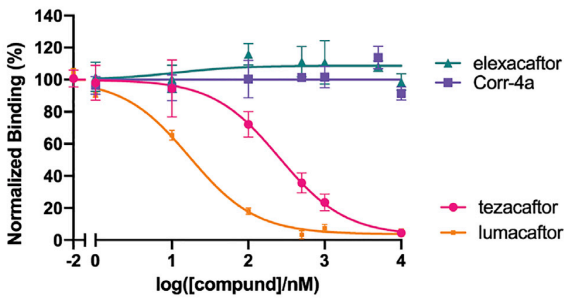
Competition binding assay. The binding of [H3]lumacaftor (10 nM) was plotted as a function of the competitor’s concentration. Data were fit to a single-site competitive binding model. The Ki values for lumacaftor and Tezacaftor are 7.7 ± 2.0 nM and 0.12 ± 0.04 mM, respectively. No competition was observed for elexacaftor and Corr-4a.
-
Am J Respir Crit Care Med
Elexacaftor/Tezacaftor/Ivacaftor Improved Clinical Outcomes in a Patient with N1303K-CFTR Based on In Vitro Experimental Evidence. [Abstract]2021 Nov 15;204(10):1231-1235. PMID: 34379998 -
Nat Commun
INSIG1/2 succination mediated by the moonlighting function of ADSL promotes lipogenesis and liver tumorigenesis. [Abstract]2026 Mar 15;17(1):4002. PMID: 41833955 -
J Clin Invest
Potentiation of BKCa channels by cystic fibrosis transmembrane conductance regulator (CFTR) correctors VX-445 and VX-121. [Abstract]2024 Jul 2;134(16):e176328. PMID: 38954478 -
Mol Ther
2026 Jul 1;34(7):4212-4225. PMID: 41925277 -
J Med Chem
Target Identification with Live-Cell Photoaffinity Labeling and Mechanism of Action Elucidation of ARN23765, a Highly Potent CFTR Corrector. [Abstract]2025 Feb 27;68(4):4596-4618. PMID: 39928576
Tezacaftor purchased from MedChemExpress. Usage Cited in: J Med Chem. 2025 Feb 27;68(4):4596-4618. [Abstract]
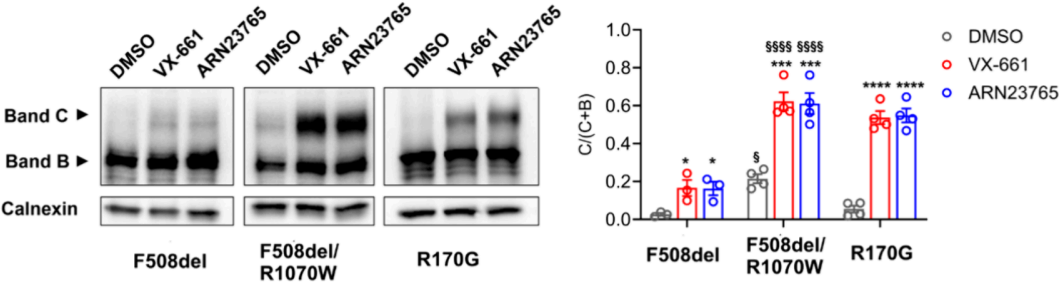
ARN23765 stabilizes NBD1-ICL4 and NBD1-ICL1 interactions. HEK293 cells were transfected with the constructs coding for F508del-CFTR, F508del/R1070W-CFTR, and R170G-CFTR and incubated for 24 h with ARN23765 (10 nM) or Tezacaftor (VX-661, 3 μM). DMSO (0.2%) was used as negative control. Left: representative WBs with detection of CFTR B- and C-bands. Right: quantification (mean ± SD, 3–4 independent experiments) of CFTR band-C abundance, calculated using the conventional equation [band-C/band C+B].
Tezacaftor purchased from MedChemExpress. Usage Cited in: J Med Chem. 2025 Feb 27;68(4):4596-4618. [Abstract]
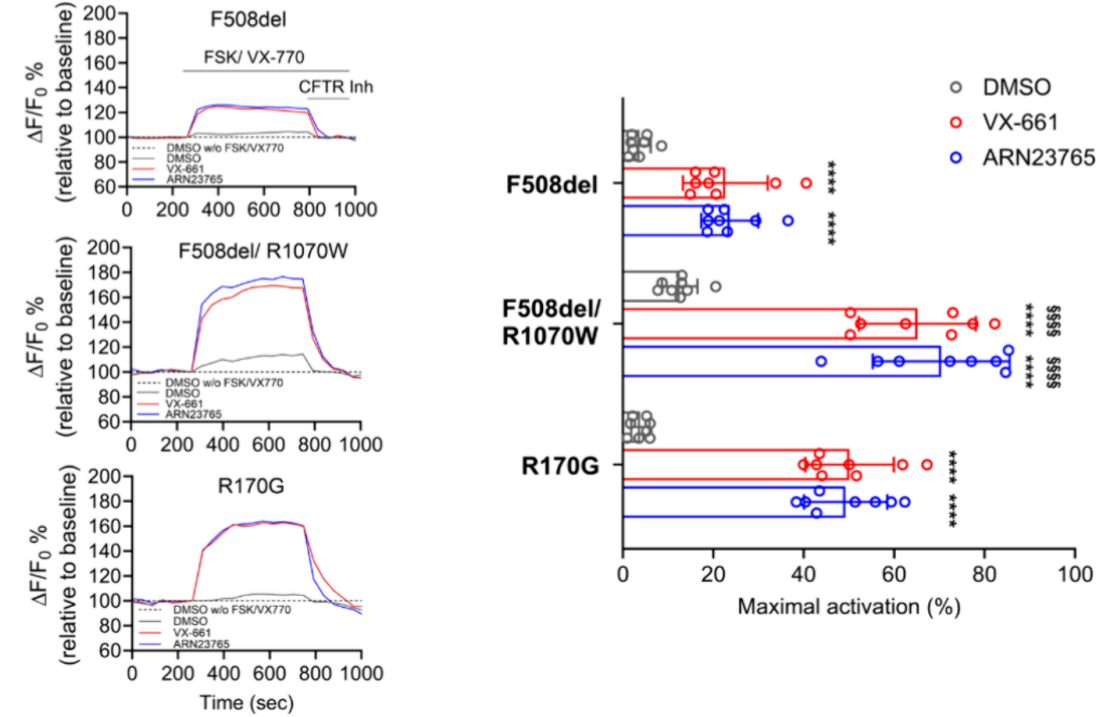
ARN23765 stabilizes NBD1-ICL4 and NBD1-ICL1 interactions. HEK293 cells were transfected with the constructs coding for F508del-CFTR, F508del/R1070W-CFTR, and R170G-CFTR and incubated for 24 h with ARN23765 (10 nM) or Tezacaftor (VX-661, 3 μM). DMSO (0.2%) was used as negative control. CFTR channel activity was evaluated with fluorometric imaging plate reader functional assay (FLIPR).40 Plasma membrane depolarization was detected as an increase in fluorescence (ΔF), after which CFTR was inhibited by the addition of inhibitor-172, (10 μM). Left: representative fluorescence traces. Right: peak change in fluorescence (mean ± SD, 8 replicates), expressed relative to baseline fluorescence (ΔF/F0). FSK: forskolin; CFTR Inh: inhibitor-172.
-
JCI Insight
Targeting PI3Kγ anchoring enhances CFTR membrane localization and modulator efficacy via PKD1. [Abstract]2026 Mar 23;11(6):e198846. PMID: 41869727 -
Int J Mol Sci
Restoration of Defective CFTR in Human Nasal Respiratory Epithelial Cells by CFTR Modulators and mRNA Transfection. [Abstract]2026 Feb 23;27(4):2063. PMID: 41752197 -
Int J Mol Sci
2025 May 31;26(11):5306. PMID: 40508114 -
Int J Mol Sci
Synergy between Readthrough and Nonsense Mediated Decay Inhibition in a Murine Model of Cystic Fibrosis Nonsense Mutations. [Abstract]2020 Dec 31;22(1):344. PMID: 33396210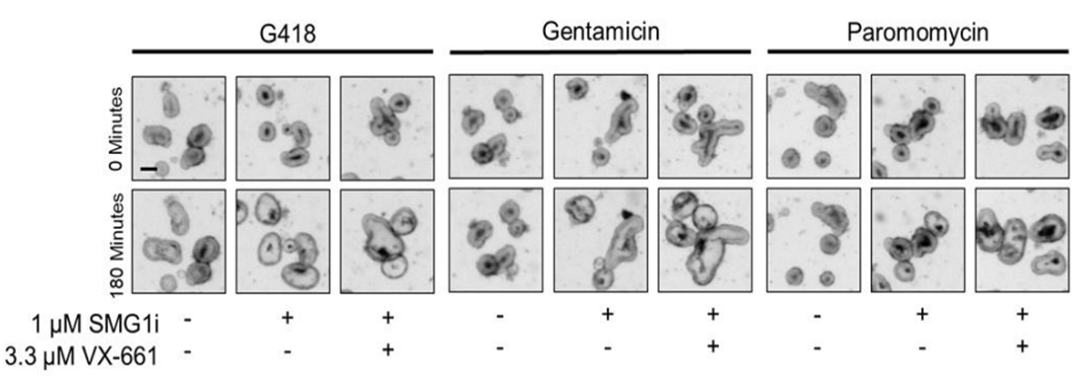
Tezacaftor purchased from MedChemExpress. Usage Cited in: Int J Mol Sci. 2020 Dec 31;22(1):344. [Abstract]
Representative brightfield images of G542X intestinal organoids treated with 100 µM G418, 2.5 mM gentamicin, or 2.5 mM paromomycin and indicated combinations of 1 µM SMG1i and/or 3.3 µM Tezacaftor (VX-661) at 0 min and 180 min following treatment with 10 µM forskolin. Scale bar is 100 µm.
-
J Cyst Fibros
A functional comparison of vanzacaftor/tezacaftor/deutivacaftor and elexacaftor/tezacaftor/ivacaftor in patient-derived intestinal organoids with rare CFTR variants. [Abstract]2026 Jun 16:S1569-1993(26)01643-7. PMID: 42303492 -
J Cyst Fibros
A W1282X cystic fibrosis mouse allows the study of pharmacological and gene-editing therapeutics to restore CFTR function. [Abstract]2025 Jan;24(1):164-174. PMID: 39532588 -
Am J Respir Cell Mol Biol
Distinct Responses of Cystic Fibrosis Epithelial Cells to SARS-CoV-2 and Influenza A Virus. [Abstract]2025 Mar;72(3):308-319. PMID: 39311876 -
Am J Physiol Cell Physiol
KCa3.1 potentiation stimulates Cl- secretion in F508del and G551D CFTR-corrected primary human bronchial epithelial cells. [Abstract]2022 Oct 1;323(4):C1215-C1230. PMID: 36062876 -
PNAS Nexus
VX-445 (elexacaftor) inhibits chloride secretion across human bronchial epithelial cells by directly blocking KCa3.1 channels. [Abstract]2025 Jul 4;4(7):pgaf211. PMID: 40688096 -
J Physiol
2025 May;603(9):2619-2632. PMID: 40047394 -
Hum Gene Ther
SP-101, A Novel Adeno-Associated Virus Gene Therapy for the Treatment of Cystic Fibrosis, Mediates Functional Correction of Primary Human Airway Epithelia From Donors with Cystic Fibrosis. [Abstract]2024 Sep;35(17-18):695-709. PMID: 39155805 -
iScience
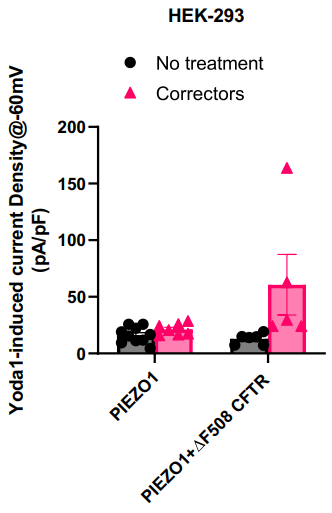
Defective CFTR modulates mechanosensitive channels TRPV4 and PIEZO1 and drives endothelial barrier failure. [Abstract]2024 Aug 9;27(9):110703. PMID: 39252977
Tezacaftor purchased from MedChemExpress. Usage Cited in: iScience. 2024 Aug 9;27(9):110703. [Abstract]
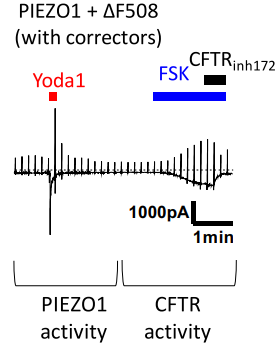
Representative traces of whole-cell currents of HEK-293 cells cotransfected with PIEZO1 and CFTR mutant F508del, pre-treated with combination of CFTR correctors VX445/VX661 (Tezacafto) (2 μM each) for 24 h.107 Bath solution contained 10 μM Yoda1, 20 μM Forskolin, and 20 μM CFTRinh-172.
Tezacaftor purchased from MedChemExpress. Usage Cited in: iScience. 2024 Aug 9;27(9):110703. [Abstract]
Summary of Yoda1-induced current in HEK-293 cells transfected with PIEZO1 only or cotransfected with PIEZO1 and CFTR mutant F508del. Cells were pre-treated with or without combination of CFTR correctors VX445/VX661 (Tezacafto) (2 μM each) for 24 h.
-
Microbiol Spectr
Condition-dependent effects of Elexacaftor/Tezacaftor/Ivacaftor (Trikafta) on Aspergillus fumigatus growth. [Abstract]2025 Sep 2;13(9):e0227524. PMID: 40736245 -
J Biol Chem
A nonnatural peptide targeting the A-kinase anchoring function of PI3Kγ for therapeutic cAMP modulation in pulmonary cells. [Abstract]2024 Nov;300(11):107873. PMID: 39393573 -
BMC Cancer
Single-cell transcriptional signature-based drug repurposing and in vitro evaluation in colorectal cancer. [Abstract]2024 Mar 25;24(1):371. PMID: 38528462 -
J Cell Sci
Lipid-driven CFTR clustering is impaired in cystic fibrosis and restored by corrector drugs. [Abstract]2022 Mar 1;135(5):jcs259002. PMID: 35060604 -
Glycoconj J
Effect of CFTR modulators Elexacaftor/Tezacaftor/Ivacaftor on lipid metabolism in human bronchial epithelial cells. [Abstract]2025 Feb;42(1):1-14. PMID: 39797966 -
Mol Biol Cell
2022 Nov 1;33(13):ar120. PMID: 36074076 -
bioRxiv
2026 Jun 8:2026.06.01.729306. PMID: 42282787 -
bioRxiv
General Trends in the Calnexin-Dependent Expression and Pharmacological Rescue of Clinical CFTR Variants. [Abstract]2025 Sep 11:2025.04.03.647093. PMID: 40964320 -
-


Solvent & Solubility
In Vitro:
DMSO : 50 mg/mL (96.06 mM; Need ultrasonic; Hygroscopic DMSO has a significant impact on the solubility of product, please use newly opened DMSO)
Please refer to the solubility information to select the appropriate solvent. Once prepared, please aliquot and store the solution to prevent product inactivation from repeated freeze-thaw cycles.
Storage method and period of stock solution: -80°C, 1 year; -20°C, 6 months (stored under nitrogen). When stored at -80°C, please use it within 1 year. When stored at -20°C, please use it within 6 months.
Please refer to the solubility information to select the appropriate solvent. Once prepared, please aliquot and store the solution to prevent product inactivation from repeated freeze-thaw cycles.
Storage method and period of stock solution: -80°C, 1 year; -20°C, 6 months (stored under nitrogen). When stored at -80°C, please use it within 1 year. When stored at -20°C, please use it within 6 months.
Concentration (start) × Volume (start) = Concentration (final) × Volume (final)
In Vivo:
Select the appropriate dissolution method based on your experimental animal and administration route.
- For the following dissolution methods, please ensure to first prepare a clear stock solution using an In Vitro approach and then sequentially add co-solvents:
- To ensure reliable experimental results, the clarified stock solution can be appropriately stored based on storage conditions. As for the working solution for In Vivo experiments, it is recommended to prepare freshly and use it on the same day.
- The percentages shown for the solvents indicate their volumetric ratio in the final prepared solution. If precipitation or phase separation occurs during preparation, heat and/or sonication can be used to aid dissolution.
Add each solvent one by one: 10% DMSO 40% PEG300 5% Tween-80 45% Saline
Solubility: ≥ 2.5 mg/mL (4.80 mM); Clear solution
This protocol yields a clear solution of ≥ 2.5 mg/mL (saturation unknown).
Taking 1 mL working solution as an example, add 100 μL DMSO stock solution (25.0 mg/mL) to 400 μL PEG300, and mix evenly; then add 50 μL Tween-80 and mix evenly; then add 450 μL Saline to adjust the volume to 1 mL.
Preparation of Saline: Dissolve 0.9 g sodium chloride in ddH₂O and dilute to 100 mL to obtain a clear Saline solution.
Add each solvent one by one: 10% DMSO 90% (20% SBE-β-CD in Saline)
Solubility: ≥ 2.5 mg/mL (4.80 mM); Clear solution
This protocol yields a clear solution of ≥ 2.5 mg/mL (saturation unknown).
Taking 1 mL working solution as an example, add 100 μL DMSO stock solution (25.0 mg/mL) to 900 μL 20% SBE-β-CD in Saline, and mix evenly.
Preparation of 20% SBE-β-CD in Saline (4°C, storage for one week): 2 g SBE-β-CD powder is dissolved in 10 mL Saline, completely dissolve until clear.
In Vivo Dissolution Calculator
Please enter the basic information of animal experiments:
-
-
-
-
Recommended: Prepare an additional quantity of animals to account for potential losses during experiments.
Please enter your animal formula composition:
-
%DMSO +
Recommended: Keep the proportion of DMSO in working solution below 2% if your animal is weak.
-
%+
-
+%Tween-80 + +
-
%Saline +
The co-solvents required include: DMSO, . All of co-solvents are available by MedChemExpress (MCE). , Tween 80. All of co-solvents are available by MedChemExpress (MCE).
Working solution concentration: 0.22 mg/mL
Method for preparing stock solution: mg drug dissolved in μL DMSO. Stock solution concentration: mg/mL. * In solvent : -80°C, 1 year; -20°C, 6 months (stored under nitrogen)
1. Take μL DMSO stock solution;
2. Add μL .
μL , mix evenly;
3. Then add μL Tween 80, mix evenly;
4. Then add μL
Please ensure that the stock solution in the first step is dissolved to a clear state, and add co-solvents in sequence. You can use ultrasonic heating (ultrasonic cleaner, recommended frequency 20-40 kHz), vortexing, etc. to assist dissolution.


Purity & Documentation
-
Data Sheet (282 KB)
-
SDS (396 KB)
- English - EN (396 KB)
- Français - FR (396 KB)
- Deutsch - DE (396 KB)
- Norwegian - NO (396 KB)
- Español - ES (396 KB)
- Swedish - SV (396 KB)
- Italian - IT (396 KB)
- Korean - KR (396 KB)
- Portuguese - PT (396 KB)
-
Handling Instructions (2659 KB)
References
[2]. Taylor-Cousar JL, et al. Tezacaftor-Ivacaftor in Patients with Cystic Fibrosis Homozygous for Phe508del. N Engl J Med. 2017 Nov 23;377(21):2013-2023. [Content Brief]
[3]. Burgel PR, et al. Rapid Improvement after Starting Elexacaftor-Tezacaftor-Ivacaftor in Patients with Cystic Fibrosis and Advanced Pulmonary Disease. Am J Respir Crit Care Med. 2021 Jul 1;204(1):64-73. [Content Brief]
[4]. Huang Y, et al. Elexacaftor/Tezacaftor/Ivacaftor Improved Clinical Outcomes in a Patient with N1303K-CFTR Based on In Vitro Experimental Evidence. Am J Respir Crit Care Med. 2021 Nov 15;204(10):1231-1235. [Content Brief]


Complete Stock Solution Preparation Table
Please refer to the solubility information to select the appropriate solvent. Once prepared, please aliquot and store the solution to prevent product inactivation from repeated freeze-thaw cycles.
Storage method and period of stock solution: -80°C, 1 year; -20°C, 6 months (stored under nitrogen). When stored at -80°C, please use it within 1 year. When stored at -20°C, please use it within 6 months.
| Optional Solvent | Concentration Solvent Mass | 1 mg | 5 mg | 10 mg | 25 mg |
|---|---|---|---|---|---|
| DMSO | 1 mM | 1.9212 mL | 9.6061 mL | 19.2123 mL | 48.0307 mL |
| 5 mM | 0.3842 mL | 1.9212 mL | 3.8425 mL | 9.6061 mL | |
| 10 mM | 0.1921 mL | 0.9606 mL | 1.9212 mL | 4.8031 mL | |
| 15 mM | 0.1281 mL | 0.6404 mL | 1.2808 mL | 3.2020 mL | |
| 20 mM | 0.0961 mL | 0.4803 mL | 0.9606 mL | 2.4015 mL | |
| 25 mM | 0.0768 mL | 0.3842 mL | 0.7685 mL | 1.9212 mL | |
| 30 mM | 0.0640 mL | 0.3202 mL | 0.6404 mL | 1.6010 mL | |
| 40 mM | 0.0480 mL | 0.2402 mL | 0.4803 mL | 1.2008 mL | |
| 50 mM | 0.0384 mL | 0.1921 mL | 0.3842 mL | 0.9606 mL | |
| 60 mM | 0.0320 mL | 0.1601 mL | 0.3202 mL | 0.8005 mL | |
| 80 mM | 0.0240 mL | 0.1201 mL | 0.2402 mL | 0.6004 mL |


Tezacaftor Related Classifications
HY-15448 Related Classifications
 Powered by Bioz