1. GPCR/G Protein Neuronal Signaling
  2. 5-HT Receptor
  3. Puerarin

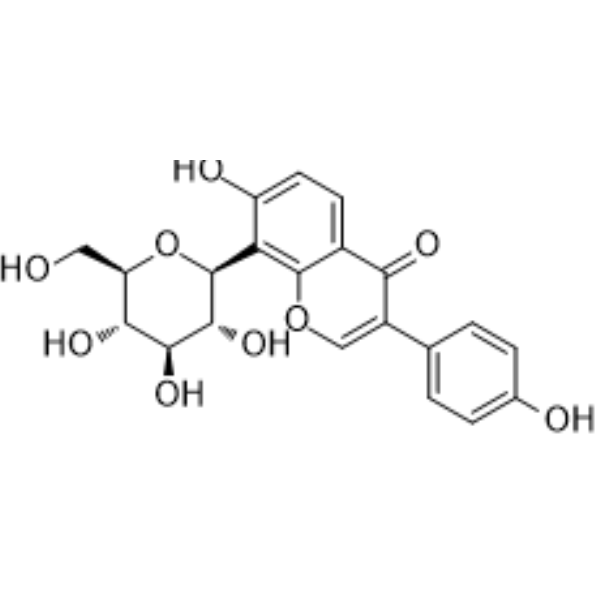
Puerarin is an isoflavone extracted from Pueraria root and is a 5-HT2C receptor antagonist. Puerarin inhibits the dorsal motor nucleus of the vagus (DMV)-vagus nerve pathway, which in turn leads to decreased fat absorption.

For research use only. We do not sell to patients.

CAS No. : 3681-99-0

Size Price Stock Quantity
Free Sample (0.1 - 0.2 mg)   Apply Now  
Solid + Solvent (Highly Recommended)
10 mM * 1 mL in DMSO
ready for reconstitution
In-stock
Solution
10 mM * 1 mL in DMSO In-stock
Solid
5 mg In-stock
10 mg In-stock
25 mg In-stock
50 mg In-stock
100 mg In-stock
200 mg   Get quote  
500 mg   Get quote  

* Please select Quantity before adding items.

This product is a controlled substance and not for sale in your territory.

Customer Review

Based on 29 publication(s) in Google Scholar

Other Forms of Puerarin:

Top Publications Citing Use of Products

29 Publications Citing Use of MCE Puerarin

IF
Flow Cytometry
Bio/Physico-chemical Assay
WB

    Puerarin purchased from MedChemExpress. Usage Cited in: Adv Sci (Weinh). 2025 Nov 18:e12793.  [Abstract]

    Immunofluorescence staining of CD4⁺FOXP3⁺ Treg infiltration in HCC model mice treated with PBS or Puerarin (PUE: 2.0 mg/kg, daily).

    Puerarin purchased from MedChemExpress. Usage Cited in: Adv Sci (Weinh). 2025 Nov 18:e12793.  [Abstract]

    Flow cytometry analysis of Ti‐Tregs and CD4⁺/CD8⁺ T cell ratios in HCC model mice treated with PBS or Puerarin (PUE: 2.0 mg/kg, daily).

    Puerarin purchased from MedChemExpress. Usage Cited in: Adv Sci (Weinh). 2025 Nov 18:e12793.  [Abstract]

    FOXP3 expression in naïve CD4⁺ T cells isolated from mice spleens and co‐cultured with Hepa53.4 cells following stimulation with anti‐CD3/CD28 magnetic beads and interleukin (IL‐2), in the presence of increasing concentrations of Puerarin (PUE: 0, 20, 40, 60 µM) for 3 days.

    Puerarin purchased from MedChemExpress. Usage Cited in: Adv Sci (Weinh). 2025 Nov 18:e12793.  [Abstract]

    Puerarin (0-60 μM; 3 days). The level of transforming growth factor (TGF)-β in mouse Ti-Treg cells in the culture supernatant was detected by enzyme-linked immunosorbent assay (ELISA).

    Puerarin purchased from MedChemExpress. Usage Cited in: Adv Sci (Weinh). 2025 Nov 18:e12793.  [Abstract]

    Western blot analysis of mitochondrial respiratory chain complex subunits (Complex I–V) in mice Ti‐Tregs treated with PBS or Puerarin (PUE: 2.0 mg/kg, daily).
    • Biological Activity

    • Protocol

    • Purity & Documentation

    • References

    • Customer Review

    Description

    Puerarin is an isoflavone extracted from Pueraria root and is a 5-HT2C receptor antagonist. Puerarin inhibits the dorsal motor nucleus of the vagus (DMV)-vagus nerve pathway, which in turn leads to decreased fat absorption[1][2][3][4][5].

    IC50 & Target

    5-HT2C Receptor


    In Vitro

    Puerarin inhibits the expression of LPS-induced iNOS, COX-2 and CRP proteins and also suppresses their mRNAs from RT-PCR experiments in RAW264.7 cells. The inhibition of iNOS, COX-2 and CRP expression is due to a dose-dependent inhibition of phosphorylation and degradation of I-κB, which resulted in the reduction of p65NF-κB nuclear translocation. The effect of puerarin-mediated inhibition of LPS-induced iNOS, COX-2 and CRP expression is attributed to suppressed NF-κB activation at the transcriptional level[1].
    Puerarin is a novel open-channel blocker of IK1, which may underlie the antiarrhythmic action of puerarin. Puerarin competes with barium, an open-channel blocker of IK1, to inhibit IK1 currents[2].

    MedChemExpress (MCE) has not independently confirmed the accuracy of these methods. They are for reference only.

    In Vivo

    Both genistein and puerarin effectively alleviate hepatic damage induced by chronic alcohol administration through potential antioxidant, anti-inflammatory, or anti apoptotic mechanisms. However, genistein is more effective than puerarin in decreasing levels of malondialdehyde (1.05±0.0947 vs. 1.28±0.213 nmol/mg pro, p< 0.05), tumor necrosis factor α (3.12±0.498 vs. 3.82±0.277 pg/mg pro, p < 0.05), interleukin-6 (1.46±0.223 vs. 1.88±0.309 pg/mg pro, p < 0.05), whereas puerarin is more effective than genistein in ameliorating serum activities or levels of alanine transaminase (35.8±3.95 vs. 42.6±6.56 U/L, p < 0.05) and low-density lipoprotein cholesterol (1.12±0.160 vs. 1.55±0.150 mmol/L, p < 0.05) [3].
    Early-stage renal damages can be significantly improved by puerarin, possibly via its suppression of ICAM-1 and TNF-α expression in diabetic rat kidneys[4].

    MedChemExpress (MCE) has not independently confirmed the accuracy of these methods. They are for reference only.

    Clinical Trial
    Molecular Weight

    416.38

    Formula

    C21H20O9

    CAS No.
    Appearance

    Solid

    Color

    White to off-white

    SMILES

    O=C1C(C2=CC=C(O)C=C2)=COC3=C([C@H]4[C@@H]([C@H]([C@@H]([C@@H](CO)O4)O)O)O)C(O)=CC=C13

    Structure Classification
    Initial Source
    Shipping

    Room temperature in continental US; may vary elsewhere.

    Storage
    Powder -20°C 3 years
    4°C 2 years
    In solvent -80°C 1 year
    -20°C 6 months
    Solvent & Solubility
    In Vitro: 

    DMSO : 50 mg/mL (120.08 mM; Need ultrasonic; Hygroscopic DMSO has a significant impact on the solubility of product, please use newly opened DMSO)

    Preparing
    Stock Solutions
    Concentration Solvent Mass 1 mg 5 mg 10 mg
    1 mM 2.4017 mL 12.0083 mL 24.0165 mL
    5 mM 0.4803 mL 2.4017 mL 4.8033 mL
    View the Complete Stock Solution Preparation Table

    * Please refer to the solubility information to select the appropriate solvent. Once prepared, please aliquot and store the solution to prevent product inactivation from repeated freeze-thaw cycles.
    Storage method and period of stock solution: -80°C, 1 year; -20°C, 6 months. When stored at -80°C, please use it within 1 year. When stored at -20°C, please use it within 6 months.

    • Molarity Calculator

    • Dilution Calculator

    Mass (g) = Concentration (mol/L) × Volume (L) × Molecular Weight (g/mol)

    Mass
    =
    Concentration
    ×
    Volume
    ×
    Molecular Weight *

    Concentration (start) × Volume (start) = Concentration (final) × Volume (final)

    This equation is commonly abbreviated as: C1V1 = C2V2

    Concentration (start)

    C1

    ×
    Volume (start)

    V1

    =
    Concentration (final)

    C2

    ×
    Volume (final)

    V2

    In Vivo:

    Select the appropriate dissolution method based on your experimental animal and administration route.

    For the following dissolution methods, please ensure to first prepare a clear stock solution using an In Vitro approach and then sequentially add co-solvents:
    To ensure reliable experimental results, the clarified stock solution can be appropriately stored based on storage conditions. As for the working solution for in vivo experiments, it is recommended to prepare freshly and use it on the same day.
    The percentages shown for the solvents indicate their volumetric ratio in the final prepared solution. If precipitation or phase separation occurs during preparation, heat and/or sonication can be used to aid dissolution.

    • Protocol 1

      Add each solvent one by one:  10% DMSO    40% PEG300    5% Tween-80    45% Saline

      Solubility: ≥ 3 mg/mL (7.20 mM); Clear solution

      This protocol yields a clear solution of ≥ 3 mg/mL (saturation unknown).

      Taking 1 mL working solution as an example, add 100 μL DMSO stock solution (30.0 mg/mL) to 400 μL PEG300, and mix evenly; then add 50 μL Tween-80 and mix evenly; then add 450 μL Saline to adjust the volume to 1 mL.

      Preparation of Saline: Dissolve 0.9 g sodium chloride in ddH₂O and dilute to 100 mL to obtain a clear Saline solution.
    • Protocol 2

      Add each solvent one by one:  10% DMSO    90% (20% SBE-β-CD in Saline)

      Solubility: ≥ 3 mg/mL (7.20 mM); Clear solution

      This protocol yields a clear solution of ≥ 3 mg/mL (saturation unknown).

      Taking 1 mL working solution as an example, add 100 μL DMSO stock solution (30.0 mg/mL) to 900 μL 20% SBE-β-CD in Saline, and mix evenly.

      Preparation of 20% SBE-β-CD in Saline (4°C, storage for one week): 2 g SBE-β-CD powder is dissolved in 10 mL Saline, completely dissolve until clear.

    For the following dissolution methods, please prepare the working solution directly. It is recommended to prepare fresh solutions and use them promptly within a short period of time.
    The percentages shown for the solvents indicate their volumetric ratio in the final prepared solution. If precipitation or phase separation occurs during preparation, heat and/or sonication can be used to aid dissolution.

    • Protocol 1

      Add each solvent one by one:  50% PEG300    50% Saline

      Solubility: 25 mg/mL (60.04 mM); Clear solution; Need ultrasonic

    • Protocol 2

      Add each solvent one by one:  20% SBE-β-CD in Saline

      Solubility: 20 mg/mL (48.03 mM); Clear solution; Need ultrasonic

    In Vivo Dissolution Calculator
    Please enter the basic information of animal experiments:

    Dosage

    mg/kg

    Animal weight
    (per animal)

    g

    Dosing volume
    (per animal)

    μL

    Number of animals

    Recommended: Prepare an additional quantity of animals to account for potential losses during experiments.
    Please enter your animal formula composition:
    %
    DMSO +
    +
    %
    Tween-80 +
    %
    Saline
    Recommended: Keep the proportion of DMSO in working solution below 2% if your animal is weak.
    The co-solvents required include: DMSO, . All of co-solvents are available by MedChemExpress (MCE). , Tween 80. All of co-solvents are available by MedChemExpress (MCE).
    Calculation results:
    Working solution concentration: mg/mL
    Method for preparing stock solution: mg drug dissolved in μL  DMSO (Stock solution concentration: mg/mL).
    The concentration of the stock solution you require exceeds the measured solubility. The following solution is for reference only. If necessary, please contact MedChemExpress (MCE).
    Method for preparing in vivo working solution for animal experiments: Take μL DMSO stock solution, add μL . μL , mix evenly, next add μL Tween 80, mix evenly, then add μL Saline.
     If the continuous dosing period exceeds half a month, please choose this protocol carefully.
    Please ensure that the stock solution in the first step is dissolved to a clear state, and add co-solvents in sequence. You can use ultrasonic heating (ultrasonic cleaner, recommended frequency 20-40 kHz), vortexing, etc. to assist dissolution.
    Purity & Documentation
    References
    Cell Assay
    [1]

    RAW264.7 cells are maintained at subconfluence in 95% air and 5% CO2 humidified atmosphere maintained at 37°C. The medium used for routine subculture is Dulbecco’s Modified Eagle’s Medium supplemented with 10% fetal bovine serum, penicillin (100 units/mL) and streptomycin (100 μg/ mL). An MTT assay is used to measure the viability of the cells after treatment with puerarin. After the supernatants are removed for nitrite determination, cells are incubated at 37°C with MTT (0.05 mg/mL) for 4 h, and the optical density is measured at 540 nm. The concentrations of puerarin are10, 20, 40 and 100 μM[1].

    MCE has not independently confirmed the accuracy of these methods. They are for reference only.

    Animal Administration
    [3][4]

    Rats: A cohort of healthy male SD rats (7 weeks old) are randomLy divided into a control group, a model group, and a puerarin treatment group with high (H), moderate (M), and low (L) dosage. Puerarin is re-suspended in 0.9% saline and is given by intra-gastric intubation at various concentrations (0.25 mg/(kg×d) for L group, 0.5 mg/(kg×d) for M group, and 1.0 mg/(kg×d) for H group) each day for 8 consecutive days. An equal volume of saline is administered to control and model rats during the same time period[4].

    Mice: Forty male ICR mice (weight: 20-22 g) are acclimatized with a daily 12 h light:12 h dark cycle at 22±2 °C room temperature and 55%±5% relative humidity. After 1 week of adaption, the mice are randomLy divided into four groups with ten mice per group. Genistein and puerarin are applied to the mice in sodium carboxymethyl cellulose solution with an equimolar concentration of 0.1 M (gastric volume: 3 mL kg-1 body weight)[3].

    MCE has not independently confirmed the accuracy of these methods. They are for reference only.

    References

    Complete Stock Solution Preparation Table

    * Please refer to the solubility information to select the appropriate solvent. Once prepared, please aliquot and store the solution to prevent product inactivation from repeated freeze-thaw cycles.
    Storage method and period of stock solution: -80°C, 1 year; -20°C, 6 months. When stored at -80°C, please use it within 1 year. When stored at -20°C, please use it within 6 months.

    Optional Solvent Concentration Solvent Mass 1 mg 5 mg 10 mg 25 mg
    DMSO 1 mM 2.4017 mL 12.0083 mL 24.0165 mL 60.0413 mL
    5 mM 0.4803 mL 2.4017 mL 4.8033 mL 12.0083 mL
    10 mM 0.2402 mL 1.2008 mL 2.4017 mL 6.0041 mL
    15 mM 0.1601 mL 0.8006 mL 1.6011 mL 4.0028 mL
    20 mM 0.1201 mL 0.6004 mL 1.2008 mL 3.0021 mL
    25 mM 0.0961 mL 0.4803 mL 0.9607 mL 2.4017 mL
    30 mM 0.0801 mL 0.4003 mL 0.8006 mL 2.0014 mL
    40 mM 0.0600 mL 0.3002 mL 0.6004 mL 1.5010 mL
    50 mM 0.0480 mL 0.2402 mL 0.4803 mL 1.2008 mL
    60 mM 0.0400 mL 0.2001 mL 0.4003 mL 1.0007 mL
    80 mM 0.0300 mL 0.1501 mL 0.3002 mL 0.7505 mL
    100 mM 0.0240 mL 0.1201 mL 0.2402 mL 0.6004 mL
    • No file chosen (Maximum size is: 1024 Kb)
    • If you have published this work, please enter the PubMed ID.
    • Your name will appear on the site.
    Help & FAQs
    • Do most proteins show cross-species activity?

      Species cross-reactivity must be investigated individually for each product. Many human cytokines will produce a nice response in mouse cell lines, and many mouse proteins will show activity on human cells. Other proteins may have a lower specific activity when used in the opposite species.

    Your Recently Viewed Products:

    Inquiry Online

    Your information is safe with us. * Required Fields.

    Product Name


    Requested Quantity *

    Applicant Name *


    Salutation

    Email Address *


    Phone Number *

    Department


    Organization Name *

    City

    State

    Country or Region *


    Remarks

    Bulk Inquiry

    Inquiry Information

    Product Name:
    Puerarin
    Cat. No.:
    HY-N0145
    Quantity:
    MCE Japan Authorized Agent: