1. GPCR/G Protein Neuronal Signaling
  2. 5-HT Receptor Dopamine Receptor
  3. Aripiprazole

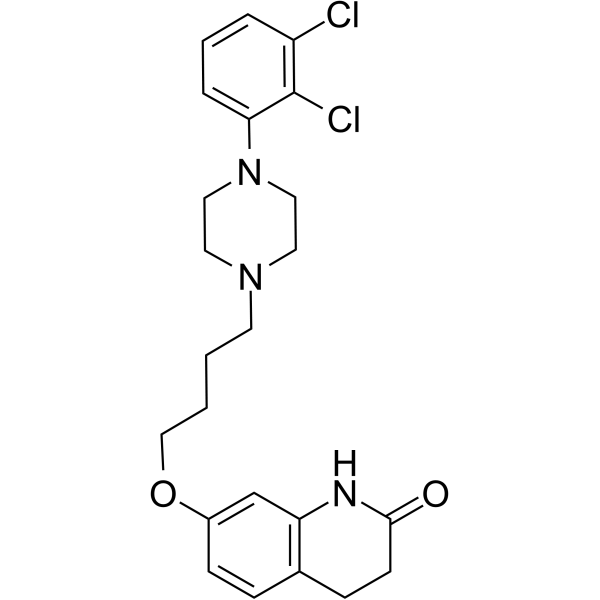
Aripiprazole (OPC-14597), an atypical antipsychotic, is a potent and high-affinity dopamine D2 receptor partial agonist. Aripiprazole is an inverse agonist at 5-HT2B and 5-HT2A receptors and displays partial agonist actions at 5-HT1A, 5-HT2C, D3, and D4 receptors. Aripiprazole can be used for the research of schizophrenia and COVID19.

For research use only. We do not sell to patients.

CAS No. : 129722-12-9

Size Price Stock Quantity
Solid + Solvent (Highly Recommended)
10 mM * 1 mL in DMSO
ready for reconstitution
In-stock
Solution
10 mM * 1 mL in DMSO In-stock
Solid
100 mg In-stock
200 mg In-stock
500 mg In-stock
1 g In-stock
5 g In-stock
10 g   Get quote  
50 g   Get quote  

* Please select Quantity before adding items.

This product is a controlled substance and not for sale in your territory.

Customer Review

Based on 11 publication(s) in Google Scholar

Other Forms of Aripiprazole:

Top Publications Citing Use of Products

    Aripiprazole purchased from MedChemExpress. Usage Cited in: CNS Neurosci Ther. 2024 May;30(5):e14739.  [Abstract]

    We evaluated the therapeutic effects of Aripiprazole (1 mg/kg, ip, single dose) on the electrophysiological activities of MK‐801‐treated mice.

    Aripiprazole purchased from MedChemExpress. Usage Cited in: CNS Neurosci Ther. 2024 May;30(5):e14739.  [Abstract]

    In the MK-801 group, theta power was significantly reduced by Aripiprazole (1 mg/kg, ip, single dose) treatment.

    Aripiprazole purchased from MedChemExpress. Usage Cited in: CNS Neurosci Ther. 2024 May;30(5):e14739.  [Abstract]

    The spontaneous spike activity of RS and FS units were significantly reduced by Aripiprazole (1 mg/kg, ip, single dose) treatment in the MK-801 group.

    Aripiprazole purchased from MedChemExpress. Usage Cited in: Int J Mol Sci. 2024 Jan 14;25(2):1035.

    Histogram showing the average percentage of change from the vehicle/vehicle-treated group for the PLF of the gamma-band ASSR recorded in rats' global cortex following an acute administration with Aripiprazole (0 and 3 mg/kg) and MK-801 in comparison with vehicle/vehicle-treated animals and MK-801/vehicle-treated animals.

    Aripiprazole purchased from MedChemExpress. Usage Cited in: Int J Mol Sci. 2024 Jan 14;25(2):1035.

    Horizontal activity plotted over 240 min following an acute administration with Aripiprazole (Ari) at 1, 3, 10 and 30 mg/kg in MK-801-treated rats in comparison with vehicle (Veh)/vehicle-treated, MK-801/vehicle-treated or MK-801/clozapine (Cloza)-treated rats (clozapine being used as a positive control).
    • Biological Activity

    • Purity & Documentation

    • References

    • Customer Review

    Description

    Aripiprazole (OPC-14597), an atypical antipsychotic, is a potent and high-affinity dopamine D2 receptor partial agonist. Aripiprazole is an inverse agonist at 5-HT2B and 5-HT2A receptors and displays partial agonist actions at 5-HT1A, 5-HT2C, D3, and D4 receptors. Aripiprazole can be used for the research of schizophrenia and COVID19[1][2][3][4].

    IC50 & Target

    5-HT1A Receptor

    4.2 nM (Ki)

    5-HT1A Receptor


    5-HT2A Receptor


    5-HT2B Receptor


    5-HT2C Receptor


    D2 Receptor


    D3 Receptor


    D4 Receptor


    Cellular Effect
    Cell Line Type Value Description References
    CHO IC50
    7.6 nM
    Compound: 1a
    Antagonist activity at human D2 dopamine receptor expressed in CHO cell membrane by GTPgammaS-binding assay
    Antagonist activity at human D2 dopamine receptor expressed in CHO cell membrane by GTPgammaS-binding assay
    [PMID: 23237836]
    HEK-293T EC50
    1 nM
    Compound: 1
    Agonist activity at human D2L receptor expressed in HEK293T cells coexpressing Gi subunit assessed as inhibition of isoproterenol-stimulated cAMP production by luminescence assay
    Agonist activity at human D2L receptor expressed in HEK293T cells coexpressing Gi subunit assessed as inhibition of isoproterenol-stimulated cAMP production by luminescence assay
    [PMID: 22845053]
    HEK-293T EC50
    1100 nM
    Compound: Aripiprazole
    Partial agonist activity at human D2SR expressed in HEK293T cells co-expressing (EA)beta-arrestin2 assessed as induction of beta-arrestin2 recruitment after 5 hrs by chemiluminescence assay
    Partial agonist activity at human D2SR expressed in HEK293T cells co-expressing (EA)beta-arrestin2 assessed as induction of beta-arrestin2 recruitment after 5 hrs by chemiluminescence assay
    [PMID: 28489379]
    HEK-293T EC50
    130 nM
    Compound: Aripiprazole
    Agonist activity at human D2S receptor expressed in HEK293T cell membranes coexpressing Galphao1 assessed as induction of nucleotide exchange preincubated for 30 mins followed by addition of [35S]GTPgammaS measured after 30 mins by [35S]GTPgammaS binding assay
    Agonist activity at human D2S receptor expressed in HEK293T cell membranes coexpressing Galphao1 assessed as induction of nucleotide exchange preincubated for 30 mins followed by addition of [35S]GTPgammaS measured after 30 mins by [35S]GTPgammaS binding assay
    [PMID: 28489379]
    HEK-293T EC50
    160 nM
    Compound: 1a
    Agonist activity at human Dopamine D2S receptor expressed in HEK293T cell membranes coexpressing Galphai2 incubated for 30 mins measured after 75 mins by [35S]GTPgammaS binding assay
    Agonist activity at human Dopamine D2S receptor expressed in HEK293T cell membranes coexpressing Galphai2 incubated for 30 mins measured after 75 mins by [35S]GTPgammaS binding assay
    [PMID: 28248104]
    HEK-293T EC50
    20 nM
    Compound: 1a
    Agonist activity at human Dopamine D3 receptor expressed in HEK293T cell membranes coexpressing GalphaoA incubated for 30 mins measured after 75 mins by [35S]GTPgammaS binding assay
    Agonist activity at human Dopamine D3 receptor expressed in HEK293T cell membranes coexpressing GalphaoA incubated for 30 mins measured after 75 mins by [35S]GTPgammaS binding assay
    [PMID: 28248104]
    HEK-293T EC50
    39 nM
    Compound: 1a
    Agonist activity at human Dopamine D2S receptor expressed in HEK293T cell membranes coexpressing GalphaoA incubated for 30 mins measured after 75 mins by [35S]GTPgammaS binding assay
    Agonist activity at human Dopamine D2S receptor expressed in HEK293T cell membranes coexpressing GalphaoA incubated for 30 mins measured after 75 mins by [35S]GTPgammaS binding assay
    [PMID: 28248104]
    HEK-293T EC50
    740 nM
    Compound: Aripiprazole
    Partial agonist activity at human D2SR expressed in HEK293T cells co-expressing (EA)beta-arrestin2 and GRK2 assessed as induction of beta-arrestin2 recruitment after 5 hrs by chemiluminescence assay
    Partial agonist activity at human D2SR expressed in HEK293T cells co-expressing (EA)beta-arrestin2 and GRK2 assessed as induction of beta-arrestin2 recruitment after 5 hrs by chemiluminescence assay
    [PMID: 28489379]
    HEK293 EC50
    160 nM
    Compound: 2a, Aripiprazole
    Agonist activity at human dopamine D2 short receptor transiently expressed in HEK293 cells co-expressing Galphai2 after 30 mins by [35S]GTPgammaS binding assay
    Agonist activity at human dopamine D2 short receptor transiently expressed in HEK293 cells co-expressing Galphai2 after 30 mins by [35S]GTPgammaS binding assay
    [PMID: 24831693]
    HEK293 EC50
    20 nM
    Compound: 2a, Aripiprazole
    Agonist activity at human dopamine D3 receptor transiently expressed in HEK293 cells co-expressing Galphao1 after 30 mins by [35S]GTPgammaS binding assay
    Agonist activity at human dopamine D3 receptor transiently expressed in HEK293 cells co-expressing Galphao1 after 30 mins by [35S]GTPgammaS binding assay
    [PMID: 24831693]
    HEK293 EC50
    > 5 μM
    Compound: Aripiprazole
    Agonist activity at human dopamine D2 receptor expressed in HEK293 cells assessed as cAMP inhibition by BRET assay
    Agonist activity at human dopamine D2 receptor expressed in HEK293 cells assessed as cAMP inhibition by BRET assay
    [PMID: 28300398]
    HEK293 EC50
    > 5 μM
    Compound: Aripiprazole
    Agonist activity at human dopamine D2 receptor expressed in HEK293 cells coexpressing renilla luciferase-fused Galphai1/GFP10-fused Ggamma2 by BRET assay
    Agonist activity at human dopamine D2 receptor expressed in HEK293 cells coexpressing renilla luciferase-fused Galphai1/GFP10-fused Ggamma2 by BRET assay
    [PMID: 28300398]
    HEK293 EC50
    > 5 μM
    Compound: Aripiprazole
    Agonist activity at human dopamine D2 receptor expressed in HEK293 cells coexpressing renilla luciferase-fused GalphaoA/GFP10-fused Ggamma2 by BRET assay
    Agonist activity at human dopamine D2 receptor expressed in HEK293 cells coexpressing renilla luciferase-fused GalphaoA/GFP10-fused Ggamma2 by BRET assay
    [PMID: 28300398]
    HEK293 EC50
    > 5 μM
    Compound: Aripiprazole
    Agonist activity at renilla luciferase-tagged human dopamine D2 receptor expressed in HEK293 cells coexpressing mVenus-fused beta-arrestin 2 assessed as induction of beta-arrestin 2 recruitment by BRET assay
    Agonist activity at renilla luciferase-tagged human dopamine D2 receptor expressed in HEK293 cells coexpressing mVenus-fused beta-arrestin 2 assessed as induction of beta-arrestin 2 recruitment by BRET assay
    [PMID: 28300398]
    HEK293 IC50
    11 nM
    Compound: 2a, Aripiprazole
    Antagonist activity at human dopamine D2 short receptor transiently expressed in HEK293 cells assessed as inhibition of beta-arrestin recruitment after 6 hrs by chemiluminescence assay
    Antagonist activity at human dopamine D2 short receptor transiently expressed in HEK293 cells assessed as inhibition of beta-arrestin recruitment after 6 hrs by chemiluminescence assay
    [PMID: 24831693]
    HEK293 IC50
    130 μM
    Compound: aripiprazole
    Inhibition of human MATE1-mediated ASP+ uptake expressed in HEK293 cells after 1.5 mins by fluorescence assay
    Inhibition of human MATE1-mediated ASP+ uptake expressed in HEK293 cells after 1.5 mins by fluorescence assay
    [PMID: 23241029]
    HEK293 IC50
    239 μM
    Compound: aripiprazole
    Inhibition of human OCT2-mediated ASP+ uptake expressed in HEK293 cells after 3 mins by fluorescence assay
    Inhibition of human OCT2-mediated ASP+ uptake expressed in HEK293 cells after 3 mins by fluorescence assay
    [PMID: 23241029]
    HEK293 IC50
    > 100 μM
    Compound: 1
    Cytotoxicity against HEK293 cells measured after 24 hrs by MTT assay
    Cytotoxicity against HEK293 cells measured after 24 hrs by MTT assay
    [PMID: 35176563]
    HEK293 IC50
    > 500 μM
    Compound: aripiprazole
    Inhibition of human MATE2K-mediated ASP+ uptake expressed in HEK293 cells after 1.5 mins by fluorescence assay
    Inhibition of human MATE2K-mediated ASP+ uptake expressed in HEK293 cells after 1.5 mins by fluorescence assay
    [PMID: 23241029]
    In Vitro

    Aripiprazole potently activates D2 receptor-mediated inhibition of cAMP accumulation[1].
    Aripiprazole shows a greater anti-inflammatory effect on TNF-α, IL-13, IL-17α and fractalkine[3].

    MedChemExpress (MCE) has not independently confirmed the accuracy of these methods. They are for reference only.

    In Vivo

    Aripiprazole (0-3 mg/kg, IP, daily) shows some anxiolytic properties[4].

    MedChemExpress (MCE) has not independently confirmed the accuracy of these methods. They are for reference only.

    Animal Model: WAG/Rij rats (N = 6 per dose, 6 months, administration of a mixture of tiletamine/zolazepam)[4]
    Dosage: 0, 0.3, 1, 3 mg/kg
    Administration: IP, 1 mL/kg, every day at 5 p.m. until the end of the experiments
    Result: Showed some anxiolytic properties with the 1 mg/kg dose being the most active.
    Molecular Weight

    448.39

    Formula

    C23H27Cl2N3O2

    CAS No.
    Appearance

    Solid

    Color

    White to off-white

    SMILES

    O=C1NC2=C(C=CC(OCCCCN3CCN(C4=CC=CC(Cl)=C4Cl)CC3)=C2)CC1

    Shipping

    Room temperature in continental US; may vary elsewhere.

    Storage

    4°C, protect from light

    *In solvent : -80°C, 6 months; -20°C, 1 month (protect from light)

    Solvent & Solubility
    In Vitro: 

    DMSO : ≥ 100 mg/mL (223.02 mM; Hygroscopic DMSO has a significant impact on the solubility of product, please use newly opened DMSO)

    DMF : 50 mg/mL (111.51 mM; Need ultrasonic)

    *"≥" means soluble, but saturation unknown.

    Preparing
    Stock Solutions
    Concentration Solvent Mass 1 mg 5 mg 10 mg
    1 mM 2.2302 mL 11.1510 mL 22.3020 mL
    5 mM 0.4460 mL 2.2302 mL 4.4604 mL
    View the Complete Stock Solution Preparation Table

    * Please refer to the solubility information to select the appropriate solvent. Once prepared, please aliquot and store the solution to prevent product inactivation from repeated freeze-thaw cycles.
    Storage method and period of stock solution: -80°C, 6 months; -20°C, 1 month (protect from light). When stored at -80°C, please use it within 6 months. When stored at -20°C, please use it within 1 month.

    • Molarity Calculator

    • Dilution Calculator

    Mass (g) = Concentration (mol/L) × Volume (L) × Molecular Weight (g/mol)

    Mass
    =
    Concentration
    ×
    Volume
    ×
    Molecular Weight *

    Concentration (start) × Volume (start) = Concentration (final) × Volume (final)

    This equation is commonly abbreviated as: C1V1 = C2V2

    Concentration (start)

    C1

    ×
    Volume (start)

    V1

    =
    Concentration (final)

    C2

    ×
    Volume (final)

    V2

    In Vivo:

    Select the appropriate dissolution method based on your experimental animal and administration route.

    For the following dissolution methods, please ensure to first prepare a clear stock solution using an In Vitro approach and then sequentially add co-solvents:
    To ensure reliable experimental results, the clarified stock solution can be appropriately stored based on storage conditions. As for the working solution for in vivo experiments, it is recommended to prepare freshly and use it on the same day.
    The percentages shown for the solvents indicate their volumetric ratio in the final prepared solution. If precipitation or phase separation occurs during preparation, heat and/or sonication can be used to aid dissolution.

    • Protocol 1

      Add each solvent one by one:  10% DMSO    40% PEG300    5% Tween-80    45% Saline

      Solubility: ≥ 2.5 mg/mL (5.58 mM); Clear solution

      This protocol yields a clear solution of ≥ 2.5 mg/mL (saturation unknown).

      Taking 1 mL working solution as an example, add 100 μL DMSO stock solution (25.0 mg/mL) to 400 μL PEG300, and mix evenly; then add 50 μL Tween-80 and mix evenly; then add 450 μL Saline to adjust the volume to 1 mL.

      Preparation of Saline: Dissolve 0.9 g sodium chloride in ddH₂O and dilute to 100 mL to obtain a clear Saline solution.
    • Protocol 2

      Add each solvent one by one:  10% DMSO    90% Corn Oil

      Solubility: ≥ 2.5 mg/mL (5.58 mM); Clear solution

      This protocol yields a clear solution of ≥ 2.5 mg/mL (saturation unknown). If the continuous dosing period exceeds half a month, please choose this protocol carefully.

      Taking 1 mL working solution as an example, add 100 μL DMSO stock solution (25.0 mg/mL) to 900 μL Corn oil, and mix evenly.

    In Vivo Dissolution Calculator
    Please enter the basic information of animal experiments:

    Dosage

    mg/kg

    Animal weight
    (per animal)

    g

    Dosing volume
    (per animal)

    μL

    Number of animals

    Recommended: Prepare an additional quantity of animals to account for potential losses during experiments.
    Please enter your animal formula composition:
    %
    DMSO +
    +
    %
    Tween-80 +
    %
    Saline
    Recommended: Keep the proportion of DMSO in working solution below 2% if your animal is weak.
    The co-solvents required include: DMSO, . All of co-solvents are available by MedChemExpress (MCE). , Tween 80. All of co-solvents are available by MedChemExpress (MCE).
    Calculation results:
    Working solution concentration: mg/mL
    Method for preparing stock solution: mg drug dissolved in μL  DMSO (Stock solution concentration: mg/mL).

    *In solvent : -80°C, 6 months; -20°C, 1 month (protect from light)

    The concentration of the stock solution you require exceeds the measured solubility. The following solution is for reference only. If necessary, please contact MedChemExpress (MCE).
    Method for preparing in vivo working solution for animal experiments: Take μL DMSO stock solution, add μL . μL , mix evenly, next add μL Tween 80, mix evenly, then add μL Saline.
     If the continuous dosing period exceeds half a month, please choose this protocol carefully.
    Please ensure that the stock solution in the first step is dissolved to a clear state, and add co-solvents in sequence. You can use ultrasonic heating (ultrasonic cleaner, recommended frequency 20-40 kHz), vortexing, etc. to assist dissolution.
    Purity & Documentation

    Purity: 99.95%

    References

    Complete Stock Solution Preparation Table

    * Please refer to the solubility information to select the appropriate solvent. Once prepared, please aliquot and store the solution to prevent product inactivation from repeated freeze-thaw cycles.
    Storage method and period of stock solution: -80°C, 6 months; -20°C, 1 month (protect from light). When stored at -80°C, please use it within 6 months. When stored at -20°C, please use it within 1 month.

    Optional Solvent Concentration Solvent Mass 1 mg 5 mg 10 mg 25 mg
    DMF / DMSO 1 mM 2.2302 mL 11.1510 mL 22.3020 mL 55.7550 mL
    5 mM 0.4460 mL 2.2302 mL 4.4604 mL 11.1510 mL
    10 mM 0.2230 mL 1.1151 mL 2.2302 mL 5.5755 mL
    15 mM 0.1487 mL 0.7434 mL 1.4868 mL 3.7170 mL
    20 mM 0.1115 mL 0.5576 mL 1.1151 mL 2.7878 mL
    25 mM 0.0892 mL 0.4460 mL 0.8921 mL 2.2302 mL
    30 mM 0.0743 mL 0.3717 mL 0.7434 mL 1.8585 mL
    40 mM 0.0558 mL 0.2788 mL 0.5576 mL 1.3939 mL
    50 mM 0.0446 mL 0.2230 mL 0.4460 mL 1.1151 mL
    60 mM 0.0372 mL 0.1859 mL 0.3717 mL 0.9293 mL
    80 mM 0.0279 mL 0.1394 mL 0.2788 mL 0.6969 mL
    100 mM 0.0223 mL 0.1115 mL 0.2230 mL 0.5576 mL
    • No file chosen (Maximum size is: 1024 Kb)
    • If you have published this work, please enter the PubMed ID.
    • Your name will appear on the site.
    Help & FAQs
    • Do most proteins show cross-species activity?

      Species cross-reactivity must be investigated individually for each product. Many human cytokines will produce a nice response in mouse cell lines, and many mouse proteins will show activity on human cells. Other proteins may have a lower specific activity when used in the opposite species.

    Your Recently Viewed Products:

    Inquiry Online

    Your information is safe with us. * Required Fields.

    Product Name


    Requested Quantity *

    Applicant Name *


    Salutation

    Email Address *


    Phone Number *

    Department


    Organization Name *

    City

    State

    Country or Region *


    Remarks

    Bulk Inquiry

    Inquiry Information

    Product Name:
    Aripiprazole
    Cat. No.:
    HY-14546
    Quantity:
    MCE Japan Authorized Agent: