



Mirin
Based on 11 publication(s) in Google Scholar
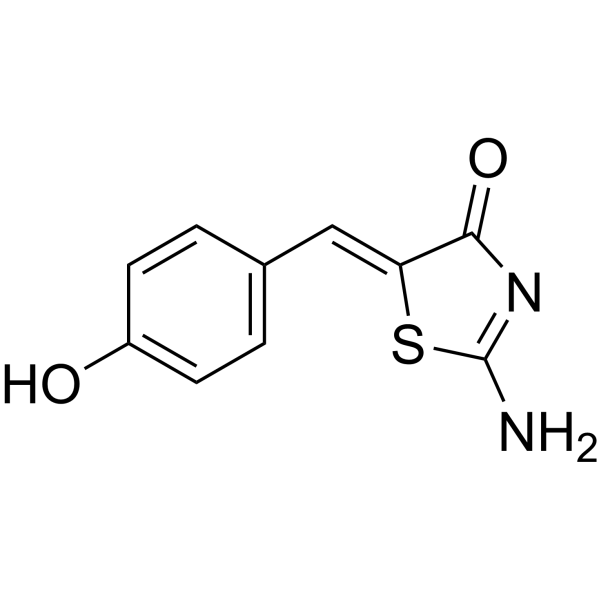
Mirin is a potent Mre11-Rad50-Nbs1 (MRN) complex inhibitor. Mirin prevents MRN-dependent activation of ATM (IC50=12 μM) without affecting ATM protein kinase activity, and it inhibits Mre11-associated exonuclease activity. Mirin abolishes the G2/M checkpoint and homology-dependent repair in mammalian cells. Mirin prevents ATM activation in response to DNA double-strand breaks (DSBs) and blocks homology-directed repair (HDR) in mammalian cells.
For research use only. We do not sell to patients.
- Purity : 99.63%
- CAS No.: 1198097-97-0
- Formula: C10H8N2O2S
- Molecular Weight:220.25
-
Storage:Powder -20°C, 3 years , 4°C, 2 years ; In solvent -80°C, 2 years , -20°C, 1 year

To place orders, for customer services and technical support, please contact: MedChemExpress USA
Tel: 609-228-6898 E-mail: [email protected] [email protected]


-
 Biological Activity
-
Chemical Information
-
Solvent & Solubility
- Protocols
- Purity & Documentation
- References
-
 Help & FAQs


-
HY-12016
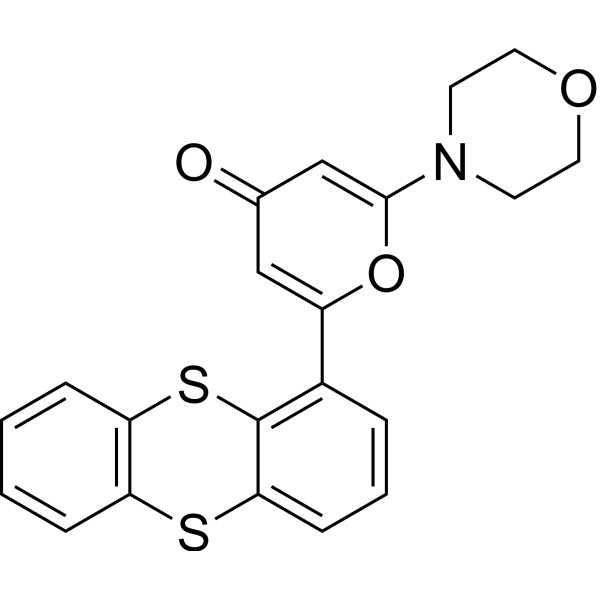
KU-55933ATM Inhibitor -
HY-19323
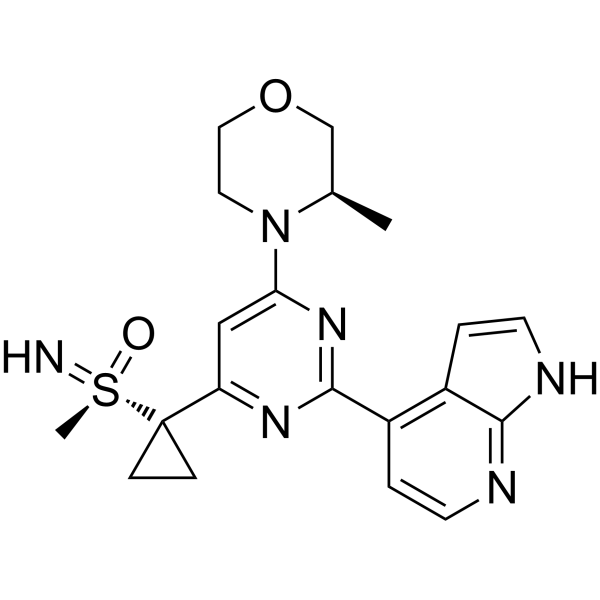
CeralasertibATR Inhibitor -
HY-14731
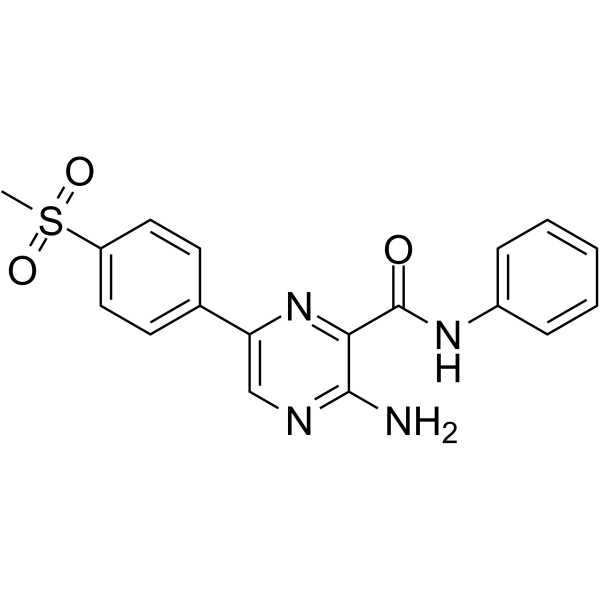
VE-821ATR Inhibitor -
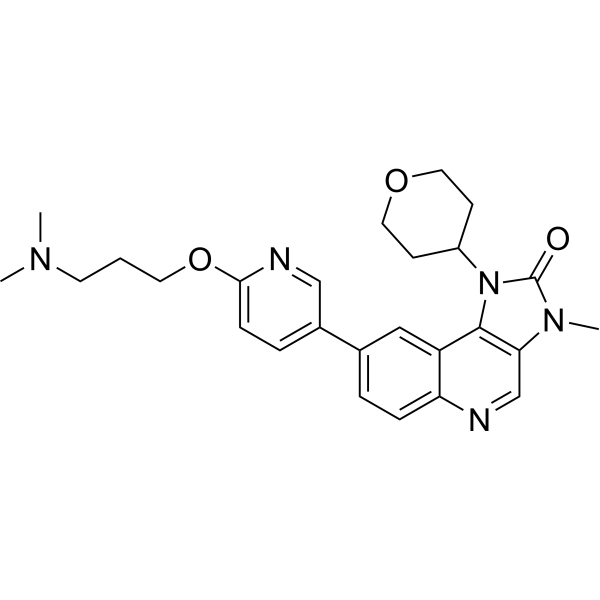
HY-100016
AZD0156ATM Inhibitor -
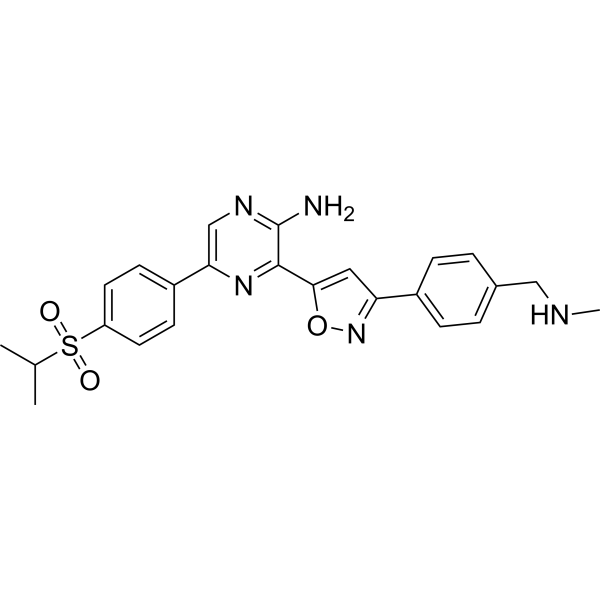
HY-13902
BerzosertibATR Inhibitor -
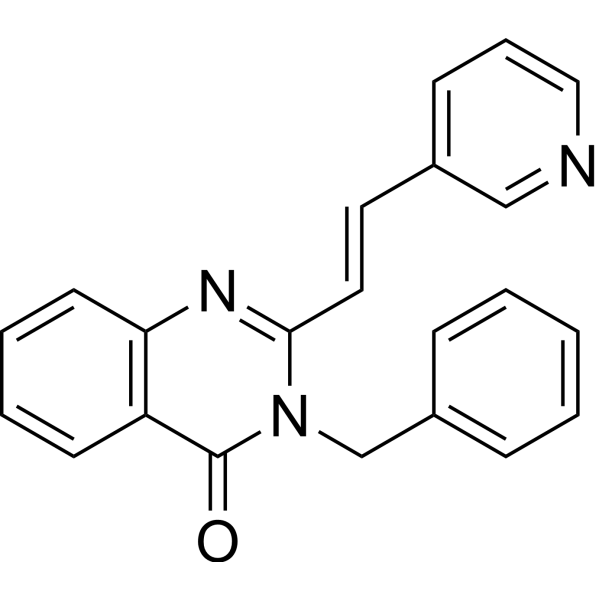
HY-101462
RAD51 Inhibitor B02RAD51 Inhibitor -
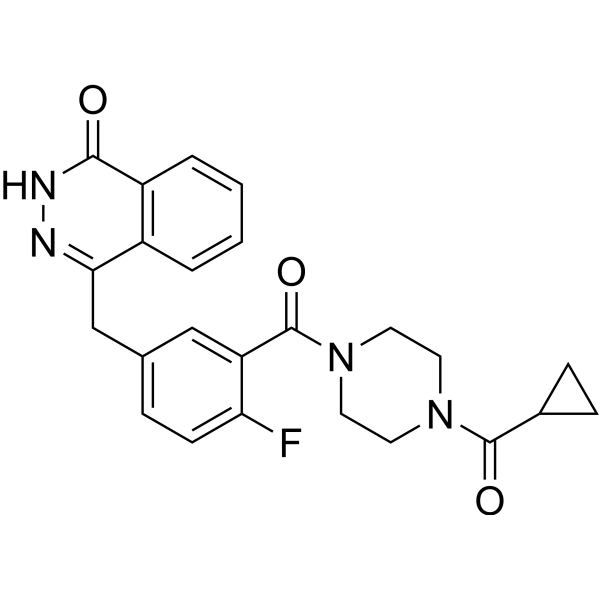
HY-10162
OlaparibPARP Inhibitor -
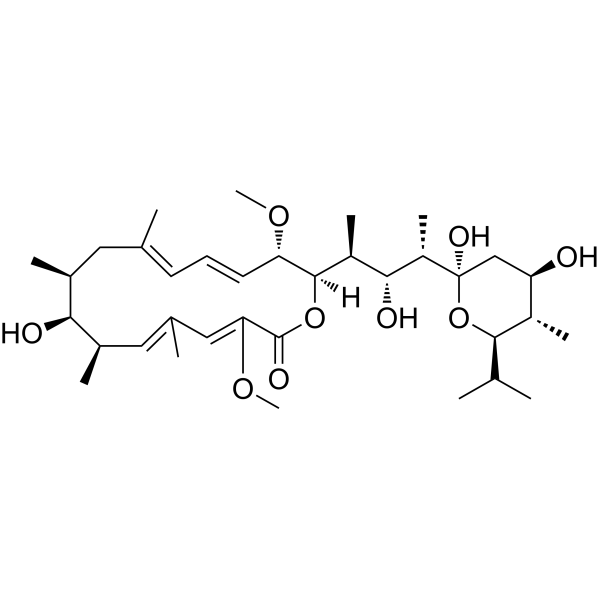
HY-100558
Bafilomycin A1V-ATPase Inhibitor -
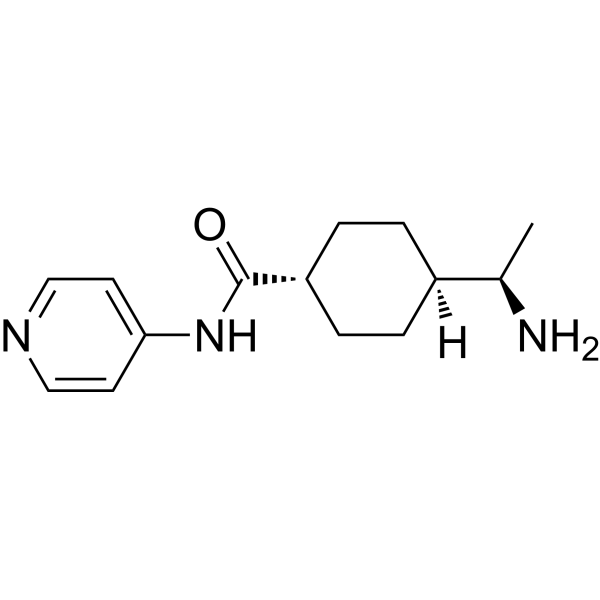
HY-10071
Y-27632ROCK Inhibitor -
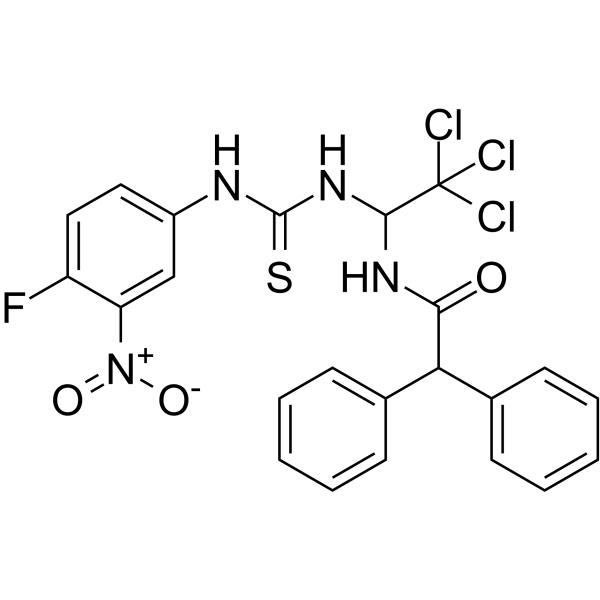
HY-15520
CGK733ATM/ATR Inhibitor -
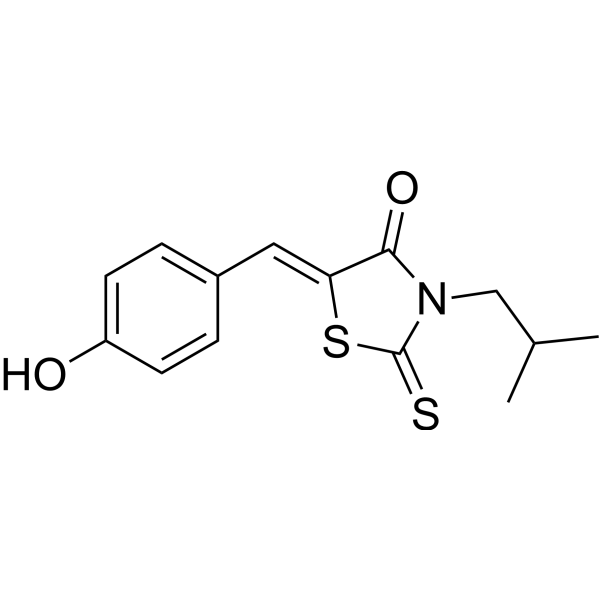
HY-116770
PFM01Endonuclease Inhibitor -
HY-12342
ML216BLM Helicase Inhibitor
Publications Citing Use of MedChemExpress (MCE) Mirin
More- Science. 2026 Feb 26;391(6788):eadz3121. [Abstract]
- Drug Resist Updat. 2026 Jan:84:101319. [Abstract]
- Nat Commun. 2023 Apr 3;14(1):1838. [Abstract]
- Cell Rep. 2022 Nov 29;41(9):111716. [Abstract]
- Mol Cancer Ther. 2026 Jul 15:10.1158/1535-7163.MCT-26-0182.
- EMBO Rep. 2020 Aug 5;21(8):e48920. [Abstract]
- Neoplasia. 2021 May;23(5):515-528. [Abstract]
- Food Chem Toxicol. 2025 Oct:204:115653. [Abstract]
- Res Sq. 2026 Apr 24.
- bioRxiv. 2025 Jun 17:2025.06.16.659978. [Abstract]
- Utrecht University. 2023 Feb.
 Customer Validation & Images

-
Cell Proliferation/Viability Assay
-
Bio/Physico-chemical Assay
-
IF
-
WB
-
Cell Imaging/Staining


Biological Activity
Description
Cellular Effect
|
Cell Line

|
Type | Value | Description | References |
|---|---|---|---|---|
| Vero | CC50 |
>100 μM
Compound: 14
|
Cytotoxicity against african green monkey Vero cells assessed as reduction in cell viability after 72 hrs by cell titer-blue fluorescent assay
Cytotoxicity against african green monkey Vero cells assessed as reduction in cell viability after 72 hrs by cell titer-blue fluorescent assay
|
[PMID: 25462237] |
In Vitro
Mirin (50, 100, 500 μM) inhibits ATM-dependent phosphorylation of Nbs1 and Chk2 and the MRN-dependent autophosphorylation of ATM at Ser1981 in response to DNA double-strand breaks (DSBs). Mirin (100 μM) inhibits Mre11 nuclease activity[1].
Mirin (10-100 μM; 24 h) shows 50% cytotoxicity at 50 μM in HEK293 cells[1].
Mirin (10-100 μM) induces a substantial G2 arrest at concentrations of 50 μM and 100 μM[1].
Mirin (18 µM; 48 h) increases apoptosis in PEO4 cells[2].
MedChemExpress (MCE) has not independently confirmed the accuracy of these methods. They are for reference only. Further protocols information, click here.
-
Cell Line:Human embryonic kidney (HEK) 293 cells
-
Concentration:10, 25, 50, 100 μM
-
Incubation Time:24 h
-
Result:Had little effect on cell survival at 25 μM and showed 50% cytotoxicity at 50 μM.
-
Cell Line:TOSA4 cells
-
Concentration:10, 25, 50, 100 μM
-
Incubation Time:
-
Result:Induced a substantial G2 arrest at concentrations of 50 μM and 100 μM.
-
Cell Line:PEO4 cells
-
Concentration:18 µM
-
Incubation Time:48 h
-
Result:Increased apoptosis.


Chemical Information
-
CAS No. 1198097-97-0
-
Appearance Solid
-
Molecular Weight 220.25
-
Formula C10H8N2O2S
-
Color Yellow to orange
-
SMILES
O=C1N=C(S/C1=C\C2=CC=C(C=C2)O)N
-
Shipping
Room temperature in continental US; may vary elsewhere.
-
Storage
Powder -20°C 3 years 4°C 2 years In solvent -80°C 2 years -20°C 1 year


Publications (11)
-
Journal Impact Factor
-
Most Recent
-
Science
Different repair pathways support intact or truncated insertions by R2 retrotransposon protein. [Abstract]2026 Feb 26;391(6788):eadz3121. PMID: 41231928 -
Drug Resist Updat
ZBP1 antagonizes MRE11-mediated DNA end resection and confers synthetic lethality to PARP inhibition in ovarian cancer. [Abstract]2026 Jan:84:101319. PMID: 41192279 -
Nat Commun
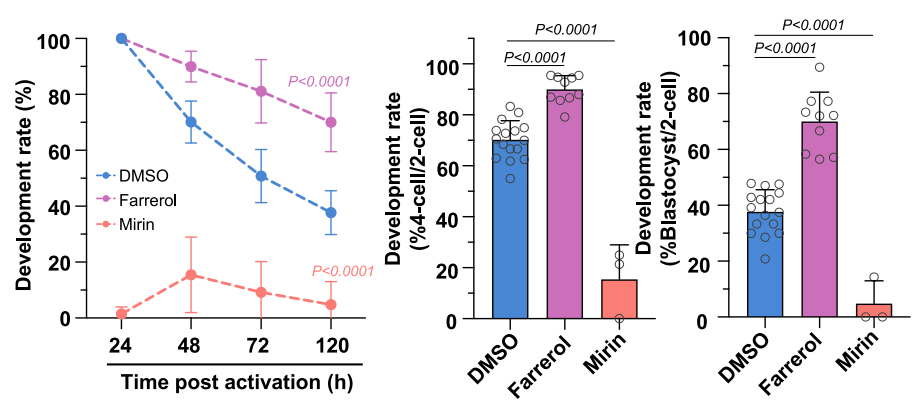
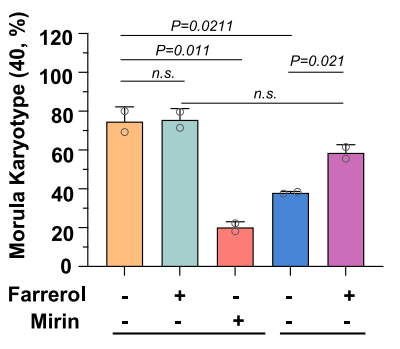
Farrerol directly activates the deubiqutinase UCHL3 to promote DNA repair and reprogramming when mediated by somatic cell nuclear transfer. [Abstract]2023 Apr 3;14(1):1838. PMID: 37012254
Mirin purchased from MedChemExpress. Usage Cited in: Nat Commun. 2023 Apr 3;14(1):1838. [Abstract]
The average euploidy rate of morula cells in the mouse IVF embryos treated with Mirin (50 μM).
Mirin purchased from MedChemExpress. Usage Cited in: Nat Commun. 2023 Apr 3;14(1):1838. [Abstract]
Mirin (50 μM; ~16 h) significantly blocked SCNT-mediated reprogramming and retarded early embryonic development.
-
Cell Rep
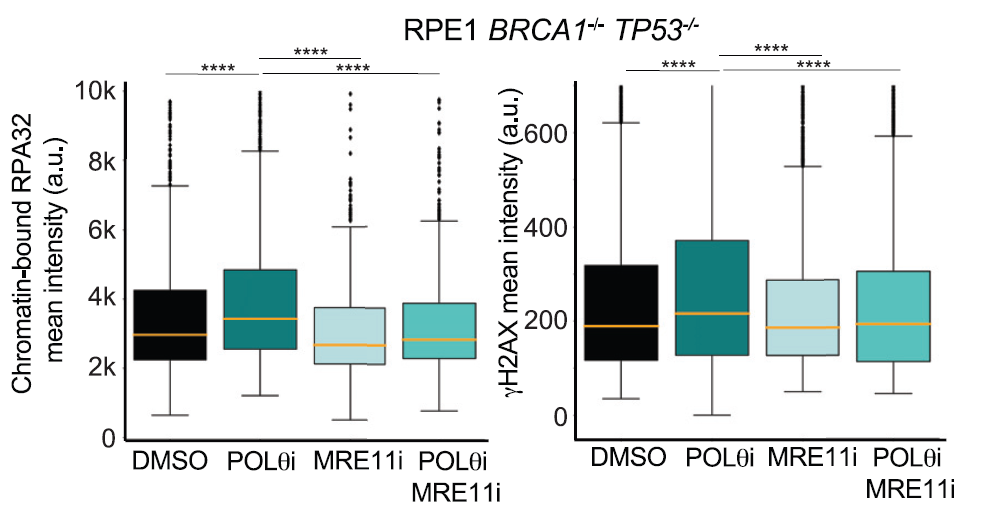
POLθ processes ssDNA gaps and promotes replication fork progression in BRCA1-deficient cells. [Abstract]2022 Nov 29;41(9):111716. PMID: 36400033
Mirin purchased from MedChemExpress. Usage Cited in: Cell Rep. 2022 Nov 29;41(9):111716. [Abstract]
Mirin (MRE11i) (50 μM; 6 h) suppressed RPA chromatin binding and decreased H2AX phosphorylation in RPE1 BRCA1-/- TP53-/- cells compared with POLθ inhibition alone.
-
-
EMBO Rep
CDC7 kinase promotes MRE11 fork processing, modulating fork speed and chromosomal breakage. [Abstract]2020 Aug 5;21(8):e48920. PMID: 32496651
Mirin purchased from MedChemExpress. Usage Cited in: EMBO Rep. 2020 Aug 5;21(8):e48920. [Abstract]
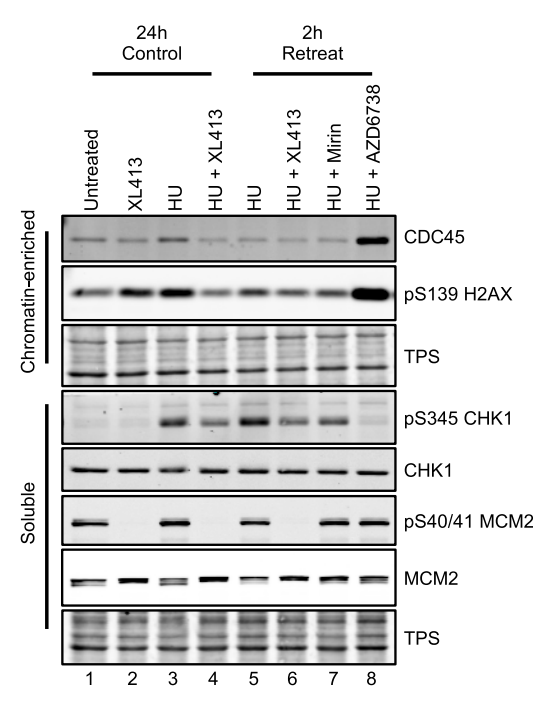
Mirin (50 μM) strongly limited histone H2AX and CHK1 phosphorylation in U2OS cells to almost similar levels as maintaining the CDC7 inhibition.
Mirin purchased from MedChemExpress. Usage Cited in: EMBO Rep. 2020 Aug 5;21(8):e48920. [Abstract]
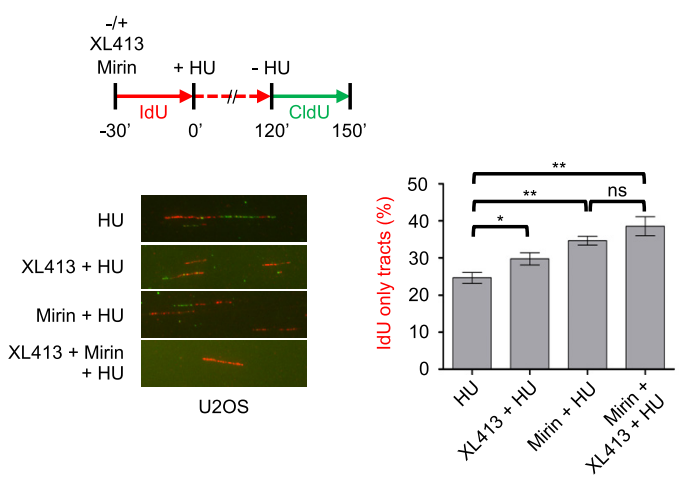
Mirin (50 μM) induced the fork restart defect in U2OS cells.
-
Neoplasia
Synergistic effect of Chloroquine and Panobinostat in ovarian cancer through induction of DNA damage and inhibition of DNA repair. [Abstract]2021 May;23(5):515-528. PMID: 33930758 -
Food Chem Toxicol
PAK1 mediates ivermectin-induced DNA damage in porcine oocytes during meiotic maturation. [Abstract]2025 Oct:204:115653. PMID: 40716667 -
-
bioRxiv
2025 Jun 17:2025.06.16.659978. PMID: 40667017 -


Solvent & Solubility
In Vitro:
DMSO : ≥ 31 mg/mL (140.75 mM; Hygroscopic DMSO has a significant impact on the solubility of product, please use newly opened DMSO)
* "≥" means soluble, but saturation unknown.
Please refer to the solubility information to select the appropriate solvent. Once prepared, please aliquot and store the solution to prevent product inactivation from repeated freeze-thaw cycles.
Storage method and period of stock solution: -80°C, 2 years; -20°C, 1 year. When stored at -80°C, please use it within 2 years. When stored at -20°C, please use it within 1 year.
Please refer to the solubility information to select the appropriate solvent. Once prepared, please aliquot and store the solution to prevent product inactivation from repeated freeze-thaw cycles.
Storage method and period of stock solution: -80°C, 2 years; -20°C, 1 year. When stored at -80°C, please use it within 2 years. When stored at -20°C, please use it within 1 year.
Concentration (start) × Volume (start) = Concentration (final) × Volume (final)
In Vivo:
Select the appropriate dissolution method based on your experimental animal and administration route.
- For the following dissolution methods, please ensure to first prepare a clear stock solution using an In Vitro approach and then sequentially add co-solvents:
- To ensure reliable experimental results, the clarified stock solution can be appropriately stored based on storage conditions. As for the working solution for In Vivo experiments, it is recommended to prepare freshly and use it on the same day.
- The percentages shown for the solvents indicate their volumetric ratio in the final prepared solution. If precipitation or phase separation occurs during preparation, heat and/or sonication can be used to aid dissolution.
Add each solvent one by one: 10% DMSO 40% PEG300 5% Tween-80 45% Saline
Solubility: ≥ 1 mg/mL (4.54 mM); Clear solution
This protocol yields a clear solution of ≥ 1 mg/mL (saturation unknown).
Taking 1 mL working solution as an example, add 100 μL DMSO stock solution (10.0 mg/mL) to 400 μL PEG300, and mix evenly; then add 50 μL Tween-80 and mix evenly; then add 450 μL Saline to adjust the volume to 1 mL.
Preparation of Saline: Dissolve 0.9 g sodium chloride in ddH₂O and dilute to 100 mL to obtain a clear Saline solution.
Add each solvent one by one: 10% DMSO 90% (20% SBE-β-CD in Saline)
Solubility: ≥ 1 mg/mL (4.54 mM); Clear solution
This protocol yields a clear solution of ≥ 1 mg/mL (saturation unknown).
Taking 1 mL working solution as an example, add 100 μL DMSO stock solution (10.0 mg/mL) to 900 μL 20% SBE-β-CD in Saline, and mix evenly.
Preparation of 20% SBE-β-CD in Saline (4°C, storage for one week): 2 g SBE-β-CD powder is dissolved in 10 mL Saline, completely dissolve until clear.
In Vivo Dissolution Calculator
Please enter the basic information of animal experiments:
-
-
-
-
Recommended: Prepare an additional quantity of animals to account for potential losses during experiments.
Please enter your animal formula composition:
-
%DMSO +
Recommended: Keep the proportion of DMSO in working solution below 2% if your animal is weak.
-
%+
-
+%Tween-80 + +
-
%Saline +
The co-solvents required include: DMSO, . All of co-solvents are available by MedChemExpress (MCE). , Tween 80. All of co-solvents are available by MedChemExpress (MCE).
Working solution concentration: 0.22 mg/mL
Method for preparing stock solution: mg drug dissolved in μL DMSO. Stock solution concentration: mg/mL.
1. Take μL DMSO stock solution;
2. Add μL .
μL , mix evenly;
3. Then add μL Tween 80, mix evenly;
4. Then add μL
Please ensure that the stock solution in the first step is dissolved to a clear state, and add co-solvents in sequence. You can use ultrasonic heating (ultrasonic cleaner, recommended frequency 20-40 kHz), vortexing, etc. to assist dissolution.

Protocols
-
Kinase activity and phosphorylation assays
Kinase activity assays measure the ability of kinases to transfer phosphate groups from ATP to specific substrates, while phosphorylation assays detect the presence and levels of phosphorylated proteins. Common methods include radiolabeled ATP incorporation (e. g. ,), ADP release detection via bioluminescence (e. g. ,[3]), enzyme-linked immunosorbent assays (ELISA) for phospho-specific epitopes (e. g. ,[6]), and microtiter-based formats for high-throughput screening (e. g. ,[8]). The ADP-Glo assay quantifies kinase activity by measuring ADP produced during phosphorylation using a luciferase-based system. Radiometric assays involve autoradiography or scintillation counting after incorporation of 32P-labeled ATP into substrate proteins. ELISA-based approaches rely on phospho-specific antibodies to detect activated kinases in cell lysates or purified samples.
-
CRISPR-Cas9 HDR knock-in/precise editing
CRISPR-Cas9 HDR knock-in uses a guide RNA to direct Cas9 to a genomic target adjacent to a PAM, where Cas9 creates a double-strand break; if a donor DNA template with homology to the cut region is present, cellular HDR can copy the donor sequence into the genome, producing a precise substitution, tag, reporter, or insertion rather than an indel. The readout is the fraction of alleles or cells carrying the intended donor-derived edit, measured by junction PCR, restriction-fragment analysis, Sanger sequencing, amplicon deep sequencing, flow cytometry for reporter knock-in, or clone genotyping; NHEJ indels and partial or non-HDR insertions are measured in parallel because they compete with or confound precise HDR outcomes.
-
Cell Cytotoxicity Assay
Cytotoxicity assays are usually based on the assessment of cell membrane damage, which can also be indirectly detected by measuring cell viability. Detection methods include MTT assay, CKK-8 assay, LDH assay and ATP assay, etc.
-
Flow cytometric DNA-content cell-cycle staining
Flow cytometric DNA-content cell-cycle staining measures the fluorescence intensity of DNA-bound fluorochromes in single cells or nuclei to estimate DNA content distributions, allowing assignment of populations to G0/G1, S, and G2/M phases by DNA histogram deconvolution. Propidium iodide (PI) intercalates into DNA, and PI fluorescence is proportional to cellular DNA content when staining is performed under conditions that make DNA accessible and minimize non-DNA signal. Cells with G2/M DNA content are expected to show approximately twice the fluorescence intensity of G0/G1 cells, while S-phase cells occupy intermediate fluorescence values. PI-based DNA-content analysis can also detect cells with fractional DNA content, often reported as sub-G1, when DNA fragmentation and extraction during staining reduce retained DNA signal in apoptotic cells. DAPI is an alternative DNA fluorochrome for univariate DNA-content analysis, while bivariate approaches combining DNA content with proliferation
-
Protocol for Cell Cycle
Cell-cycle analysis by flow cytometry measures DNA content in single cells to estimate the fraction of cells in G0/G1, S, and G2/M phases. Propidium iodide intercalates into DNA, and after RNA removal with RNase, fluorescence intensity reflects cellular DNA content: 2N cells are assigned to G0/G1, cells between 2N and 4N to S phase, and 4N cells to G2/M. DNA-content analysis alone cannot reliably separate G0 from G1 or G2 from M. Ki-67 can distinguish quiescent G0 cells from cycling cells, EdU or BrdU incorporation marks active DNA synthesis in S phase, and phospho-histone H3 staining identifies mitotic cells within the 4N population.
-
Protocol for Kinase activity and phosphorylation assays
Kinase activity assays measure transfer of phosphate from ATP to a protein or peptide substrate, generating phosphorylated substrate, ADP, or incorporated radiolabeled phosphate as the readout; phosphorylation assays measure site-specific phosphorylation in cells or tissues as a proxy for kinase-pathway activation, inhibition, or substrate regulation. Phosphorylation can be detected by phospho-specific Western blot, immunoprecipitation kinase assay, phospho-immunofluorescence, phospho-flow cytometry, luminescent ADP detection, radiolabeled ATP incorporation, or reporter-based pathway assays, and these readouts can be applied to cancer cells, primary neurons, mouse tumors, organoids, inflammatory macrophages, ferroptosis studies, and mitophagy studies when the kinase target is biologically relevant.


Purity & Documentation
-
Data Sheet (279 KB)
-
SDS (393 KB)
- English - EN (393 KB)
- Français - FR (393 KB)
- Deutsch - DE (393 KB)
- Norwegian - NO (393 KB)
- Español - ES (393 KB)
- Swedish - SV (393 KB)
- Italian - IT (393 KB)
- Korean - KR (393 KB)
- Portuguese - PT (393 KB)
-
Handling Instructions (2659 KB)
References
[1]. Rozier L, et al. The MRN-CtIP pathway is required for metaphase chromosome alignment. Mol Cell. 2013 Mar 28;49(6):1097-107. [Content Brief]
[2]. Lee JH, et al. Ataxia telangiectasia-mutated (ATM) kinase activity is regulated by ATP-driven conformational changes in the Mre11/Rad50/Nbs1 (MRN) complex. J Biol Chem. 2013 May 3;288(18):12840-51. [Content Brief]
[3]. Garner KM, et al. Corrected structure of Mirin, a small-molecule inhibitor of the Mre11-Rad50-Nbs1 complex. Nat Chem Biol. 2009 Mar;5(3):129-30. [Content Brief]
[4]. Aude Dupré, et al. A forward chemical genetic screen reveals an inhibitor of the Mre11-Rad50-Nbs1 complex. Nat Chem Biol. 2008 Feb;4(2):119-25. [Content Brief]
[5]. Adel Alblihy, et al. Selective Killing of BRCA2-Deficient Ovarian Cancer Cells via MRE11 Blockade. Int J Mol Sci. 2023 Jun 30;24(13):10966. [Content Brief]


Complete Stock Solution Preparation Table
Please refer to the solubility information to select the appropriate solvent. Once prepared, please aliquot and store the solution to prevent product inactivation from repeated freeze-thaw cycles.
Storage method and period of stock solution: -80°C, 2 years; -20°C, 1 year. When stored at -80°C, please use it within 2 years. When stored at -20°C, please use it within 1 year.
| Optional Solvent | Concentration Solvent Mass | 1 mg | 5 mg | 10 mg | 25 mg |
|---|---|---|---|---|---|
| DMSO | 1 mM | 4.5403 mL | 22.7015 mL | 45.4030 mL | 113.5074 mL |
| 5 mM | 0.9081 mL | 4.5403 mL | 9.0806 mL | 22.7015 mL | |
| 10 mM | 0.4540 mL | 2.2701 mL | 4.5403 mL | 11.3507 mL | |
| 15 mM | 0.3027 mL | 1.5134 mL | 3.0269 mL | 7.5672 mL | |
| 20 mM | 0.2270 mL | 1.1351 mL | 2.2701 mL | 5.6754 mL | |
| 25 mM | 0.1816 mL | 0.9081 mL | 1.8161 mL | 4.5403 mL | |
| 30 mM | 0.1513 mL | 0.7567 mL | 1.5134 mL | 3.7836 mL | |
| 40 mM | 0.1135 mL | 0.5675 mL | 1.1351 mL | 2.8377 mL | |
| 50 mM | 0.0908 mL | 0.4540 mL | 0.9081 mL | 2.2701 mL | |
| 60 mM | 0.0757 mL | 0.3784 mL | 0.7567 mL | 1.8918 mL | |
| 80 mM | 0.0568 mL | 0.2838 mL | 0.5675 mL | 1.4188 mL | |
| 100 mM | 0.0454 mL | 0.2270 mL | 0.4540 mL | 1.1351 mL |


Mirin Related Classifications
HY-19959 Related Classifications
 Powered by Bioz