



PACAP (1-27), human, ovine, rat
Based on 4 publication(s) in Google Scholar
PACAP (1-27), human, ovine, rat (PACAP 1-27) is the N-terminal fragment of PACAP-38, and is a potent PACAP receptor agonist with IC50s of 3 nM, 2 nM and 5 nM for rat PAC1, rat VPAC1 and human VPAC2, respectively.
For research use only. We do not sell to patients.
- Purity: 99.30%
- CAS No.: 127317-03-7
- Formula: C142H224N40O39S
- Molecular Weight:3147.66
-
Storage:
Sealed storage, away from moisture.
Powder -80°C, 2 years , -20°C, 1 year* In solvent : -80°C, 6 months; -20°C, 1 month (sealed storage, away from moisture)


To place orders, for customer services and technical support, please contact: MedChemExpress USA
Tel: 609-228-6898 E-mail: [email protected] [email protected]


-
 Biological Activity
-
Chemical Information
-
Solvent & Solubility
- Protocol
- Purity & Documentation
- References
-
 Help & FAQs


-

HY-P0221
PACAP (1-38), human, ovine, rat -

HY-P0220
PACAP (6-38), human, ovine, rat -
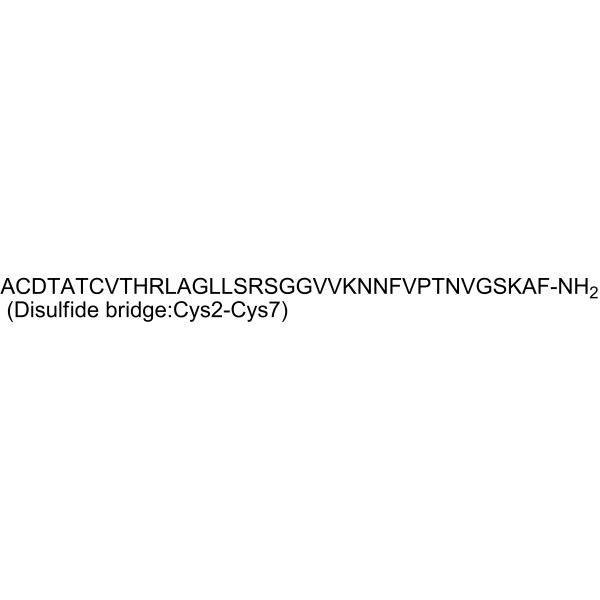
HY-P1071
α-CGRP (human) -
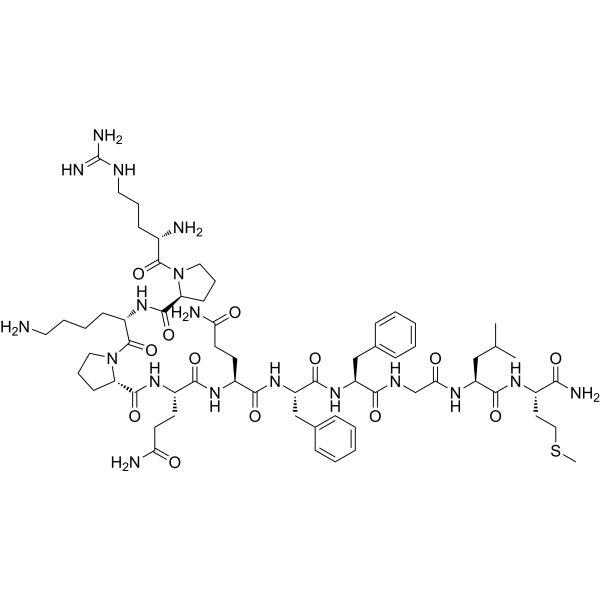
HY-P0201
Substance P -
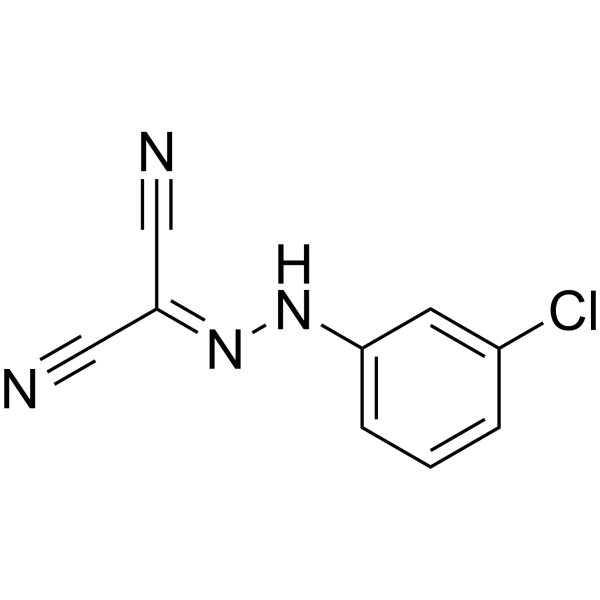
HY-100941
CCCP -

HY-P0012
Aviptadil -
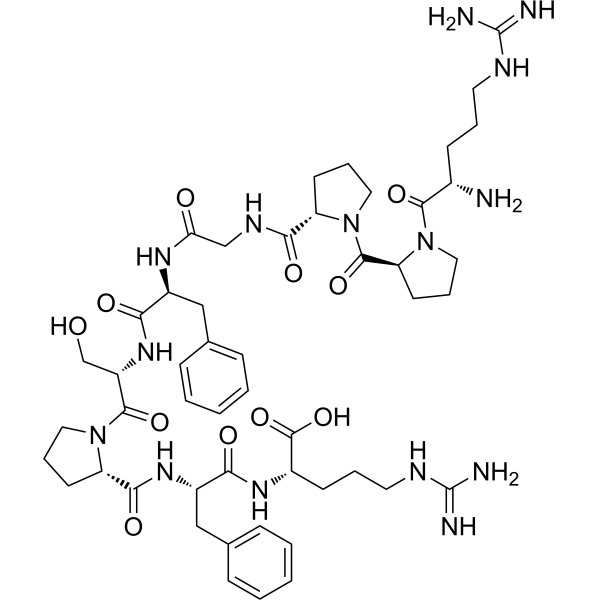
HY-P0206
Bradykinin -
HY-17446
Icatibant -

HY-P0221C
PACAP (1-38) free acid -

HY-K1090
Cytotoxicity LDH Assay Kit -
HY-Y0703D
Sodium carboxymethyl cellulose (average Mw 90000) -

HY-P0220A
PACAP (6-38), human, ovine, rat TFA
Publications Citing Use of MedChemExpress (MCE) PACAP (1-27), human, ovine, rat
MoreAll PACAP Receptor Isoforms
More

Biological Activity
Description
IC50 & Target
IC50: 3 nM (rat PAC1), 2 nM (rat VPAC1), 5 nM (human VPAC2)[1]
In Vitro
Radioligand receptor binding assays with I-monoiodinated PACAP (1-27), human, ovine, rat confirms the presence of PAC -receptors on AR4-2J cells, since PACAP (1-27), human, ovine, rat and PACAP(1–38) equipotently displaces radioligand binding with a Kd of 1-2 nM, whereas vasoactive intestinal peptide (VIP) is 1000-fold less potent. PACAP (1-27), human, ovine, rat exhibits a distinct and much higher susceptibility to VIP-amino acid substitutions. PACAP (1-27), human, ovine, rat has potency and binding affinity to stimulate IP3 and cAMP formation in AR4-2J cells[2].
MedChemExpress (MCE) has not independently confirmed the accuracy of these methods. They are for reference only.
In Vivo
MedChemExpress (MCE) has not independently confirmed the accuracy of these methods. They are for reference only.


Chemical Information
-
CAS No. 127317-03-7
-
Appearance Solid
-
Molecular Weight 3147.66
-
Formula C142H224N40O39S
-
Color White to off-white
-
Synonyms
PACAP 1-27
-
Sequence
His-Ser-Asp-Gly-Ile-Phe-Thr-Asp-Ser-Tyr-Ser-Arg-Tyr-Arg-Lys-Gln-Met-Ala-Val-Lys-Lys-Tyr-Leu-Ala-Ala-Val-Leu-NH2
-
Sequence Shortening
HSDGIFTDSYSRYRKQMAVKKYLAAVL-NH2
-
Shipping
Room temperature in continental US; may vary elsewhere.
-
Storage
Sealed storage, away from moisture
Powder -80°C 2 years -20°C 1 year * In solvent : -80°C, 6 months; -20°C, 1 month (sealed storage, away from moisture)


Publications (4)
-
Journal Impact Factor
-
Most Recent
-
Nature
2024 Mar;627(8002):149-156. PMID: 38418876 -
Cell Metab
Cancer cells co-opt nociceptive nerves to thrive in nutrient-poor environments and upon nutrient-starvation therapies. [Abstract]2022 Dec 6;34(12):1999-2017.e10. PMID: 36395769 -
-
Arch Biochem Biophys
PACAP/PAC1R activation promotes group 2 innate lymphoid cells-dependent allergic rhinitis via ERK pathway. [Abstract]2025 Oct:772:110564. PMID: 40713003


Solvent & Solubility
In Vitro:
DMSO : 100 mg/mL (31.77 mM; Need ultrasonic; Hygroscopic DMSO has a significant impact on the solubility of product, please use newly opened DMSO)
H2O : ≥ 50 mg/mL (15.88 mM)
* "≥" means soluble, but saturation unknown.
Please refer to the solubility information to select the appropriate solvent. Once prepared, please aliquot and store the solution to prevent product inactivation from repeated freeze-thaw cycles.
Storage method and period of stock solution: -80°C, 6 months; -20°C, 1 month (sealed storage, away from moisture). When stored at -80°C, please use it within 6 months. When stored at -20°C, please use it within 1 month.
* Note: If you choose water as the stock solution, please dilute it to the working solution, then filter and sterilize it with a 0.22 μm filter before use.
Please refer to the solubility information to select the appropriate solvent. Once prepared, please aliquot and store the solution to prevent product inactivation from repeated freeze-thaw cycles.
Storage method and period of stock solution: -80°C, 6 months; -20°C, 1 month (sealed storage, away from moisture). When stored at -80°C, please use it within 6 months. When stored at -20°C, please use it within 1 month.
* Note: If you choose water as the stock solution, please dilute it to the working solution, then filter and sterilize it with a 0.22 μm filter before use.
Concentration (start) × Volume (start) = Concentration (final) × Volume (final)

Protocol
Guinea-pigs[3]
PACAP-27 (0.045 to 4.5 nmol/kg/min), salbutamol (0.045 to 4.5 nmol/kg/min) or sterile saline is given i.v. (1.0 mL) via an infusion pump, starting 5 min before and continuing 10 min after airway challenge[3].
Dogs[4]
Four dogs (28.4±1.8 kg) receive PACAP (1-27) with four different concentrations of 0.01, 0.1, 1.0 and 10 µg/mL, or 0.00318, 0.0318, 0.318 and 3.18 µM, respectively. Each solution is locally infused at a rate of 0.5 mL/min for precisely 1 min. A total dose delivered to the pancreas during each infusion is therefore 0.005, 0.05, 0.5 and 5 µg. The dead volume of the pancreatic arterial catheter (0.5 mL) is taken into account in relation to the infusion rate. After taking the initial control sample, simultaneously from the SPD vein and the aorta, saline is infused for 1 min and samples are obtained 1, 3 and 5 min after the onset of infusion. This procedure is repeated every 15 min for the doses of PACAP (1-27). The sample obtained at 15 min after the onset of each infusion served as control for the subsequent intervention[4].
MedChemExpress (MCE) has not independently confirmed the accuracy of these methods. They are for reference only.


Purity & Documentation
-
Data Sheet (275 KB)
-
SDS (393 KB)
- English - EN (393 KB)
- Français - FR (393 KB)
- Deutsch - DE (393 KB)
- Norwegian - NO (393 KB)
- Español - ES (393 KB)
- Swedish - SV (393 KB)
- Italian - IT (393 KB)
- Korean - KR (393 KB)
- Portuguese - PT (393 KB)
-
Handling Instructions (2659 KB)
References
[1]. Gourlet P, et al. Fragments of pituitary adenylate cyclase activating polypeptide discriminate between type I and II recombinant receptors. Eur J Pharmacol. 1995 Dec 4;287(1):7-11. [Content Brief]
[2]. Schäfer H, et al. Structural motifs of pituitary adenylate cyclase-activating polypeptide (PACAP) defining PAC1-receptor selectivity. Regul Pept. 1999 Feb 5;79(2-3):83-92. [Content Brief]
[3]. Lindén A, et al. Inhibition of bronchoconstriction by pituitary adenylate cyclase activating polypeptide (PACAP 1-27) in guinea-pigs in vivo. Br J Pharmacol. 1995 Jul;115(6):913-6. [Content Brief]


Complete Stock Solution Preparation Table
Please refer to the solubility information to select the appropriate solvent. Once prepared, please aliquot and store the solution to prevent product inactivation from repeated freeze-thaw cycles.
Storage method and period of stock solution: -80°C, 6 months; -20°C, 1 month (sealed storage, away from moisture). When stored at -80°C, please use it within 6 months. When stored at -20°C, please use it within 1 month.
| Optional Solvent | Concentration Solvent Mass | 1 mg | 5 mg | 10 mg | 25 mg |
|---|---|---|---|---|---|
| H2O / DMSO | 1 mM | 0.3177 mL | 1.5885 mL | 3.1770 mL | 7.9424 mL |
| 5 mM | 0.0635 mL | 0.3177 mL | 0.6354 mL | 1.5885 mL | |
| 10 mM | 0.0318 mL | 0.1588 mL | 0.3177 mL | 0.7942 mL | |
| 15 mM | 0.0212 mL | 0.1059 mL | 0.2118 mL | 0.5295 mL | |
| DMSO | 20 mM | 0.0159 mL | 0.0794 mL | 0.1588 mL | 0.3971 mL |
| 25 mM | 0.0127 mL | 0.0635 mL | 0.1271 mL | 0.3177 mL | |
| 30 mM | 0.0106 mL | 0.0529 mL | 0.1059 mL | 0.2647 mL |
* Note: If you choose water as the stock solution, please dilute it to the working solution, then filter and sterilize it with a 0.22 μm filter before use.


PACAP (1-27), human, ovine, rat Related Classifications
HY-P0176 Related Classifications
 Powered by Bioz