



APOC3 Protein, Human (His-SUMO)

Based on 1 Customer Validation
APOC3 protein is found in VLDL and HDL and plays a crucial role in triglyceride homeostasis. Intracellularly, it facilitates VLDL1 assembly and secretion and assists in lipid transport. APOC3 Protein, Human (His-SUMO) is the recombinant human-derived APOC3 protein, expressed by E. coli , with N-6*His, N-SUMO labeled tag.
- Species: Human
- Source: E. coli
-
Storage:Stored at -20°C for 2 years from date of receipt. After reconstitution, it is stable at 4°C for 1 week or -20°C for longer (with carrier protein). It is recommended to freeze aliquots at -20°C or -80°C for extended storage.


To place orders, for customer services and technical support, please contact: MedChemExpress USA
Tel: 609-228-6898 E-mail: [email protected] [email protected]


-
 Biological Activity
-
Technical Parameters
-
Product Properties
- Documentation
- Help & FAQs




Biological Activity
Description
APOC3 protein is found in VLDL and HDL and plays a crucial role in triglyceride homeostasis. Intracellularly, it facilitates VLDL1 assembly and secretion and assists in lipid transport. APOC3 Protein, Human (His-SUMO) is the recombinant human-derived APOC3 protein, expressed by E. coli , with N-6*His, N-SUMO labeled tag.
Background
APOC3 protein, a constituent of both triglyceride-rich very low-density lipoproteins (VLDL) and high-density lipoproteins (HDL) in plasma, plays a multifaceted role in triglyceride homeostasis. Intracellularly, it facilitates the assembly and secretion of hepatic very low-density lipoprotein 1 (VLDL1), contributing to lipid transport. Extracellularly, APOC3 serves to modulate the hydrolysis and clearance of triglyceride-rich lipoproteins (TRLs). This functionality involves inhibiting lipoprotein lipase and impeding the hepatic uptake of TRLs through remnant receptors. Structurally, APOC3 is characterized by several curved helices connected via semiflexible hinges, allowing it to tightly wrap around the curved micelle surface and adapt to the varying diameters of its natural binding partners. This structural flexibility underscores its versatile involvement in lipid metabolism and transport processes.
Verified Bioactivity
Immobilized Human APOC3 at 2 μg/mL (100 μL/Well) on the plate can bind Anti-APOC3 Antibody. The ED50 for this effect is <50 ng/mL.
MCE Validation Data
-
Purity - SDS-PAGE
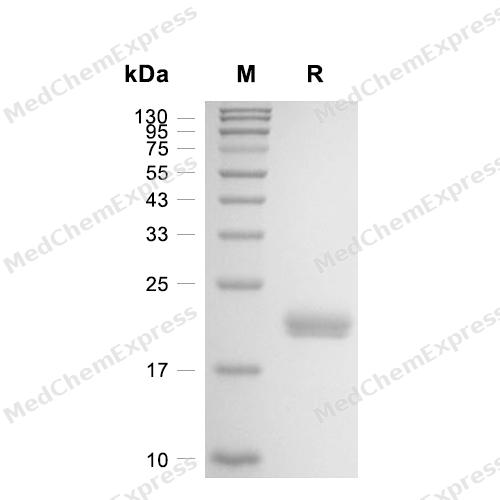
Purity - SDS-PAGE
-
Bioactivity - ELISA
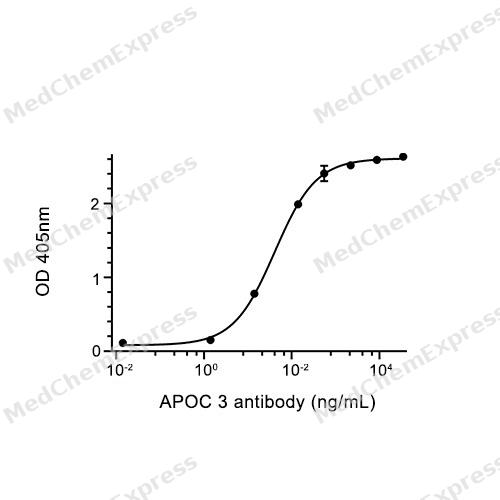
Bioactivity - ELISA


Technical Parameters
-
Species Human
-
Source E. coli
-
Tag N-6*His;N-SUMO
-
Accession
P02656 (S21-A99)
-
Molecular Construction
-
N-term
-
6*His-SUMO
-
APOC3 (S21-A99)
Accession # P02656 -
C-term
-
-
Protein Length
Full Length of Mature Protein
-
Synonyms
APOC3; ApoC-III; Apolipoprotein C3; APOCIII; Apolipoprotein C-III; Apo-C3; Apo-CIII; ApoC-3
-
AA Sequence
SEAEDASLLSFMQGYMKHATKTAKDALSSVQESQVAQQARGWVTDGFSSLKDYWSTVKDKFSEFWDLDPEVRPTSAVAA
-
Molecular Weight
Approximately 22-25 kDa, based on SDS-PAGE under reducing conditions.
-
Purity
≥ 90%, as determined by reducing SDS-PAGE.


Product Properties
Lyophilized powder
1.Lyophilized from a 0.22 μm filtered solution of 20 mM Tris-HCl, 0.5 M NaCl, 6% trehalose, pH 8.0.
2.Lyophilized from a 0.22 μm filtered solution of PBS, 6% trehalose.
3.Lyophilized from a 0.22 μm filtered solution of PBS, pH 7.4, 6% trehalose.
Please refer to the lot-specific COA for specific buffer information.
Note: For SPR assay, please replace the buffer. Primary amine components (e.g., Tris, imidazole) can affect protein-coupled chips.
<1 EU/μg, determined by LAL method.
It is not recommended to reconstitute to a concentration less than 100 μg/mL in ddH2O.
Stored at -20°C for 2 years from date of receipt. After reconstitution, it is stable at 4°C for 1 week or -20°C for longer (with carrier protein). It is recommended to freeze aliquots at -20°C or -80°C for extended storage.
Room temperature in continental US; may vary elsewhere.


Documentation
-
Data Sheet (236 KB)
-
SDS (252 KB)
- English - EN (252 KB)
- Français - FR (252 KB)
- Deutsch - DE (252 KB)
- Norwegian - NO (252 KB)
- Español - ES (252 KB)
- Swedish - SV (252 KB)
- Italian - IT (252 KB)
- Korean - KR (252 KB)
- Portuguese - PT (252 KB)
-
Handling Instructions (2659 KB)

Calculators
Concentration (start) × Volume (start) = Concentration (final) × Volume (final)


 Powered by Bioz

