



B2M/Beta-2-microglobulin Protein, Human (His)

Based on 1 Customer Validation
B2M/Beta-2-microglobulin Protein is a secreted protein found on the outside of the cell membrane. B2M/Beta-2-microglobulin Protein is a crucial component of MHC class I molecules, essential for presenting tumor antigens to T cells. B2M/Beta-2-microglobulin Protein is a systemic pro-aging factor that can impair cognitive function and neurogenesis. B2M/Beta-2-microglobulin Protein, Human (His) is a recombinant human Beta-2-microglobulin protein with a His tag, expressed in E. coli.
- Species: Human
- Source: E. coli
-
Storage:Stored at -20°C for 2 years from date of receipt. After reconstitution, it is stable at 4°C for 1 week or -20°C for longer (with carrier protein). It is recommended to freeze aliquots at -20°C or -80°C for extended storage.


To place orders, for customer services and technical support, please contact: MedChemExpress USA
Tel: 609-228-6898 E-mail: [email protected] [email protected]


-
 Biological Activity
-
Technical Parameters
-
Product Properties
- Documentation
- References
- Help & FAQs


-
HY-10219
RapamycinmTOR Inhibitor -

HY-P73243
Insulin Protein, Human (P.pastoris) -
HY-P7525
Apolipoprotein A-I/APOA1 Protein, Human (HEK293, His) -
HY-P701094
Apolipoprotein E/APOE2 Protein, Human (R154S, R176C, HEK293, C-His) -
HY-P74403
B2M/Beta-2 microglobulin Protein, Mouse (HEK293, His) -
HY-P700292
Prolactin Protein, Human -
HY-P78542A
Apolipoprotein E/APOE4 Protein, Human (C130R, HEK293, Fc)


Biological Activity
Description
B2M/Beta-2-microglobulin Protein is a secreted protein found on the outside of the cell membrane. B2M/Beta-2-microglobulin Protein is a crucial component of MHC class I molecules, essential for presenting tumor antigens to T cells. B2M/Beta-2-microglobulin Protein is a systemic pro-aging factor that can impair cognitive function and neurogenesis. B2M/Beta-2-microglobulin Protein, Human (His) is a recombinant human Beta-2-microglobulin protein with a His tag, expressed in E. coli[1][2].
Background
B2M/Beta-2-microglobulin Protein is a low molecular weight protein that shares sequence homology with immunoglobulins. It is found in almost all nucleated cells and most body fluids, including serum, urine, and synovial fluid[2]. B2M/Beta-2-microglobulin Protein shows about 70% amino acid sequence similarity with mouse protein, and both are located on homologous chromosomes. The secondary structure of this protein consists of seven β chains, which are connected by a single disulfide bond to form two β sheets, displaying the classic β sandwich structure typical of immunoglobulin domains[3]. B2M/Beta-2-microglobulin Protein is expressed at a constant level in many cells and can induce the expression of IL-6, IL-8, and IL-10 in various cell types, regulate the expression of hormones/growth factors, and coordinate interactions between cytokines and their receptors[2]. B2M/Beta-2-microglobulin Protein can interact with MHC I or similar molecules to stabilize their tertiary structure, and it plays a significant role in regulating functions related to the survival, proliferation, apoptosis, and even metastasis of cancer cells[2]. B2M/Beta-2-microglobulin Protein is closely related to diseases such as acute and chronic inflammation, liver/kidney dysfunction, viral infections, and tumors[2].
In Vitro
The expression of B2M/Beta-2-microglobulin Protein in B2M gene-transfected melanoma cells FO-1 can induce the expression of HLA class I antigens, which leads to a decreased sensitivity of tumor cells to lysis mediated by natural killer cells[4]. Targeting the destruction of the B2M/Beta-2-microglobulin gene can reduce the immunogenicity of human embryonic stem cells[5].
In Vivo
In B2M gene knockout mice, the lack of B2M/Beta-2-microglobulin Protein expression leads to decreased mating frequency and impaired reproductive phenotype[1]. In mice with functional inactivation of the B2M gene, the lack of B2M/Beta-2-microglobulin protein expression leads to resistance against diabetes and pancreatitis[2]. B2M/Beta-2-microglobulin Protein (100 μg/kg; 5 times within 12 days; intraorbital injections) can impair the learning and memory abilities of young mice[1].
Verified Bioactivity
Immobilized Human B2M at 2 μg/mL (100 μL/well) can bind Anti-B2M antibody. The ED50 for this effect is 0.5-1.0 μg/mL.
MCE Validation Data
-
Purity - SDS-PAGE
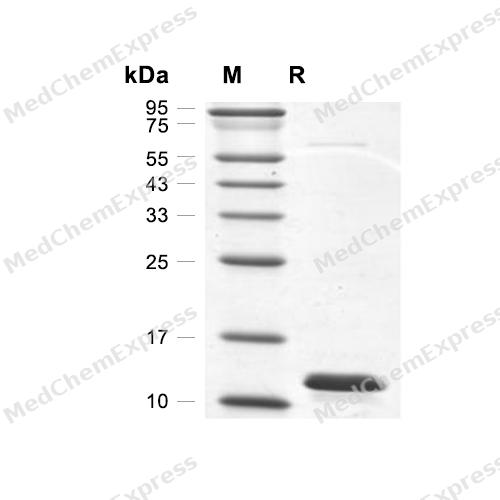
Purity - SDS-PAGE
-
Bioactivity - ELISA
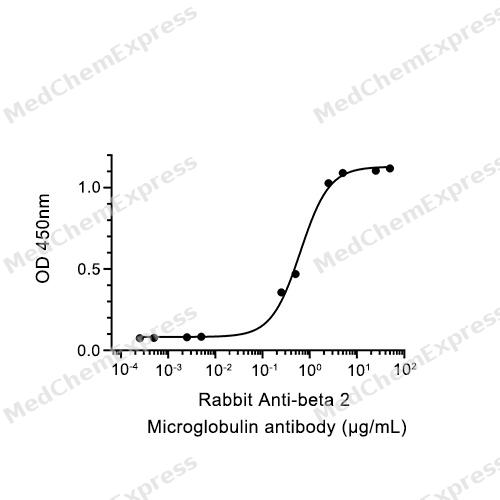
Bioactivity - ELISA


Technical Parameters
-
Species Human
-
Source E. coli
-
Tag N-6*His
-
Accession
P61769 (I21-M119)
-
Molecular Construction
-
N-term
-
6*His
-
B2M (I21-M119)
Accession # P61769 -
C-term
-
-
Protein Length
Full Length of Mature Protein
-
Synonyms
B2M; Beta 2-Microglobulin; Beta-2-Microglobulin; Beta-2-Microglobin; Beta Chain Of MHC Class I Molecules; AMYLD6; Beta 2-Microglobulin Protein; MHC1D4; Human Nkt Tcr Alpha Chain; IMD43; Human Nkt Tcr Beta Chain
-
AA Sequence
IQRTPKIQVYSRHPAENGKSNFLNCYVSGFHPSDIEVDLLKNGERIEKVEHSDLSFSKDWSFYLLYYTEFTPTEKDEYACRVNHVTLSQPKIVKWDRDM
-
Molecular Weight
Approximately 14 kDa, based on SDS-PAGE under reducing conditions.
-
Purity
≥ 95%, as determined by reducing SDS-PAGE.


Product Properties
Lyophilized powder
1.Lyophilized from a 0.22 μm filtered solution of PBS, pH 7.4.
2.Lyophilized from a 0.22 μm filtered solution of PBS, 300 mM NaCl, pH 7.4.
3.Lyophilized from a 0.22 μm filtered solution of 20 mM PB, 300 mM NaCl, 10% trehalose, 0.02% Tween 80, pH 7.4.
4.Lyophilized from a 0.22 μm filtered solution of PBS, pH 7.4, 8% trehalose.
Please refer to the lot-specific COA for specific buffer information.
<1 EU/μg, determined by LAL method.
It is not recommended to reconstitute to a concentration less than 100 μg/mL in ddH2O. For long term storage it is recommended to add a carrier protein (0.1% BSA, 5% HSA, 10% FBS or 5% Trehalose).
Stored at -20°C for 2 years from date of receipt. After reconstitution, it is stable at 4°C for 1 week or -20°C for longer (with carrier protein). It is recommended to freeze aliquots at -20°C or -80°C for extended storage.
Room temperature in continental US; may vary elsewhere.


Documentation
-
Data Sheet (264 KB)
-
SDS (252 KB)
- English - EN (252 KB)
- Français - FR (252 KB)
- Deutsch - DE (252 KB)
- Norwegian - NO (252 KB)
- Español - ES (252 KB)
- Swedish - SV (252 KB)
- Italian - IT (252 KB)
- Korean - KR (252 KB)
- Portuguese - PT (252 KB)
-
Handling Instructions (2659 KB)


References
[1]. Smith LK, et al. β2-microglobulin is a systemic pro-aging factor that impairs cognitive function and neurogenesis. Nat Med. 2015 Aug;21(8):932-7. [Content Brief]
[2]. Li L, et al. The Implication and Significance of Beta 2 Microglobulin: A Conservative Multifunctional Regulator. Chin Med J (Engl). 2016 Feb 20;129(4):448-55. [Content Brief]
[3]. Saper MA, et al. Refined structure of the human histocompatibility antigen HLA-A2 at 2.6 A resolution. J Mol Biol. 1991 May 20;219(2):277-319. [Content Brief]
[4]. Maio M, et al. Reduction in susceptibility to natural killer cell-mediated lysis of human FO-1 melanoma cells after induction of HLA class I antigen expression by transfection with B2m gene. J Clin Invest. 1991 Jul;88(1):282-9. [Content Brief]
[5]. Wang D, et al. Targeted Disruption of the β2-Microglobulin Gene Minimizes the Immunogenicity of Human Embryonic Stem Cells. Stem Cells Transl Med. 2015 Oct;4(10):1234-45. [Content Brief]
[6]. Cooper JC, et al. An impaired breeding phenotype in mice with a genetic deletion of beta-2 microglobulin and diminished MHC class I expression: role in reproductive fitness. Biol Reprod. 2007 Aug;77(2):274-9. [Content Brief]
[7]. Serreze DV, et al. Major histocompatibility complex class I-deficient NOD-B2mnull mice are diabetes and insulitis resistant. Diabetes. 1994 Mar;43(3):505-9. [Content Brief]

Calculators
Concentration (start) × Volume (start) = Concentration (final) × Volume (final)


 Powered by Bioz

