



B2M/Beta-2 microglobulin Protein, Rat (HEK293, His)

Based on 1 Customer Validation
B2M or Beta-2 microglobulin binds to MHC class II protein complexes and forms homodimers. It responds to cadmium ions and exogenous stimuli and is present in the extracellular space. B2M/Beta-2 microglobulin Protein, Rat (HEK293, His) is the recombinant rat-derived B2M/Beta-2 microglobulin protein, expressed by HEK293 , with C-His labeled tag.
- Species: Rat
- Source: HEK293
-
Storage:Stored at -20°C for 2 years from date of receipt. After reconstitution, it is stable at 4°C for 1 week or -20°C for longer (with carrier protein). It is recommended to freeze aliquots at -20°C or -80°C for extended storage.


To place orders, for customer services and technical support, please contact: MedChemExpress USA
Tel: 609-228-6898 E-mail: [email protected] [email protected]


-
 Biological Activity
-
Technical Parameters
-
Product Properties
- Documentation
- Help & FAQs




Biological Activity
Description
B2M or Beta-2 microglobulin binds to MHC class II protein complexes and forms homodimers. It responds to cadmium ions and exogenous stimuli and is present in the extracellular space. B2M/Beta-2 microglobulin Protein, Rat (HEK293, His) is the recombinant rat-derived B2M/Beta-2 microglobulin protein, expressed by HEK293 , with C-His labeled tag.
Background
B2M, or Beta-2 microglobulin, is predicted to possess MHC class II protein complex binding activity and protein homodimerization activity. It plays a role in the response to cadmium ion and xenobiotic stimulus, and it is located in the extracellular space. B2M serves as a biomarker for conditions such as acute kidney failure, pyelonephritis, and ureteral obstruction. The human ortholog(s) of this gene have been implicated in various health conditions, including arthritis, familial visceral amyloidosis, immunodeficiency 43, and inflammatory bowel disease. B2M exhibits biased expression in tissues such as the spleen, lung, and nine other tissues, suggesting its involvement in diverse physiological processes.
Verified Bioactivity
Measured in a cell proliferation assay using U251 cells. ED50 this effect is ≤60 ng/mL, corresponding to a specific activity is 16666.667 units/mg.
MCE Validation Data
-
Purity - SDS-PAGE
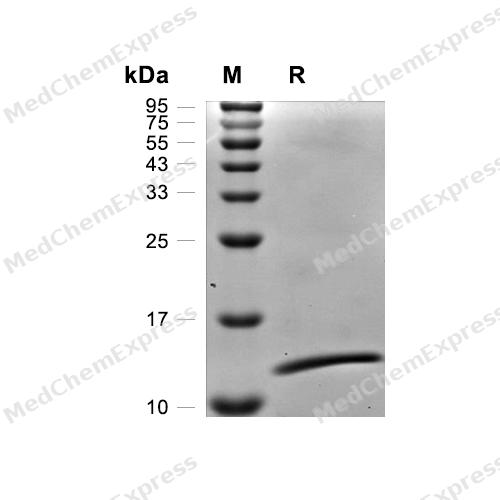
Purity - SDS-PAGE
-
Bioactivity - Cell-Based Assay
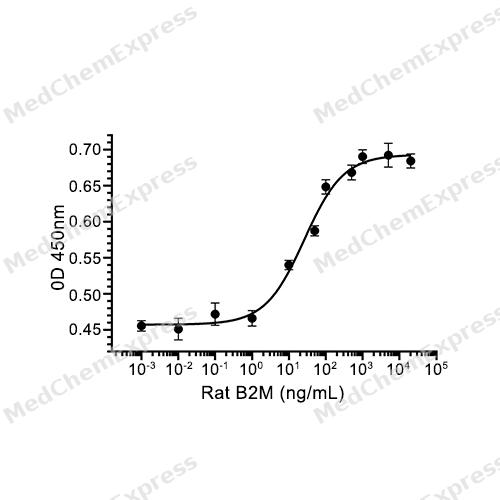
Bioactivity - Cell-Based Assay


Technical Parameters
-
Species Rat
-
Source HEK293
-
Tag C-His
-
Accession
NP_036644 (I21-M119)
-
Molecular Construction
-
N-term
-
B2M/Beta-2 microglobulin (I21-M119)
Accession # NP_036644 -
His
-
C-term
-
-
Protein Length
Full Length of Mature Protein
-
Synonyms
B2M; Beta 2-Microglobulin; Beta-2-Microglobulin; Beta-2-Microglobin; Beta Chain Of MHC Class I Molecules; AMYLD6; Beta 2-Microglobulin Protein; MHC1D4; Human Nkt Tcr Alpha Chain; IMD43; Human Nkt Tcr Beta Chain
-
AA Sequence
IQKTPQIQVYSRHPPENGKPNFLNCYVSQFHPPQIEIELLKNGKKIPNIEMSDLSFSKDWSFYILAHTEFTPTETDVYACRVKHVTLKEPKTVTWDRDM
-
Predicted Molecular Mass
11.6 kDa
-
Molecular Weight
Approximately 13 kDa, based on SDS-PAGE under reducing conditions.
-
Purity
≥ 95%, as determined by reducing SDS-PAGE.


Product Properties
Lyophilized powder.
Lyophilized from a 0.22 μm filtered solution of PBS, pH 7.4.
<1 EU/μg, determined by LAL method.
It is not recommended to reconstitute to a concentration less than 100 μg/mL in ddH2O. For long term storage it is recommended to add a carrier protein (0.1% BSA, 5% HSA, 10% FBS or 5% Trehalose).
Stored at -20°C for 2 years from date of receipt. After reconstitution, it is stable at 4°C for 1 week or -20°C for longer (with carrier protein). It is recommended to freeze aliquots at -20°C or -80°C for extended storage.
Room temperature in continental US; may vary elsewhere.


Documentation
-
Data Sheet (236 KB)
-
SDS (252 KB)
- English - EN (252 KB)
- Français - FR (252 KB)
- Deutsch - DE (252 KB)
- Norwegian - NO (252 KB)
- Español - ES (252 KB)
- Swedish - SV (252 KB)
- Italian - IT (252 KB)
- Korean - KR (252 KB)
- Portuguese - PT (252 KB)
-
Handling Instructions (2659 KB)

Calculators
Concentration (start) × Volume (start) = Concentration (final) × Volume (final)


 Powered by Bioz

