



Basigin/CD147 Protein, Human (HEK293, His)

Based on 1 Customer Validation
Basigin/BSG proteins are critical for retinal maturation and development and function as retinal cell receptors for NXNL1, promoting the survival of retinal cone photoreceptors. Basigin/CD147 Protein, Human (HEK293, His) is the recombinant human-derived Basigin/CD147 protein, expressed by HEK293 , with C-6*His labeled tag.
- Species: Human
- Source: HEK293
-
Storage:Stored at -20°C for 2 years from date of receipt. After reconstitution, it is stable at 4°C for 1 week or -20°C for longer (with carrier protein). It is recommended to freeze aliquots at -20°C or -80°C for extended storage.


To place orders, for customer services and technical support, please contact: MedChemExpress USA
Tel: 609-228-6898 E-mail: [email protected] [email protected]


-
 Biological Activity
-
Technical Parameters
-
Product Properties
- Documentation
- Help & FAQs




Biological Activity
Description
Basigin/BSG proteins are critical for retinal maturation and development and function as retinal cell receptors for NXNL1, promoting the survival of retinal cone photoreceptors. Basigin/CD147 Protein, Human (HEK293, His) is the recombinant human-derived Basigin/CD147 protein, expressed by HEK293 , with C-6*His labeled tag.
Background
Basigin/BSG protein is essential for the normal maturation and development of the retina, functioning as a critical cell surface receptor for NXNL1 and playing a pivotal role in NXNL1-mediated survival of retinal cone photoreceptors. Collaborating with glucose transporter SLC16A1/GLUT1 and NXNL1, Basigin/BSG promotes the survival of retinal cones by facilitating aerobic glycolysis and accelerating glucose entry into photoreceptors. Additionally, it serves as a potent inducer of IL6 secretion in various cell lines, including monocytes. In the context of microbial infection, Basigin/BSG acts as an erythrocyte receptor for P. falciparum RH5, playing an indispensable role in erythrocyte invasion by the merozoite stage of P. falciparum isolates 3D7 and Dd2. These diverse functions highlight the multifaceted roles of Basigin/BSG in cellular processes and host-pathogen interactions.
Verified Bioactivity
Measured by its binding ability in a functional ELISA. Immobilized SARS-COV-2 S RBD (HY-P7431) at 1 μg/mL (100 μL/well) on the plate can bind Biotinylated Human CD147. The ED50 for this effect is 6.982 μg/mL.
MCE Validation Data
-
Purity - SDS-PAGE
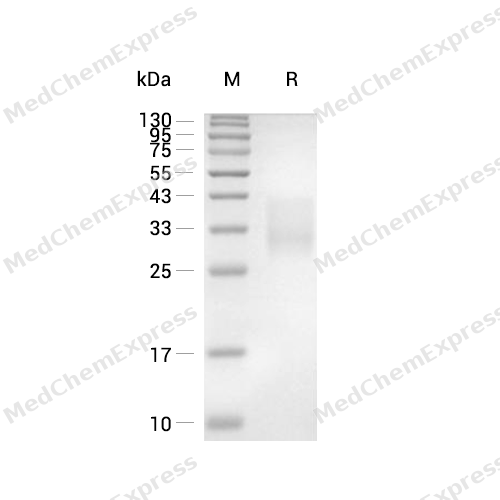
Purity - SDS-PAGE
-
Bioactivity - ELISA
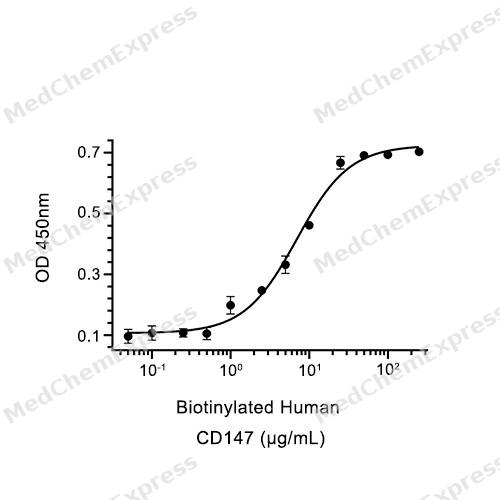
Bioactivity - ELISA


Technical Parameters
-
Species Human
-
Source HEK293
-
Tag C-6*His
-
Accession
P35613-2 (A22-H205)
-
Molecular Construction
-
N-term
-
Basigin (A22-H205)
Accession # P35613-2 -
6*His
-
C-term
-
-
Protein Length
Partial Extracellular Domain
-
Synonyms
BSG; Leukocyte Activation Antigen M6; Prev. OK; Hepatoma-Associated Antigen; EMMPRIN; OK Blood Group Antigen; Basigin; HAb18G; Tumor Cell-Derived Collagenase Stimulatory Factor; TCSF; Extracellular Matrix Metalloproteinase Inducer; 5F7; EMPRIN; Ok Blood G
-
AA Sequence
AAGTVFTTVEDLGSKILLTCSLNDSATEVTGHRWLKGGVVLKEDALPGQKTEFKVDSDDQWGEYSCVFLPEPMGTANIQLHGPPRVKAVKSSEHINEGETAMLVCKSESVPPVTDWAWYKITDSEDKALMNGSESRFFVSSSQGRSELHIENLNMEADPGQYRCNGTSSKGSDQAIITLRVRSH
-
Predicted Molecular Mass
21.2 kDa
-
Molecular Weight
Approximately 26-40 kDa, based on SDS-PAGE under reducing conditions, due to the glycosylation.
-
Glycosylation
Yes
-
Purity
≥ 95%, as determined by reducing SDS-PAGE.


Product Properties
Lyophilized powder.
Lyophilized from a 0.2 μm filtered solution of 20 mM PB, 150 mM NaCl, pH 7.2.
<1 EU/μg, determined by LAL method.
It is not recommended to reconstitute to a concentration less than 100 μg/mL in ddH2O. For long term storage it is recommended to add a carrier protein (0.1% BSA, 5% HSA, 10% FBS or 5% Trehalose).
Stored at -20°C for 2 years from date of receipt. After reconstitution, it is stable at 4°C for 1 week or -20°C for longer (with carrier protein). It is recommended to freeze aliquots at -20°C or -80°C for extended storage.
Room temperature in continental US; may vary elsewhere.


Documentation
-
Data Sheet (237 KB)
-
SDS (252 KB)
- English - EN (252 KB)
- Français - FR (252 KB)
- Deutsch - DE (252 KB)
- Norwegian - NO (252 KB)
- Español - ES (252 KB)
- Swedish - SV (252 KB)
- Italian - IT (252 KB)
- Korean - KR (252 KB)
- Portuguese - PT (252 KB)
-
Handling Instructions (2659 KB)

Calculators
Concentration (start) × Volume (start) = Concentration (final) × Volume (final)


 Powered by Bioz

