



Cardiotrophin-1/CTF1 Protein, Human (CHO)
Based on 1 Customer Validation
Cardiotrophin-1/CTF1 Protein, Human (CHO), a member of IL-6 family of cytokines, is a key regulator of energy homeostasis and of glucose and lipid metabolism.
- Species: Human
- Source: CHO
-
Storage:Stored at -20°C for 2 years from date of receipt. After reconstitution, it is stable at 4°C for 1 week or -20°C for longer (with carrier protein). It is recommended to freeze aliquots at -20°C or -80°C for extended storage.


To place orders, for customer services and technical support, please contact: MedChemExpress USA
Tel: 609-228-6898 E-mail: [email protected] [email protected]


-
 Biological Activity
-
Technical Parameters
-
Product Properties
- Documentation
- References
- Help & FAQs




Biological Activity
Description
Cardiotrophin-1/CTF1 Protein, Human (CHO), a member of IL-6 family of cytokines, is a key regulator of energy homeostasis and of glucose and lipid metabolism.
Background
Cardiotrophin (CT)-1 belongs to the IL-6 family of cytokines[1]. Cardiotrophin-1 (CT1) plays an important role in the differentiation, development, and survival of neural stem cells. CT1 plays a key role in neural tissue development and has survival-promoting, anti-apoptotic effects in neural injury or death. CT1 induces a phenotypic switch in sympathetic neurons and promotes the survival of dopaminergic neurons from the central nervous system and ciliary neurons from the periphery[2].
Verified Bioactivity
The ED50 is <0.4 ng/mL as measured by TF-1 cells.
MCE Validation Data
-
Purity - SDS-PAGE
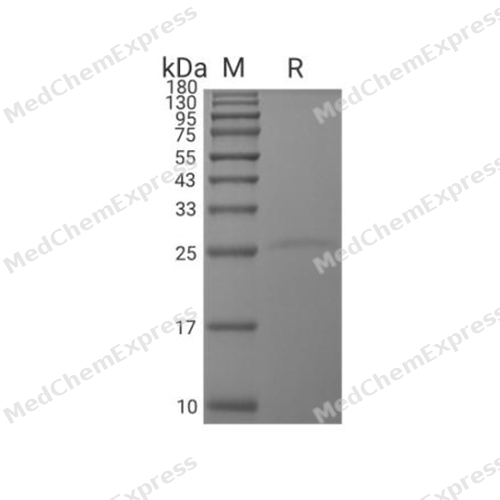
Purity - SDS-PAGE


Technical Parameters
-
Species Human
-
Source CHO
-
Tag Tag Free
-
Accession
Q16619-1 (S2-A201)
-
Molecular Construction
-
N-term
-
CTF1 (S2-A201)
Accession # Q16619-1 -
C-term
-
-
Protein Length
Full Length of Isoform-1
-
Synonyms
CTF1; CT1; Cardiotrophin 1; Cardiotrophin-1; CT-1; Cardiophin 1
-
AA Sequence
SRREGSLEDPQTDSSVSLLPHLEAKIRQTHSLAHLLTKYAEQLLQEYVQLQGDPFGLPSFSPPRLPVAGLSAPAPSHAGLPVHERLRLDAAALAALPPLLDAVCRRQAELNPRAPRLLRRLEDAARQARALGAAVEALLAALGAANRGPRAEPPAATASAASATGVFPAKVLGLRVCGLYREWLSRTEGDLGQLLPGGSA
-
Molecular Weight
Approximately 24-26 kDa, based on SDS-PAGE under reducing conditions.
-
Purity
≥ 95%, as determined by reducing SDS-PAGE.


Product Properties
Lyophilized powder.
Lyophilized from a 0.22 μm filtered solution of PBS.
<0.2 EU/μg, determined by LAL method.
It is not recommended to reconstitute to a concentration less than 100 μg/mL in ddH2O. For long term storage it is recommended to add a carrier protein (0.1% BSA, 5% HSA, 10% FBS or 5% Trehalose).
Stored at -20°C for 2 years from date of receipt. After reconstitution, it is stable at 4°C for 1 week or -20°C for longer (with carrier protein). It is recommended to freeze aliquots at -20°C or -80°C for extended storage.
Room temperature in continental US; may vary elsewhere.


Documentation
-
Data Sheet (262 KB)
-
SDS (251 KB)
- English - EN (251 KB)
- Français - FR (251 KB)
- Deutsch - DE (251 KB)
- Norwegian - NO (251 KB)
- Español - ES (251 KB)
- Swedish - SV (251 KB)
- Italian - IT (251 KB)
- Korean - KR (251 KB)
- Portuguese - PT (251 KB)
-
Handling Instructions (2659 KB)


References
[1]. López-Yoldi M, et al. Role of cardiotrophin-1 in the regulation of metabolic circadian rhythms and adipose core clock genes in mice and characterization of 24-h circulating CT-1 profiles in normal-weight and overweight/obese subjects. FASEB J. 2017 Apr;31(4):1639-1649. [Content Brief]
[2]. Peng L, et al. Cardiotrophin-1 stimulates the neural differentiation of human umbilical cord blood-derived mesenchymal stem cells and survival of differentiated cells through PI3K/Akt-dependent signaling pathways. Cytotechnology. 2017 Dec;69(6):933-941. [Content Brief]

Calculators
Concentration (start) × Volume (start) = Concentration (final) × Volume (final)


 Powered by Bioz

