



CD38 Protein, Cynomolgus (HEK293, His)

Based on 1 Customer Validation
The CD38 protein plays multifaceted roles in cell signaling and is critical for the synthesis of cyclic ADP-ribose (cADPR) as a possible second messenger in glucose-induced insulin secretion. CD38 also promotes calcium mobilization through the synthesis of niacin adenine dinucleotide phosphate (NAADP+) and exhibits cADPR hydrolase activity. CD38 Protein, Cynomolgus (HEK293, His) is the recombinant cynomolgus-derived CD38 protein, expressed by HEK293 , with C-6*His labeled tag.
- Species: Cynomolgus
- Source: HEK293
-
Storage:Stored at -20°C for 2 years from date of receipt. After reconstitution, it is stable at 4°C for 1 week or -20°C for longer (with carrier protein). It is recommended to freeze aliquots at -20°C or -80°C for extended storage.


To place orders, for customer services and technical support, please contact: MedChemExpress USA
Tel: 609-228-6898 E-mail: [email protected] [email protected]


-
 Biological Activity
-
Technical Parameters
-
Product Properties
- Documentation
- Help & FAQs




Biological Activity
Description
The CD38 protein plays multifaceted roles in cell signaling and is critical for the synthesis of cyclic ADP-ribose (cADPR) as a possible second messenger in glucose-induced insulin secretion. CD38 also promotes calcium mobilization through the synthesis of niacin adenine dinucleotide phosphate (NAADP+) and exhibits cADPR hydrolase activity. CD38 Protein, Cynomolgus (HEK293, His) is the recombinant cynomolgus-derived CD38 protein, expressed by HEK293 , with C-6*His labeled tag.
Background
The CD38 protein assumes a multifaceted role in cellular signaling, playing a pivotal part in the synthesis of cyclic ADP-ribose (cADPR), identified as a probable second messenger crucial for glucose-induced insulin secretion. Additionally, CD38 contributes to calcium mobilization by synthesizing nicotinate-adenine dinucleotide phosphate, NAADP(+), derived from 2'-phospho-cADPR and nicotinic acid, as well as from NADP(+) and nicotinic acid. Beyond its synthetic functions, CD38 exhibits cADPR hydrolase activity, suggesting its involvement in the dynamic regulation of these signaling molecules. This intricate repertoire of activities underscores the central role CD38 plays in mediating crucial cellular responses, particularly in the context of insulin secretion and calcium mobilization.
MCE Validation Data
-
Purity - SDS-PAGE
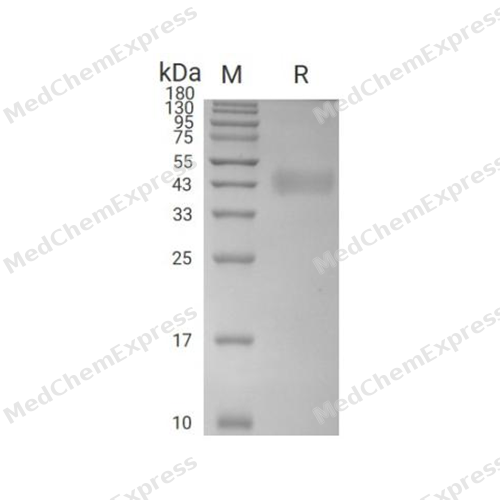
Purity - SDS-PAGE


Technical Parameters
-
Species Cynomolgus
-
Source HEK293
-
Tag C-6*His
-
Accession
Q5VAN0 (L44-I301)
-
Molecular Construction
-
N-term
-
CD38 (L44-I301)
Accession # Q5VAN0 -
6*His
-
C-term
-
-
Protein Length
Extracellular Domain
-
Synonyms
CD38; NAD(+) Nucleosidase; CD38 Molecule; CD38 Antigen (P45); ADP-Ribosyl Cyclase 1; ADPRC 1; ADP-Ribosyl Cyclase/Cyclic ADP-Ribose Hydrolase 1; Ecto-Nicotinamide Adenine Dinucleotide Glycohydrolase; 2'-Phospho-Cyclic-ADP-Ribose Transferase; Cluster Of Di
-
AA Sequence
LPRWRQQWSGSGTTSRFPETVLARCVKYTEVHPEMRHVDCQSVWDAFKGAFISKYPCNITEEDYQPLVKLGTQTVPCNKTLLWSRIKDLAHQFTQVQRDMFTLEDMLLGYLADDLTWCGEFNTFEINYQSCPDWRKDCSNNPVSVFWKTVSRRFAETACGVVHVMLNGSRSKIFDKNSTFGSVEVHNLQPEKVQALEAWVIHGGREDSRDLCQDPTIKELESIISKRNIRFFCKNIYRPDKFLQCVKNPEDSSCLSGI
-
Predicted Molecular Mass
30.9 kDa
-
Molecular Weight
Approximately 38-50 kDa, based on SDS-PAGE under reducing conditions, due to the glycosylation.
-
Glycosylation
Yes
-
Purity
≥ 95%, as determined by reducing SDS-PAGE.


Product Properties
Lyophilized powder.
Lyophilized from a 0.22 μm filtered solution of 20 mM Tris-HCl, 150 mM NaCl, pH 8.0.
Note: For SPR assay, please replace the buffer. Primary amine components (e.g., Tris, imidazole) can affect protein-coupled chips.
<1 EU/μg, determined by LAL method.
It is not recommended to reconstitute to a concentration less than 100 μg/mL in ddH2O. For long term storage it is recommended to add a carrier protein (0.1% BSA, 5% HSA, 10% FBS or 5% Trehalose).
Stored at -20°C for 2 years from date of receipt. After reconstitution, it is stable at 4°C for 1 week or -20°C for longer (with carrier protein). It is recommended to freeze aliquots at -20°C or -80°C for extended storage.
Room temperature in continental US; may vary elsewhere.


Documentation
-
Data Sheet (237 KB)
-
SDS (251 KB)
- English - EN (251 KB)
- Français - FR (251 KB)
- Deutsch - DE (251 KB)
- Norwegian - NO (251 KB)
- Español - ES (251 KB)
- Swedish - SV (251 KB)
- Italian - IT (251 KB)
- Korean - KR (251 KB)
- Portuguese - PT (251 KB)
-
Handling Instructions (2659 KB)

Calculators
Concentration (start) × Volume (start) = Concentration (final) × Volume (final)


 Powered by Bioz

