



CD40 Protein, Human (HEK293, His)
Based on 1 Customer Validation
CD40 protein is a TNFSF5/CD40LG receptor that transduces signals through TRAF6 and MAP3K8-mediated pathways, activates ERK in macrophages and B cells, and induces immunoglobulin secretion. CD40 exists as monomers and homodimers and interacts with TRAF proteins (TRAF1, TRAF2, TRAF3, TRAF5, and TRAF6). CD40 Protein, Human (HEK293, C-His) is the recombinant human-derived CD40 protein, expressed by HEK293 , with C-6*His labeled tag.
- Species: Human
- Source: HEK293
-
Storage:Stored at -20°C for 2 years from date of receipt. After reconstitution, it is stable at 4°C for 1 week or -20°C for longer (with carrier protein). It is recommended to freeze aliquots at -20°C or -80°C for extended storage.


To place orders, for customer services and technical support, please contact: MedChemExpress USA
Tel: 609-228-6898 E-mail: [email protected] [email protected]


-
 Biological Activity
-
Technical Parameters
-
Product Properties
- Documentation
- Help & FAQs




Biological Activity
Description
CD40 protein is a TNFSF5/CD40LG receptor that transduces signals through TRAF6 and MAP3K8-mediated pathways, activates ERK in macrophages and B cells, and induces immunoglobulin secretion. CD40 exists as monomers and homodimers and interacts with TRAF proteins (TRAF1, TRAF2, TRAF3, TRAF5, and TRAF6). CD40 Protein, Human (HEK293, C-His) is the recombinant human-derived CD40 protein, expressed by HEK293 , with C-6*His labeled tag.
Background
CD40 Protein, acting as the receptor for TNFSF5/CD40LG, is instrumental in transducing signals through TRAF6- and MAP3K8-mediated pathways, leading to the activation of ERK in macrophages and B cells and subsequent induction of immunoglobulin secretion. Existing in both monomeric and homodimeric forms, CD40 Protein exhibits variations in its homodimeric structure, as observed in the bladder carcinoma cell line Hu549. The receptor interacts with key signaling molecules such as TRAF1, TRAF2, TRAF3, TRAF5, and TRAF6, with the crucial interaction occurring between CD40 Protein, TRAF6, and MAP3K8, thereby playing a pivotal role in ERK activation.
Verified Bioactivity
1.Measured by its binding ability in a functional ELISA. Immobilized human CD40 at 2 μg/mL (100 μL/well) can bind human CD40L with a linear range of 15.6-500 ng/mL.
2.Loaded Abiprubart (HY-P990726) on AHC2 biosensor, can bind CD40 Protein, Human (HEK293, His) with an affinity constant of 2.792E-09 M as determined in BLI assay.
3.Measured by its binding ability in a functional ELISA. Immobilized Human CD40 Ligand (HY-P70609) at 5 µg/mL (100 µL/well) can bind Biotinylated Human CD40. The ED50 for this effect is < 200 ng/mL.
MCE Validation Data
-
Purity - SDS-PAGE
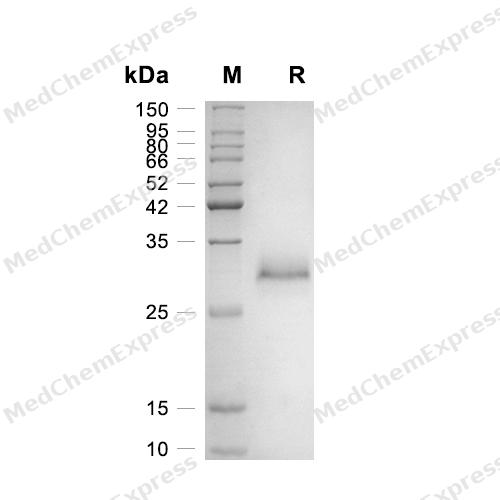
Purity - SDS-PAGE
-
Bioactivity - BLI
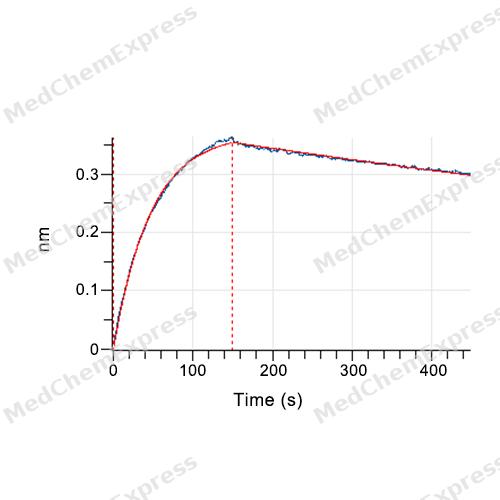
Bioactivity - BLI


Technical Parameters
-
Species Human
-
Source HEK293
-
Tag C-6*His
-
Accession
P25942-1 (E21-R193)
-
Molecular Construction
-
N-term
-
CD40 (E21-R193)
Accession # P25942-1-1 -
6*His
-
C-term
-
-
Protein Length
Extracellular Domain
-
Synonyms
CD40; B-Cell Surface Antigen CD40; Prev. TNFRSF5; B Cell Surface Antigen CD40; Bp50; B Cell-Associated Molecule; Tumor Necrosis Factor Receptor Superfamily Member 5; CD40 Antigen; CD40L Receptor; CDW40; P50; CDw40; CD40 Molecule, TNF Receptor Superfamily Member 5; CD40 Molecule; Tumor Necrosis Factor Receptor Superfamily, Member 5
-
AA Sequence
EPPTACREKQYLINSQCCSLCQPGQKLVSDCTEFTETECLPCGESEFLDTWNRETHCHQHKYCDPNLGLRVQQKGTSETDTICTCEEGWHCTSEACESCVLHRSCSPGFGVKQIATGVSDTICEPCPVGFFSNVSSAFEKCHPWTSCETKDLVVQQAGTNKTDVVCGPQDRLR
-
Molecular Weight
Approximately 28-32 kDa, based on SDS-PAGE under reducing conditions, due to the glycosylation.
-
Glycosylation
Yes
-
Purity
≥ 95%, as determined by reducing SDS-PAGE.


Product Properties
Lyophilized powder
Lyophilized from a 0.22 μm filtered solution of 20 mM PB, 150 mM NaCl, pH 7.4.
<1 EU/μg, determined by LAL method.
It is not recommended to reconstitute to a concentration less than 100 μg/mL in ddH2O. For long term storage it is recommended to add a carrier protein (0.1% BSA, 5% HSA, 10% FBS or 5% Trehalose).
Stored at -20°C for 2 years from date of receipt. After reconstitution, it is stable at 4°C for 1 week or -20°C for longer (with carrier protein). It is recommended to freeze aliquots at -20°C or -80°C for extended storage.
Room temperature in continental US; may vary elsewhere.


Documentation
-
Data Sheet (237 KB)
-
SDS (252 KB)
- English - EN (252 KB)
- Français - FR (252 KB)
- Deutsch - DE (252 KB)
- Norwegian - NO (252 KB)
- Español - ES (252 KB)
- Swedish - SV (252 KB)
- Italian - IT (252 KB)
- Korean - KR (252 KB)
- Portuguese - PT (252 KB)
-
Handling Instructions (2659 KB)

Calculators
Concentration (start) × Volume (start) = Concentration (final) × Volume (final)


 Powered by Bioz

