



CTHRC1 Protein, Human (HEK293, His)
Based on 5 publication(s) in Google Scholar
CTHRC1 Protein, Human (HEK293, His) is a negative regulator of collagen matrix deposition. CTHRC1, a secreted 28-kDa protein, is a glycosylated protein with a signal sequence.
- Species: Human
- Source: HEK293
-
Storage:Stored at -20°C for 2 years from date of receipt. After reconstitution, it is stable at 4°C for 1 week or -20°C for longer (with carrier protein). It is recommended to freeze aliquots at -20°C or -80°C for extended storage.


To place orders, for customer services and technical support, please contact: MedChemExpress USA
Tel: 609-228-6898 E-mail: [email protected] [email protected]


-
 Biological Activity
-
Technical Parameters
-
Product Properties
- Documentation
- References
- Help & FAQs




Biological Activity
Description
CTHRC1 Protein, Human (HEK293, His) is a negative regulator of collagen matrix deposition. CTHRC1, a secreted 28-kDa protein, is a glycosylated protein with a signal sequence.
Background
CTHRC1 is a secreted 28-kDa protein that is glycosylated and highly conserved from lower chordates to mammals. A short collagen motif with 12 Gly-X-Y repeats appears to be responsible for trimerization of the protein and this renders the molecule susceptible to cleavage by collagenase. Cthrc1 mRNA expression levels are increased in response to transforming growth factor-beta and bone morphogenetic protein-4. Although CTHRC1 is associated with the extracellular matrix and contains a short collagen-like motif, its transient expression in the vessel wall argues against a function as a structural protein unlike other members of the collagen family. A series of articles suggested that overexpression of CTHRC1 promotes tumor progression through various signaling pathways via angiogenesis, the infiltration of tumor-associated macrophages and epithelial-mesenchymal transition[1][2].
MCE Validation Data
-
Purity - SDS-PAGE
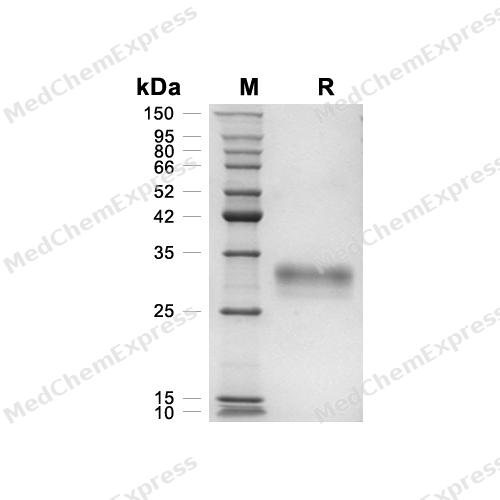
Purity - SDS-PAGE


Publications (5)
-
Journal Impact Factor
-
Most Recent
-
Cell Commun Signal
Senescent fibroblasts secrete CTHRC1 to promote cancer stemness in hepatocellular carcinoma. [Abstract]2025 Aug 25;23(1):379. PMID: 40855439 -
Dig Liver Dis
CTHRC1 serves as an indicator in biliary atresia for evaluating the stage of liver fibrosis and predicting prognosis. [Abstract]2025 Feb;57(2):385-393. PMID: 39043537 -
bioRxiv
2026 May 8:2026.05.05.722659. PMID: 42146549 -
-


Technical Parameters
-
Species Human
-
Source HEK293
-
Tag C-6*His
-
Accession
Q96CG8-1 (S31-K243)
-
Molecular Construction
-
N-term
-
CTHRC1 (S31-K243)
Accession # Q96CG8 -
6*His
-
C-term
-
-
Protein Length
Full Length of Isoform-1
-
Synonyms
CTHRC1; Collagen Triple Helix Repeat-Containing Protein 1; Collagen Triple Helix Repeat Containing 1
-
AA Sequence
SEIPKGKQKAQLRQREVVDLYNGMCLQGPAGVPGRDGSPGANGIPGTPGIPGRDGFKGEKGECLRESFEESWTPNYKQCSWSSLNYGIDLGKIAECTFTKMRSNSALRVLFSGSLRLKCRNACCQRWYFTFNGAECSGPLPIEAIIYLDQGSPEMNSTINIHRTSSVEGLCEGIGAGLVDVAIWVGTCSDYPKGDASTGWNSVSRIIIEELPK
-
Molecular Weight
Approximately 25-30 kDa, based on SDS-PAGE under reducing conditions.
-
Glycosylation
Yes
-
Purity
≥ 95%, as determined by reducing SDS-PAGE.


Product Properties
Lyophilized powder
Lyophilized from a 0.2 μm filtered solution of 20 mM PB, 150 mM NaCl, pH 7.4.
<1 EU/μg, determined by LAL method.
It is not recommended to reconstitute to a concentration less than 100 μg/mL in ddH2O. For long term storage it is recommended to add a carrier protein (0.1% BSA, 5% HSA, 10% FBS or 5% Trehalose).
Stored at -20°C for 2 years from date of receipt. After reconstitution, it is stable at 4°C for 1 week or -20°C for longer (with carrier protein). It is recommended to freeze aliquots at -20°C or -80°C for extended storage.
Room temperature in continental US; may vary elsewhere.


Documentation
-
Data Sheet (263 KB)
-
SDS (252 KB)
- English - EN (252 KB)
- Français - FR (252 KB)
- Deutsch - DE (252 KB)
- Norwegian - NO (252 KB)
- Español - ES (252 KB)
- Swedish - SV (252 KB)
- Italian - IT (252 KB)
- Korean - KR (252 KB)
- Portuguese - PT (252 KB)
-
Handling Instructions (2659 KB)


References
[1]. Xusheng Ding, et al. CTHRC1 promotes gastric cancer metastasis via HIF-1α/CXCR4 signaling pathway. Biomed Pharmacother. 2020 Mar;123:109742. [Content Brief]
[2]. Peter Pyagay, et al. Collagen triple helix repeat containing 1, a novel secreted protein in injured and diseased arteries, inhibits collagen expression and promotes cell migration. Circ Res. 2005 Feb 4;96(2):261-8. [Content Brief]

Calculators
Concentration (start) × Volume (start) = Concentration (final) × Volume (final)


 Powered by Bioz

