



IL-6 Protein, Human (N-His)
Based on 1 publication(s) in Google Scholar
IL-6 protein is a multifunctional cytokine that plays multiple biological functions in immunity, tissue regeneration, and metabolism. After binding to IL6R, the resulting complex binds to the signaling subunit IL6ST/gp130, triggering the intracellular IL6 signaling pathway. IL-6 Protein, Human (N-His) is the recombinant human-derived IL-6 protein, expressed by E. coli , with N-6*His labeled tag.
- Species: Human
- Source: E. coli
-
Storage:Stored at -20°C for 2 years from date of receipt. After reconstitution, it is stable at 4°C for 1 week or -20°C for longer (with carrier protein). It is recommended to freeze aliquots at -20°C or -80°C for extended storage.


To place orders, for customer services and technical support, please contact: MedChemExpress USA
Tel: 609-228-6898 E-mail: [email protected] [email protected]


-
 Biological Activity
-
Technical Parameters
-
Product Properties
- Documentation
- Help & FAQs


-

HY-P70426A
TNF-alpha/TNFSF2 protein, Human (His) -
HY-P73193
IL-23 Protein, Human (HEK293, His) -
HY-P70576
IL-3 Protein, Human (His) -
HY-P70568
IL-13 Protein, Human (HEK293, His) -
HY-P7034
IL-15 Protein, Human -
HY-P7038
IL-21 Protein, Human -
HY-P70781
SCF Protein, Human -
HY-P78459A
IL-1 beta Protein, Human (C-His) -
HY-P70710
IL-4R alpha/CD124 Protein, Human (HEK293, His)


Biological Activity
Description
IL-6 protein is a multifunctional cytokine that plays multiple biological functions in immunity, tissue regeneration, and metabolism. After binding to IL6R, the resulting complex binds to the signaling subunit IL6ST/gp130, triggering the intracellular IL6 signaling pathway. IL-6 Protein, Human (N-His) is the recombinant human-derived IL-6 protein, expressed by E. coli , with N-6*His labeled tag.
Background
GMP IL-6 Protein, a versatile cytokine, performs various biological functions in immunity, tissue regeneration, and metabolism. Upon binding to IL6R, the resulting complex associates with the signaling subunit IL6ST/gp130, triggering the intracellular IL6-signaling pathway. Its interaction with membrane-bound IL6R and IL6ST stimulates 'classic signaling,' while the binding of IL6 and soluble IL6R to IL6ST induces 'trans-signaling.' Moreover, 'cluster signaling' occurs when membrane-bound IL6:IL6R complexes on transmitter cells activate IL6ST receptors on neighboring receiver cells. IL-6 serves as a potent inducer of the acute phase response, rapidly mobilizing host defenses during infection and tissue injury, although excessive IL6 synthesis is implicated in disease pathology. In the innate immune response, IL-6 is synthesized by myeloid cells, such as macrophages and dendritic cells, upon recognizing pathogens through toll-like receptors at the infection or tissue injury site. In the adaptive immune response, IL-6 is essential for B-cell differentiation into immunoglobulin-secreting cells and plays a major role in the differentiation of CD4(+) T cell subsets. It is a crucial factor in the development of T follicular helper (Tfh) cells necessary for germinal-center formation and is required to drive naive CD4(+) T cells to the Th17 lineage. Additionally, IL-6 is essential for the proliferation of myeloma cells and the survival of plasmablast cells.
Verified Bioactivity
1. Measured in a cell proliferation assay using TF-1 human erythroleukemic cells. The ED50 is 0.7347 ng/mL, corresponding to a specific activity is 1.36×10⁶ units/mg.
2. Loaded Ziltivekimab (HY-P99505) on AHC2 biosensor, can bind IL-6 Protein, Human (N-His) with an affinity constant of 5.234E-10 M as determined in BLI assay.
MCE Validation Data
-
Purity - SDS-PAGE
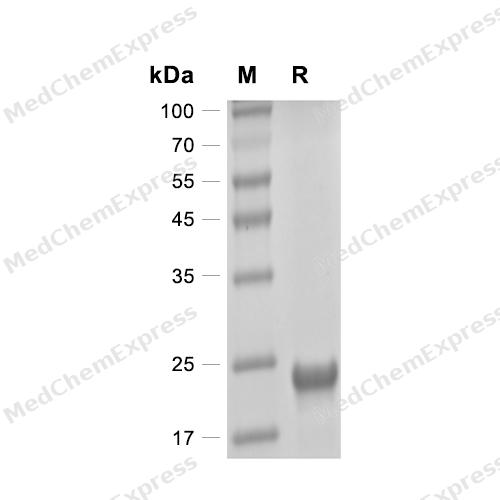
Purity - SDS-PAGE
-
Bioactivity - Cell-Based Assay
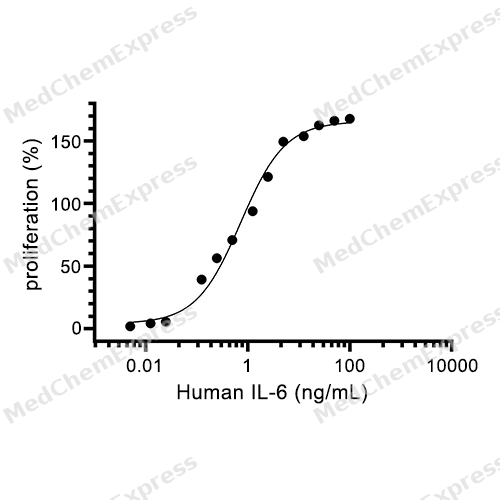
Bioactivity - Cell-Based Assay
-
Bioactivity - BLI
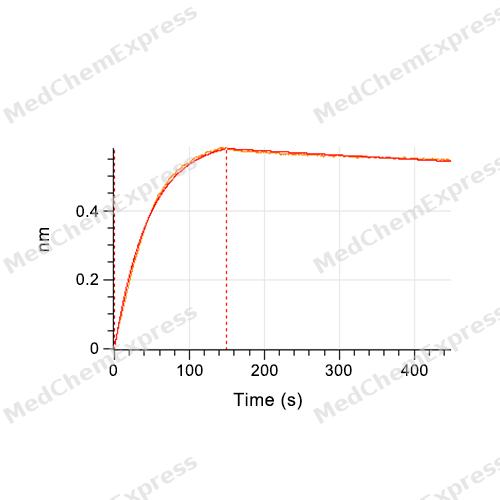
Bioactivity - BLI


Publications (1)
-
Journal Impact Factor
-
Most Recent
-
J Adv Res
Shikonin nasal spray film preparation promoted the repair of nasal mucosal injury by the interaction of shikonin with interleukin-6. [Abstract]2025 Jun 18:S2090-1232(25)00453-9. PMID: 40541778


Technical Parameters
-
Species Human
-
Source E. coli
-
Tag N-6*His
-
Accession
P05231 (P29-M212)
-
Molecular Construction
-
N-term
-
6*His
-
IL-6 (P29-M212)
Accession # P05231 -
C-term
-
-
Protein Length
Full Length of Mature Protein
-
Synonyms
IL6; Hybridoma Growth Factor; Prev. IFNB2; IFN-Beta-2; IL-6; BSF-2; Interleukin-6; CDF; BSF2; Interleukin 6 (Interferon, Beta 2); HGF; B-Cell Differentiation Factor; HSF; Truncated Interleukin 6; B-Cell Stimulatory Factor 2; Interferon, Beta 2; CTL Differ
-
AA Sequence
PVPPGEDSKDVAAPHRQPLTSSERIDKQIRYILDGISALRKETCNKSNMCESSKEALAENNLNLPKMAEKDGCFQSGFNEETCLVKIITGLLEFEVYLEYLQNRFESSEEQARAVQMSTKVLIQFLQKKAKNLDAITTPDPTTNASLLTKLQAQNQWLQDMTTHLILRSFKEFLQSSLRALRQM
-
Predicted Molecular Mass
21 kDa
-
Molecular Weight
Approximately 21 kDa, based on SDS-PAGE under reducing conditions.
-
Purity
≥ 95%, as determined by reducing SDS-PAGE.


Product Properties
Lyophilized powder.
Lyophilized from a 0.22 μm filtered solution of 50 mM Tris-HCl, 300 mM NaCl, pH 7.4, 5% trehalose, 5% mannitol and 0.01% Tween 80.
Note: For SPR assay, please replace the buffer. Primary amine components (e.g., Tris, imidazole) can affect protein-coupled chips.
<1.0 EU/μg, determined by LAL method.
It is not recommended to reconstitute to a concentration less than 100 μg/mL in ddH2O.
Stored at -20°C for 2 years from date of receipt. After reconstitution, it is stable at 4°C for 1 week or -20°C for longer (with carrier protein). It is recommended to freeze aliquots at -20°C or -80°C for extended storage.
Room temperature in continental US; may vary elsewhere.


Documentation
-
Data Sheet (237 KB)
-
SDS (252 KB)
- English - EN (252 KB)
- Français - FR (252 KB)
- Deutsch - DE (252 KB)
- Norwegian - NO (252 KB)
- Español - ES (252 KB)
- Swedish - SV (252 KB)
- Italian - IT (252 KB)
- Korean - KR (252 KB)
- Portuguese - PT (252 KB)
-
Handling Instructions (2659 KB)

Calculators
Concentration (start) × Volume (start) = Concentration (final) × Volume (final)


 Powered by Bioz

