



ING5 Protein, Human (His)

Based on 1 Customer Validation
The ING5 protein is a key component of the HBO1 complex and mediates H3K14ac and H4 acetylation. In the MOZ/MORF complex, it exhibits histone H3 acetyltransferase activity and may regulate DNA replication and act as a transcriptional coactivator. ING5 Protein, Human (His) is the recombinant human-derived ING5 protein, expressed by E. coli , with N-His labeled tag.
- Species: Human
- Source: E. coli
-
Storage:Stored at -20°C for 2 years from date of receipt. After reconstitution, it is stable at 4°C for 1 week or -20°C for longer (with carrier protein). It is recommended to freeze aliquots at -20°C or -80°C for extended storage.


To place orders, for customer services and technical support, please contact: MedChemExpress USA
Tel: 609-228-6898 E-mail: [email protected] [email protected]


-
 Biological Activity
-
Technical Parameters
-
Product Properties
- Documentation
- Help & FAQs




Biological Activity
Description
The ING5 protein is a key component of the HBO1 complex and mediates H3K14ac and H4 acetylation. In the MOZ/MORF complex, it exhibits histone H3 acetyltransferase activity and may regulate DNA replication and act as a transcriptional coactivator. ING5 Protein, Human (His) is the recombinant human-derived ING5 protein, expressed by E. coli , with N-His labeled tag.
Background
ING5, an integral component of the HBO1 complex, plays a crucial role in mediating the acetylation of histone H3 at 'Lys-14' (H3K14ac), and, to a lesser extent, histone H4 acetylation. Within the context of the MOZ/MORF complex, which possesses histone H3 acetyltransferase activity, ING5 contributes to chromatin acetylation, potentially regulating DNA replication and serving as a transcriptional coactivator. Functionally, ING5 inhibits cell growth, induces a delay in S-phase progression, and enhances Fas-induced apoptosis, relying on the presence of INCA1. As a versatile participant in distinct complexes, ING5 forms the HBO1 complex with KAT7/HBO1, MEAF6, and a scaffold subunit, influencing H3K14ac specificity, and the MOZ/MORF complex comprising ING5, KAT6A, KAT6B, MEAF6, and a scaffold subunit. Interactions with H3K4me3 and H3K4me2, as well as associations with EP300 and p53/TP53, further underscore the multifaceted roles of ING5 in chromatin modification and cellular processes.
MCE Validation Data
-
Purity - SDS-PAGE
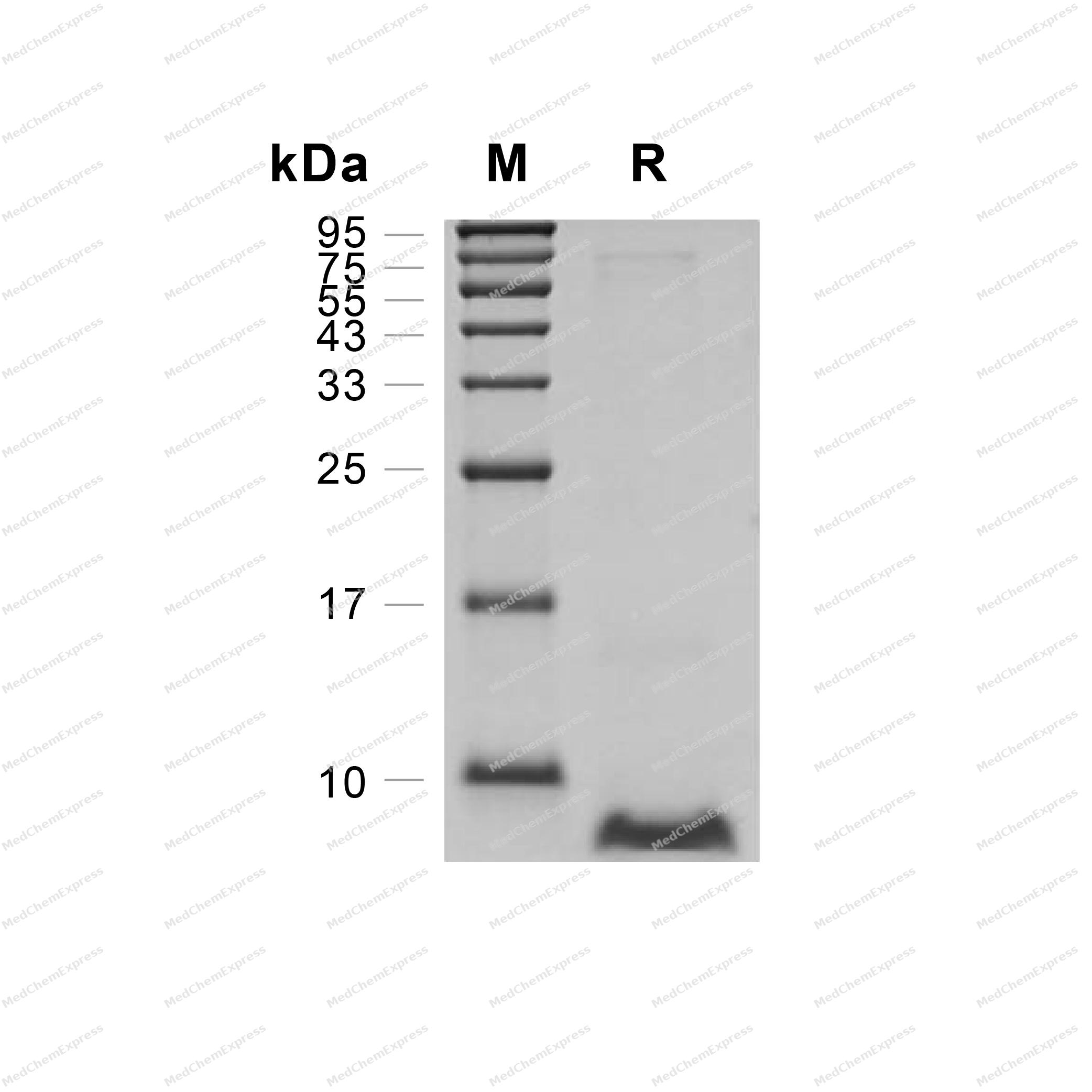
Purity - SDS-PAGE


Technical Parameters
-
Species Human
-
Source E. coli
-
Tag N-His
-
Accession
Q8WYH8-2 (E36-Q84)
-
Molecular Construction
-
N-term
-
His
-
ING5 (E36-Q84)
Accession # Q8WYH8-2 -
C-term
-
-
Protein Length
Partial
-
Synonyms
ING5; Inhibitor Of Growth Protein 5; Inhibitor Of Growth Family Member 5; FLJ23842; P28ING5
-
AA Sequence
EDKKAEIDILAAEYISTVKTLSPDQRVERLQKIQNAYSKCKEYSDDKVQ
-
Predicted Molecular Mass
5.7 kDa
-
Molecular Weight
Approximately 7 kDa, based on SDS-PAGE under reducing conditions.
-
Purity
≥ 95%, as determined by reducing SDS-PAGE.


Product Properties
Lyophilized powder.
Lyophilized from a 0.22 μm filtered solution of PBS, pH 7.4.
<1 EU/μg, determined by LAL method.
It is not recommended to reconstitute to a concentration less than 100 μg/mL in ddH2O. For long term storage it is recommended to add a carrier protein (0.1% BSA, 5% HSA, 10% FBS or 5% Trehalose).
Stored at -20°C for 2 years from date of receipt. After reconstitution, it is stable at 4°C for 1 week or -20°C for longer (with carrier protein). It is recommended to freeze aliquots at -20°C or -80°C for extended storage.
Room temperature in continental US; may vary elsewhere.


Documentation
-
Data Sheet (235 KB)
-
SDS (252 KB)
- English - EN (252 KB)
- Français - FR (252 KB)
- Deutsch - DE (252 KB)
- Norwegian - NO (252 KB)
- Español - ES (252 KB)
- Swedish - SV (252 KB)
- Italian - IT (252 KB)
- Korean - KR (252 KB)
- Portuguese - PT (252 KB)
-
Handling Instructions (2659 KB)

Calculators
Concentration (start) × Volume (start) = Concentration (final) × Volume (final)


 Powered by Bioz

