



Leptin Protein, Human (His)

Based on 1 Customer Validation
Leptin is a cytokine-like sugar secretory protein secreted by adipocytes that helps regulate energy balance by inhibiting food intake and increasing thermogenesis. Leptin can activate the JAK2-STAT3 and PI3K-AKT/mTOR pathways to regulate energy metabolism, prolong the QT interval via MAPK in the myocardium, and play a protective role in the gastric mucosa by inducing NO/CGRP release via the vagus nerve. Circulating CRP protein binds to leptin and blocks signal transduction, leading to obesity resistance. Leptin Protein, Human (His) is a recombinant human Leptin protein expressed by E. coli with N-6*His tag.
- Species: Human
- Source: E. coli
-
Storage:Stored at -20°C for 2 years from date of receipt. After reconstitution, it is stable at 4°C for 1 week or -20°C for longer (with carrier protein). It is recommended to freeze aliquots at -20°C or -80°C for extended storage.


To place orders, for customer services and technical support, please contact: MedChemExpress USA
Tel: 609-228-6898 E-mail: [email protected] [email protected]


-
 Biological Activity
-
Technical Parameters
-
Product Properties
- Documentation
- References
- Help & FAQs




Biological Activity
Description
Leptin is a cytokine-like sugar secretory protein secreted by adipocytes that helps regulate energy balance by inhibiting food intake and increasing thermogenesis. Leptin can activate the JAK2-STAT3 and PI3K-AKT/mTOR pathways to regulate energy metabolism, prolong the QT interval via MAPK in the myocardium, and play a protective role in the gastric mucosa by inducing NO/CGRP release via the vagus nerve. Circulating CRP protein binds to leptin and blocks signal transduction, leading to obesity resistance. Leptin Protein, Human (His) is a recombinant human Leptin protein expressed by E. coli with N-6*His tag.
Background
Leptin is a hormone secreted by adipocytes that helps regulate energy balance by inhibiting food intake and increasing thermogenesis. It belongs to the cytokine-like protein family. Leptin has a conserved four-helix bundle conformation, with a tertiary structure stabilized by disulfide bonds. It lacks a classical signal peptide but is secreted via a non-classical pathway. The C-terminal domain of leptin mediates receptor binding, while the N-terminal region promotes oligomerization. Leptin binds to the long receptor OB-Rb in hypothalamic neurons and peripheral tissues, activating the JAK2-STAT3 and PI3K-AKT/mTOR pathways, inhibiting food intake and enhancing energy expenditure. In cardiomyocytes, leptin mediates MAPK activation through OB-Rb, reducing heart rate and prolonging the QT interval, an effect that is independent of β-adrenergic signaling[1][2][3][4].
In the gastric mucosa, leptin stimulates sensory neurons to release NO and CGRP via the vagus nerve, enhancing blood flow and protecting tissues from ischemia-reperfusion injury. Circulating C-reactive protein (CRP) binds to leptin, blocks receptor interaction and attenuates STAT3 phosphorylation, leading to leptin resistance in obesity[3][4]. Upstream regulators of leptin include leptin secreted by adipocytes and CRP synthesized by the liver; downstream targets include STAT3, PI3K, eNOS and mTOR, which play a role in regulating metabolism, neurogenesis and vascular function[1][4].
In metabolic diseases, leptin resistance is associated with hyperleptinemia and inhibition of CRP-mediated signaling, and leptin supplementation may inhibit congenital lipodystrophy and type 2 diabetes[4]. At the same time, Leptin's direct effect on cardiac repolarization (QT interval prolongation) and its interaction with CRP may be involved in obesity-related arrhythmias and atherosclerosis[2]. Leptin also enhances gastric mucosal blood flow and protects against ischemic damage through vagus-sensory nerve-mediated NO/CGRP release, and can be used in the study of peptic ulcer disease[3].
Verified Bioactivity
1.Fully biologically active determined by the dose dependent proliferation of MCF7 cells. The ED50 for this effect is 14.64 ng/mL, corresponding to a specific activity is 6.83×10⁴ units/mg.
2.Measured in a cell proliferation assay using BaF3 mouse pro‑B cells transfected with human Leptin R. The ED50 for this effect is 1.0-5.0 ng/mL.
MCE Validation Data
-
Purity - SDS-PAGE
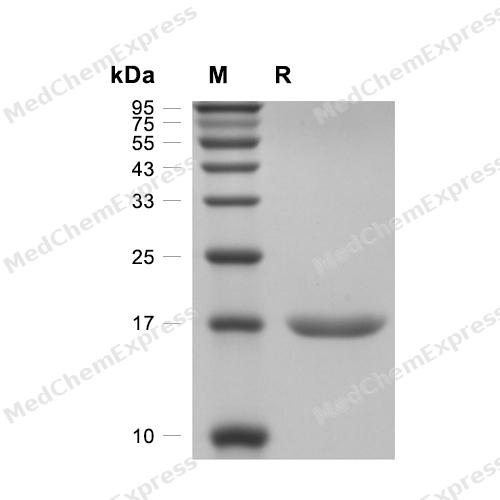
Purity - SDS-PAGE
-
Bioactivity - Cell-Based Assay
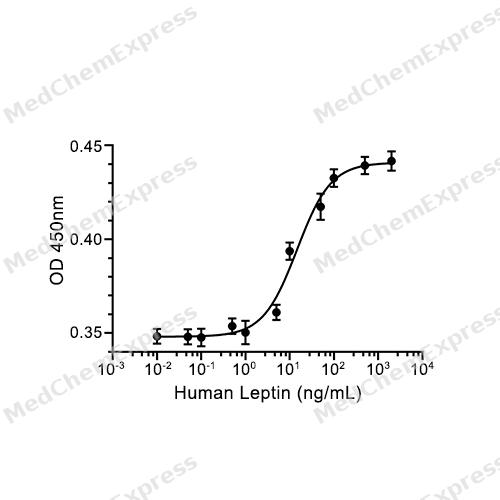
Bioactivity - Cell-Based Assay


Technical Parameters
-
Species Human
-
Source E. coli
-
Tag N-6*His
-
Accession
P41159 (V22-C167)
-
Molecular Construction
-
N-term
-
6*His
-
Leptin (V22-C167)
Accession # P41159 -
C-term
-
-
Protein Length
Full Length of Mature Protein
-
Synonyms
LEP; Leptin (Murine Obesity Homolog); Prev. OBS; Obese Protein; Prev. OB; Obese, Mouse, Homolog Of; Obesity Factor; LEPD; Leptin; Leptin (Obesity Homolog, Mouse)
-
AA Sequence
VPIQKVQDDTKTLIKTIVTRINDISHTQSVSSKQKVTGLDFIPGLHPILTLSKMDQTLAVYQQILTSMPSRNVIQISNDLENLRDLLHVLAFSKSCHLPWASGLETLDSLGGVLEASGYSTEVVALSRLQGSLQDMLWQLDLSPGC
-
Predicted Molecular Mass
16 kDa
-
Molecular Weight
Approximately 17 kDa, based on SDS-PAGE under reducing conditions.
-
Purity
≥ 95%, as determined by reducing SDS-PAGE.


Product Properties
Lyophilized powder
1.Lyophilized from a 0.22 μm filtered solution of 50 mM Tris-HCl, 300 mM NaCl, 200 mM arginine, pH 8.0.
2.Lyophilized from a 0.22 μm filtered solution of PBS, pH 7.4, 8% trehalose.
Please refer to the lot-specific COA for specific buffer information.
Note: For SPR assay, please replace the buffer. Primary amine components (e.g., Tris, imidazole) can affect protein-coupled chips.
<1 EU/μg, determined by LAL method.
It is not recommended to reconstitute to a concentration less than 100 μg/mL in ddH2O. For long term storage it is recommended to add a carrier protein (0.1% BSA, 5% HSA, 10% FBS or 5% Trehalose).
Stored at -20°C for 2 years from date of receipt. After reconstitution, it is stable at 4°C for 1 week or -20°C for longer (with carrier protein). It is recommended to freeze aliquots at -20°C or -80°C for extended storage.
Room temperature in continental US; may vary elsewhere.


Documentation
-
Data Sheet (264 KB)
-
SDS (251 KB)
- English - EN (251 KB)
- Français - FR (251 KB)
- Deutsch - DE (251 KB)
- Norwegian - NO (251 KB)
- Español - ES (251 KB)
- Swedish - SV (251 KB)
- Italian - IT (251 KB)
- Korean - KR (251 KB)
- Portuguese - PT (251 KB)
-
Handling Instructions (2659 KB)


References
[1]. Chen K, et al. Induction of leptin resistance through direct interaction of C-reactive protein with leptin. Nat Med. 2006 Apr;12(4):425-32. [Content Brief]
[2]. Tsuchiya T, et al. Expression of leptin receptor in lung: leptin as a growth factor. Eur J Pharmacol. 1999 Jan 22;365(2-3):273-9. [Content Brief]
[3]. Lin YC, et al. Leptin decreases heart rate associated with increased ventricular repolarization via its receptor. Am J Physiol Heart Circ Physiol. 2015 Nov 15;309(10):H1731-9. [Content Brief]
[4]. Brzozowski T, et al. Brain-gut axis in gastroprotection by leptin and cholecystokinin against ischemia-reperfusion induced gastric lesions. J Physiol Pharmacol. 2001 Dec;52(4 Pt 1):583-602. [Content Brief]

Calculators
Concentration (start) × Volume (start) = Concentration (final) × Volume (final)


 Powered by Bioz

