



Lipocalin-2/NGAL Protein, Mouse (HEK293, C-His)
Based on 4 publication(s) in Google Scholar
Lipocalin-2/NGAL Protein, Mouse (HEK293, His) is an 20-28 kDa NGAL protein with a His-flag, which is expressed in HEK293 cells. NGAL is an antibacterial factor of natural immunity, and an acute-phase protein.
- Species: Mouse
- Source: HEK293
-
Storage:Stored at -20°C for 2 years from date of receipt. After reconstitution, it is stable at 4°C for 1 week or -20°C for longer (with carrier protein). It is recommended to freeze aliquots at -20°C or -80°C for extended storage.


To place orders, for customer services and technical support, please contact: MedChemExpress USA
Tel: 609-228-6898 E-mail: [email protected] [email protected]


-
 Biological Activity
-
Technical Parameters
-
Product Properties
- Documentation
- Help & FAQs


-
HY-Q45780
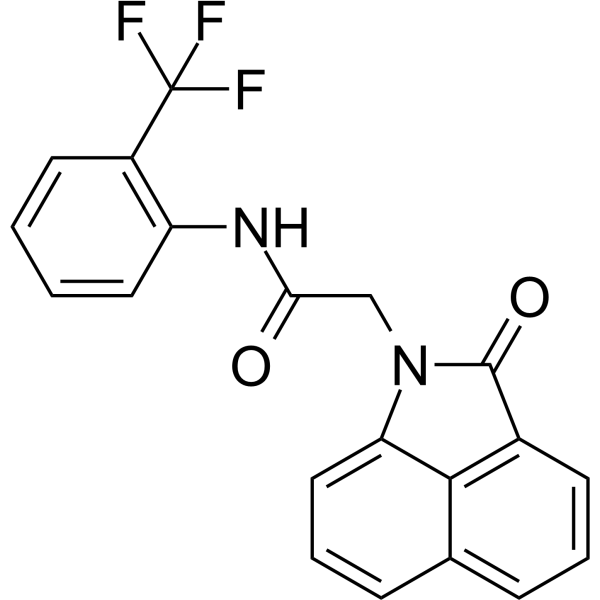
ZINC00640089LCN2 Inhibitor -

HY-P71156
Lipocalin-2/NGAL Protein, Human (HEK293, His) -
HY-B2176
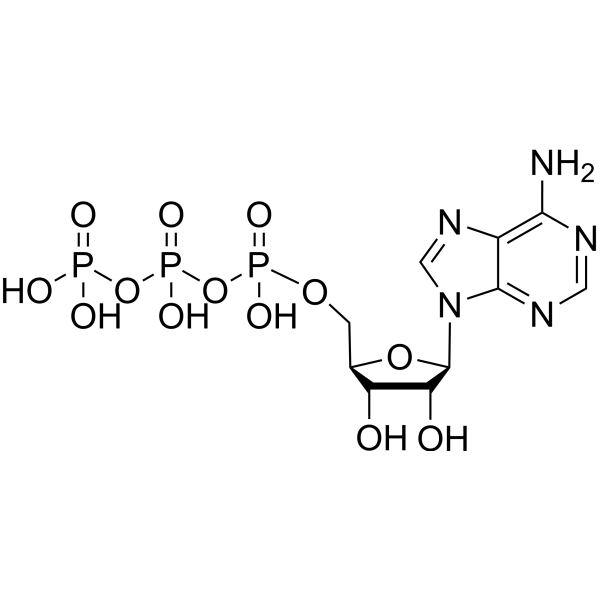
ATPEndogenous Metabolite -
HY-P7063
IL-6 Protein, Mouse -
HY-P71809
Serum amyloid A-3 protein/Saa3 Protein, Mouse (P.pastoris, His) -

HY-P0203B
β-CGRP (mouse)CGRP -
HY-P7845
Chitinase-like protein 3/YM1 Protein, Mouse (HEK293, His)


Biological Activity
Description
Lipocalin-2/NGAL Protein, Mouse (HEK293, His) is an 20-28 kDa NGAL protein with a His-flag, which is expressed in HEK293 cells. NGAL is an antibacterial factor of natural immunity, and an acute-phase protein[1].
Background
NGAL is a 25 kDa protein belonging to the lipocalin superfamily, which is first known as an antibacterial factor of natural immunity, and an acute-phase protein.NGAL is initially found in activated neutrophils, and other cells, like kidney tubular cells, may produce NGAL in response to various insults.ipocalin-2 (LCN2/NGAL) has been implicated in a variety of processes including cell differentiation, proliferation, survival, and morphogenesis.NGAL has anti-tumoral and anti-metastatic effects in neoplasias, for example, the colon, ovary and pancreas[1].
Verified Bioactivity
1.Measured by its ability to bind Iron(III) dihydroxybenzoic acid [Fe(DHBA)3] that Incubate at room temperature for 10 minutes. The binding of Fe(DHBA)3 results in the quenching of Trp fluorescence in NGAL. >1.0 µM of Fe(DHBA)3 can be bound.
2.Measured by its ability to bind Iron(III) dihydroxybenzoic acid [Fe(DHBA)3] in 30 min at 25°C. The binding of Fe(DHBA)3 results in the quenching of Trp fluorescence in 2 μM NGAL. >1.5 µM of Fe(DHBA)3 can be bound.
MCE Validation Data
-
Purity - SDS-PAGE
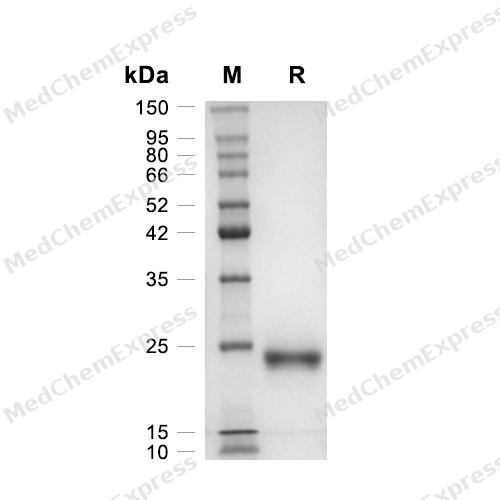
Purity - SDS-PAGE


Publications (4)
-
Journal Impact Factor
-
Most Recent
-
Cell Death Dis
2025 Mar 1;16(1):146. PMID: 40025014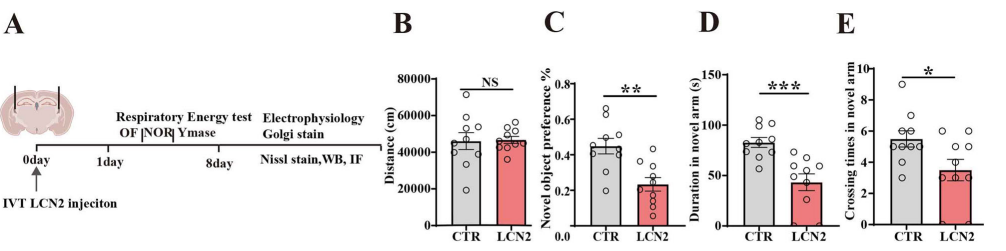
Lipocalin-2/NGAL Protein, Mouse (HEK293, C-His) purchased from MedChemExpress. Usage Cited in: Cell Death Dis. 2025 Mar 1;16(1):146. [Abstract]
Lipocalin-2/NGAL Protein, Mouse (HEK293, C-His) (50 μg/kg) bilaterally injected with Eight-week-old male C57 mice. In the control group, 10 mice were injected intraperitoneally with PBS. Open-field test data indicated no significant difference in the total distance covered (Fig. 2B). NOR results revealed a reduced preference in exploring new objects in the LCN2 group compared to the control group (Fig. 2C). Y-maze test showed that LCN2 mice exhibit a significantly decreased duration (Fig. 2D) and crossing times (Fig. 2E) in the novel arm compared to the control group.
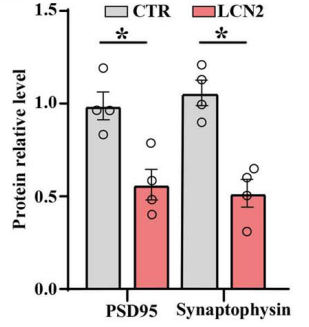
Lipocalin-2/NGAL Protein, Mouse (HEK293, C-His) purchased from MedChemExpress. Usage Cited in: Cell Death Dis. 2025 Mar 1;16(1):146. [Abstract]
Lipocalin-2/NGAL Protein, Mouse (HEK293, C-His) (50 μg/kg) bilaterally injected with Eight-week-old male C57 mice. In the control group, 10 mice were injected intraperitoneally with PBS. Postsynaptic density protein95 (PSD95) and synaptophysin (SYT) significantly decreased in the LCN2 group compared to the control group.
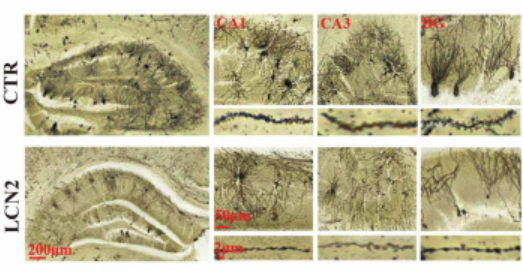
Lipocalin-2/NGAL Protein, Mouse (HEK293, C-His) purchased from MedChemExpress. Usage Cited in: Cell Death Dis. 2025 Mar 1;16(1):146. [Abstract]
Lipocalin-2/NGAL Protein, Mouse (HEK293, C-His) (50 μg/kg) bilaterally injected with Eight-week-old male C57 mice. In the control group, 10 mice were injected intraperitoneally with PBS. This revealed a marked decrease in the dendritic complexity in the LCN2 group compared to the control group.
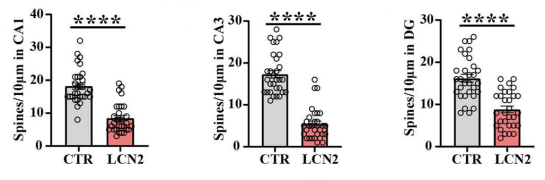
Lipocalin-2/NGAL Protein, Mouse (HEK293, C-His) purchased from MedChemExpress. Usage Cited in: Cell Death Dis. 2025 Mar 1;16(1):146. [Abstract]
Lipocalin-2/NGAL Protein, Mouse (HEK293, C-His) (50 μg/kg) bilaterally injected with Eight-week-old male C57 mice. In the control group, 10 mice were injected intraperitoneally with PBS. This revealed a marked decrease in the dendritic spine density in the LCN2 group compared to the control group.
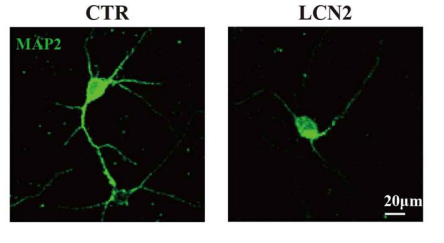
Lipocalin-2/NGAL Protein, Mouse (HEK293, C-His) purchased from MedChemExpress. Usage Cited in: Cell Death Dis. 2025 Mar 1;16(1):146. [Abstract]
Primary hippocampal neurons were treated with Lipocalin-2/NGAL Protein, Mouse (HEK293, C-His) (LCN2; 100 ng/mL; 5 days), and the MAP2 was measured by immunofluorescence.
-
Phytomedicine
Handelin inhibits osteoclastogenesis and bone loss by targeting lipocalin-2 and restoring autophagy to suppress NF-κB signaling. [Abstract]2026 Jul 25:157:158331. PMID: 42229383 -
Redox Rep
Artesunate ameliorates experimental autoimmune uveitis by inhibiting the LCN2-STAT3 axis and suppressing microglial activation. [Abstract]2026 Dec;31(1):2627096. PMID: 41674301 -
Acta Neuropathol Commun
LCN2/SLC22A17 mediates the phagocytosis of GABAergic synapses by oligodendrocyte progenitor cells and contributes to cancer-induced pain and comorbid anxiety-like behaviors in mice. [Abstract]2026 Apr 10;14(1):115. PMID: 41964063


Technical Parameters
-
Species Mouse
-
Source HEK293
-
Tag C-6*His
-
Accession
P11672 (Q21-N200)
-
Molecular Construction
-
N-term
-
NGAL (Q21-N200)
Accession # P11672 -
6*His
-
C-term
-
-
Protein Length
Full Length of Mature Protein
-
Synonyms
LCN2; P25; Lipocalin 2; Migration-Stimulating Factor Inhibitor; NGAL; Lipocalin 2 (Oncogene 24p3); Neutrophil Gelatinase-Associated Lipocalin; Siderocalin LCN2; Oncogene 24p3; Lipocalin-2; 24p3; MSFI; 25 KDa Alpha-2-Microglobulin-Related Subunit Of MMP-9; HNL; Siderocalin
-
AA Sequence
QDSTQNLIPAPSLLTVPLQPDFRSDQFRGRWYVVGLAGNAVQKKTEGSFTMYSTIYELQENNSYNVTSILVRDQDQGCRYWIRTFVPSSRAGQFTLGNMHRYPQVQSYNVQVATTDYNQFAMVFFRKTSENKQYFKITLYGRTKELSPELKERFTRFAKSLGLKDDNIIFSVPTDQCIDN
-
Molecular Weight
Approximately 20-28 kDa, based on SDS-PAGE under reducing conditions.
-
Glycosylation
Yes
-
Purity
≥ 95%, as determined by reducing SDS-PAGE.


Product Properties
Lyophilized powder
1.Lyophilized from a 0.22 μm filtered solution of 20 mM MES, 150 mM NaCl, pH 5.5.
2.Lyophilized from a 0.22 μm filtered solution of PBS, pH 7.4.
3.Lyophilized from a 0.22 μm filtered solution of 20 mM MES, 150 mM NaCl, pH 5.5, 5% trehalose, 5% mannitol, 0.01% Tween 80.
Please refer to the lot-specific COA for specific buffer information.
<1 EU/μg, determined by LAL method.
It is not recommended to reconstitute to a concentration less than 100 μg/mL in ddH2O.
Stored at -20°C for 2 years from date of receipt. After reconstitution, it is stable at 4°C for 1 week or -20°C for longer (with carrier protein). It is recommended to freeze aliquots at -20°C or -80°C for extended storage.
Room temperature in continental US; may vary elsewhere.


Documentation
-
Data Sheet (237 KB)
-
SDS (252 KB)
- English - EN (252 KB)
- Français - FR (252 KB)
- Deutsch - DE (252 KB)
- Norwegian - NO (252 KB)
- Español - ES (252 KB)
- Swedish - SV (252 KB)
- Italian - IT (252 KB)
- Korean - KR (252 KB)
- Portuguese - PT (252 KB)
-
Handling Instructions (2659 KB)

Calculators
Concentration (start) × Volume (start) = Concentration (final) × Volume (final)


 Powered by Bioz

