



MIF Protein, Mouse
Based on 3 publication(s) in Google Scholar
MIF Protein, Mouse has assumed an important role as a pivotal regulator of innate immunity.MIF Protein, Mouse promotes the pro-inflammatory functions of immune cells.
- Species: Mouse
- Source: E. coli
-
Storage:Stored at -20°C for 2 years from date of receipt. After reconstitution, it is stable at 4°C for 1 week or -20°C for longer (with carrier protein). It is recommended to freeze aliquots at -20°C or -80°C for extended storage.


To place orders, for customer services and technical support, please contact: MedChemExpress USA
Tel: 609-228-6898 E-mail: [email protected] [email protected]


-
 Biological Activity
-
Technical Parameters
-
Product Properties
- Documentation
- References
- Help & FAQs




Biological Activity
Description
MIF Protein, Mouse has assumed an important role as a pivotal regulator of innate immunity.MIF Protein, Mouse promotes the pro-inflammatory functions of immune cells.
Background
Macrophage Migration Inhibitory Factor (MIF) has assumed an important role as a pivotal regulator of innate immunity. MIF is an integral component of the host antimicrobial alarm system and stress response that promotes the pro-inflammatory functions of immune cells. MIF-directed therapies might offer new treatment opportunities for human diseases in the future[1].
Verified Bioactivity
1.Measured in a cell proliferation assay using MCF-7 human breast cancer cells. The ED50 this effect is ≤10.51 ng/mL, corresponding to a specific activity is ≥9.515×10⁴ units/mg.
2.Measured by its ability to inhibit THP-1 cells migration. The ED50 for this effect is ≤ 9.142 ng/mL, corresponding to a specific activity is ≥1.094×10⁵ U/mg.
MCE Validation Data
-
Purity - SDS-PAGE
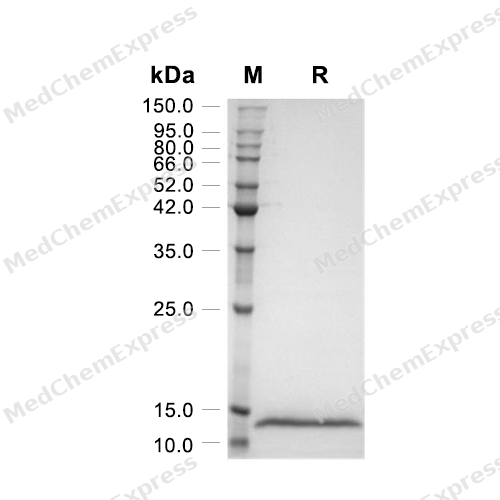
Purity - SDS-PAGE
-
Bioactivity - Cell-Based Assay
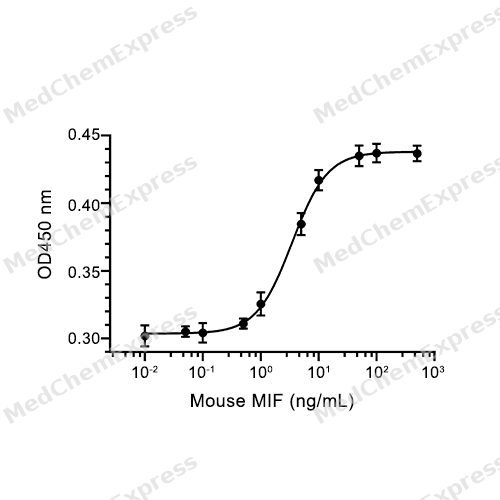
Bioactivity - Cell-Based Assay


Publications (3)
-
Journal Impact Factor
-
Most Recent
-
EMBO J
Pericyte signaling via soluble guanylate cyclase shapes the vascular niche and microenvironment of tumors. [Abstract]2024 Apr;43(8):1519-1544. PMID: 38528180 -
J Invest Dermatol
Dendritic cells remodel eccrine sweat gland niche metabolism through oxidative phosphorylation during aging. [Abstract]2026 Mar 24:S0022-202X(26)00998-X. PMID: 41887396 -


Technical Parameters
-
Species Mouse
-
Source E. coli
-
Tag Tag Free
-
Accession
P34884 (M1-A115)
-
Molecular Construction
-
N-term
-
MIF (M1-A115)
Accession # P34884 -
C-term
-
-
Protein Length
Full Length
-
Synonyms
MIF; L-Dopachrome Isomerase; Prev. GLIF; Glycosylation-Inhibiting Factor; Phenylpyruvate Tautomerase; MMIF; GIF; Epididymis Secretory Sperm Binding Protein; L-Dopachrome Tautomerase; Macrophage Migration Inhibitory Factor; Macrophage Migration Inhibitory
-
AA Sequence
MPMFIVNTNVPRASVPEGFLSELTQQLAQATGKPAQYIAVHVVPDQLMTFSGTNDPCALCSLHSIGKIGGAQNRNYSKLLCGLLSDRLHISPDRVYINYYDMNAANVGWNGSTFA
-
Predicted Molecular Mass
12.5 kDa
-
Molecular Weight
Approximately 11 kDa, based on SDS-PAGE under reducing conditions.
-
Purity
≥ 95%, as determined by reducing SDS-PAGE.


Product Properties
Lyophilized powder
1.Lyophilized from a 0.22 μm filtered solution of PBS.
2.Lyophilized from a 0.22 μm filtered solution of 20 mM PB, 150 mM NaCl, pH 7.4.
3.Lyophilized from a 0.22 μm filtered solution of PBS, pH 7.4.
4.Lyophilized from a 0.22 μm filtered solution of PBS, 1 mM DTT, pH 7.4.
Please refer to the lot-specific COA for specific buffer information.
<1 EU/μg, determined by LAL method.
It is not recommended to reconstitute to a concentration less than 100 μg/mL in ddH2O. For long term storage it is recommended to add a carrier protein (0.1% BSA, 5% HSA, 10% FBS or 5% Trehalose).
Stored at -20°C for 2 years from date of receipt. After reconstitution, it is stable at 4°C for 1 week or -20°C for longer (with carrier protein). It is recommended to freeze aliquots at -20°C or -80°C for extended storage.
Room temperature in continental US; may vary elsewhere.


Documentation
-
Data Sheet (261 KB)
-
SDS (251 KB)
- English - EN (251 KB)
- Français - FR (251 KB)
- Deutsch - DE (251 KB)
- Norwegian - NO (251 KB)
- Español - ES (251 KB)
- Swedish - SV (251 KB)
- Italian - IT (251 KB)
- Korean - KR (251 KB)
- Portuguese - PT (251 KB)
-
Handling Instructions (2659 KB)


References

Calculators
Concentration (start) × Volume (start) = Concentration (final) × Volume (final)


 Powered by Bioz

