



Noggin Protein, Mouse (CHO)
Based on 13 publication(s) in Google Scholar
Noggin protein is an important BMP inhibitor that plays an indispensable role in the neural tube, somite growth, cartilage morphogenesis, and joint formation. Its homodimeric structure promotes significant interactions with GDF5 and possibly GDF6, inhibiting chondrocyte differentiation. Noggin Protein, Mouse (CHO) is the recombinant mouse-derived Noggin protein, expressed in CHO.
- Species: Mouse
- Source: CHO
-
Storage:Stored at -20°C for 2 years from date of receipt. After reconstitution, it is stable at 4°C for 1 week or -20°C for longer (with carrier protein). It is recommended to freeze aliquots at -20°C or -80°C for extended storage.


To place orders, for customer services and technical support, please contact: MedChemExpress USA
Tel: 609-228-6898 E-mail: [email protected] [email protected]


-
 Biological Activity
-
Technical Parameters
-
Product Properties
- Documentation
- References
- Help & FAQs


-
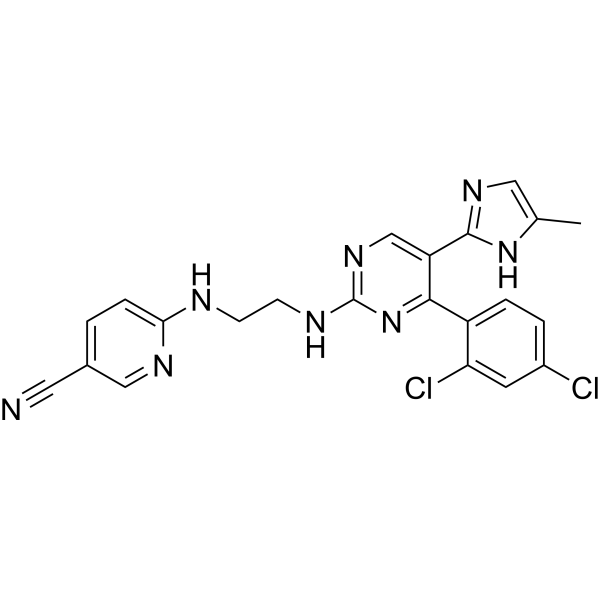
HY-10182
LaduviglusibGSK-3 Inhibitor -

HY-P76012
RSPO1/R-spondin-1 Protein, Mouse (CHO, His) -
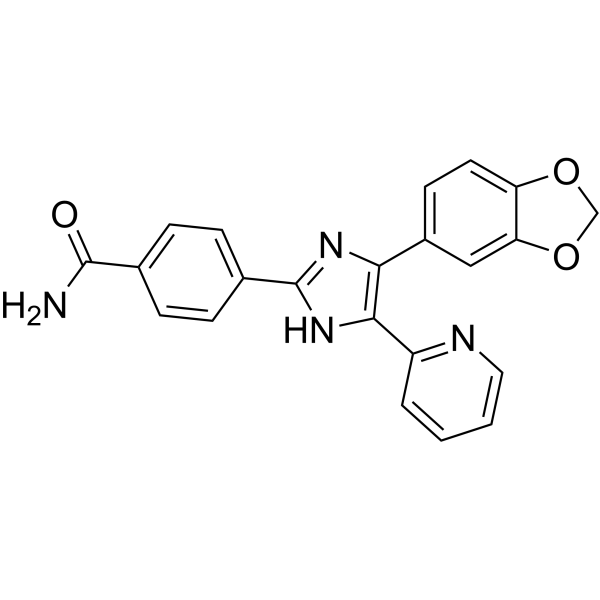
HY-10431
SB-431542TGF-β Receptor Kinase Inhibitor -
HY-P7170
KGF-2/FGF-10 Protein, Mouse -
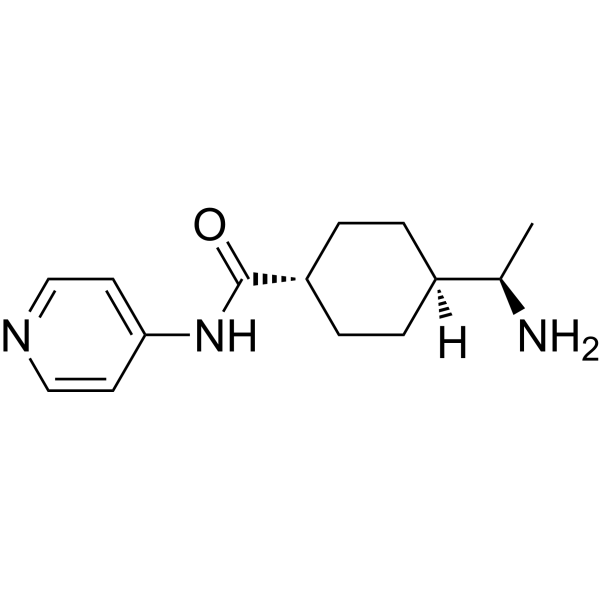
HY-10071
Y-27632ROCK Inhibitor -
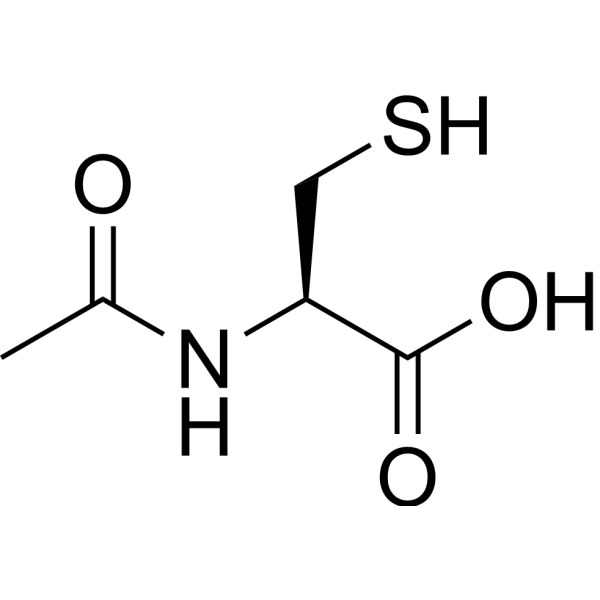
HY-B0215
AcetylcysteineMucolytic Agent -
HY-P7067
EGF Protein, Mouse -
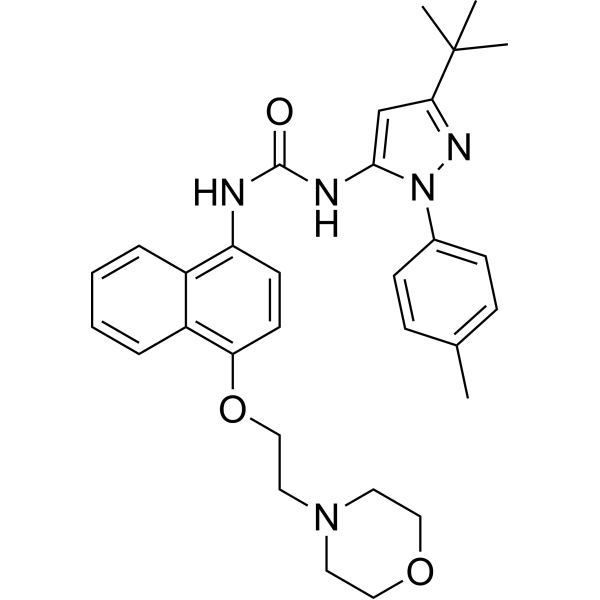
HY-10320
Doramapimodp38 MAPK Inhibitor -
HY-P7109
EGF Protein, Human -
HY-P7114
RSPO1/R-spondin-1 Protein, Human (CHO, His) -
HY-P70452
Wnt3a Protein, Mouse (His) -
HY-P7073
IL-1 beta Protein, Mouse


Biological Activity
Description
Noggin protein is an important BMP inhibitor that plays an indispensable role in the neural tube, somite growth, cartilage morphogenesis, and joint formation. Its homodimeric structure promotes significant interactions with GDF5 and possibly GDF6, inhibiting chondrocyte differentiation. Noggin Protein, Mouse (CHO) is the recombinant mouse-derived Noggin protein, expressed in CHO.
Background
Mammalian noggin is remarkably similar in its sequence to Xenopus noggin, and is similarly active in induction assays performed on Xenopus embryo tissues. In the adult mammal, noggin is most notably expressed in the nervous system[1]. Noggin is a bone morphogenetic protein (BMP) antagonist expressed in Spemann's organizer. Murine Noggin is expressed in condensing cartilage and immature chondrocytes. In mice lacking Noggin, cartilage condensations initiated normally but developed hyperplasia, and initiation of joint development failed[2]. Noggin protein binds BMP4with high affinity and can abolish BMP4 activity by blocking binding to cognate cell-surface receptors[3]. Human Noggin (hNoggin) has 205 amino acids (residues 28–232) after removal of its signal sequence (residues 1–27) and is secreted as a glycosylated, covalently linked homodimer. Human Noggin binds with high affinity to hBMP-4 (and with lower affinity to hBMP-7[4].
In Vitro
Noggin Protein, Mouse (200 ng/mL, 10 days) induces alkaline phosphatase in human mesenchymal stem cell (HMSC), and induces mineralization in HMSC into the osteoblast phenotype[5].
In Vivo
Noggin Protein, Mouse (17.8 µg/kg/day, intrathecal administration for 2 weeks) promotes the recovery of motor function and the descending corticospinal tract (CST) regeneration in mouse spinal cord injury models[6].
Verified Bioactivity
1.Measured by its ability to inhibit BMP-4-induced alkaline phosphatase production by ATDC5 mouse chondrogenic cells. The ED50 for this effect is ≤0.1 μg/mL in the presence of 30 ng/mL of Recombinant Human BMP-4 (HY-P7007), corresponding to a specific activity is ≥1×10⁵units/mg.
2.Measured by its ability to inhibit BMP-4-induced alkaline phosphatase production by ATDC5 mouse chondrogenic cells. The ED50 for this effect is ≤0.06 μg/mL in the presence of 10 ng/mL of Recombinant Human BMP-4 (HY-P7007), corresponding to a specific activity is ≥1.7×10⁷units/mg.
3.Measured by its ability to inhibit BMP-4-induced alkaline phosphatase production by ATDC5 mouse chondrogenic cells. The ED50 for this effect is 0.02-0.16 μg/mL in the presence of 50 ng/mL of Recombinant Human BMP-4 (HY-P7007).
MCE Validation Data
-
Purity - SDS-PAGE
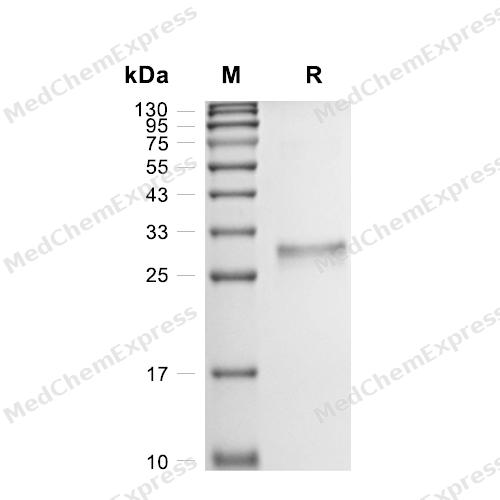
Purity - SDS-PAGE
-
Bioactivity - Cell-Based Assay
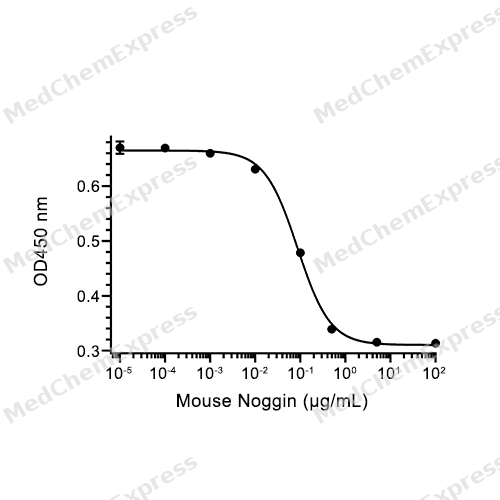
Bioactivity - Cell-Based Assay


Publications (13)
-
Journal Impact Factor
-
Most Recent
-
-
Acta Pharm Sin B
Evidence that metformin promotes fibrosis resolution via activating alveolar epithelial stem cells and FGFR2b signaling. [Abstract]2025 Sep;15(9):4711-4729. PMID: 41049730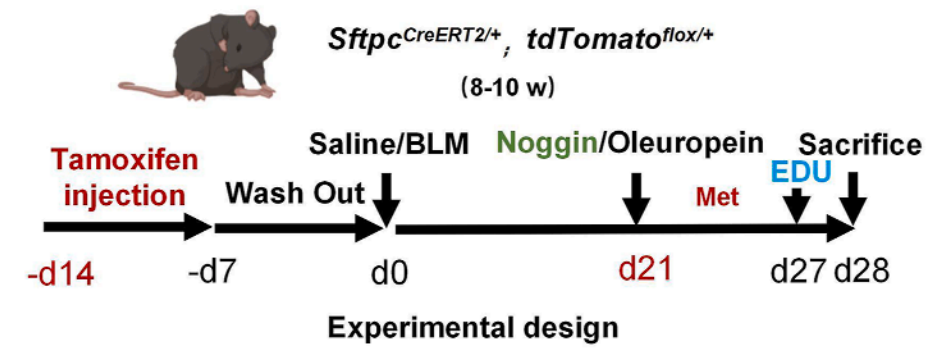
Noggin Protein, Mouse (CHO) purchased from MedChemExpress. Usage Cited in: Acta Pharm Sin B. 2025 Sep;15(9):4711-4729. [Abstract]
Timeline and scheme of combined treatment with BLM, Met and Noggin Protein or Oleuropein. The mice were sacrificed at dpi28 after BLM injury and were i.t. injected with EDU the day before sacrifice.
Noggin Protein, Mouse (CHO) purchased from MedChemExpress. Usage Cited in: Acta Pharm Sin B. 2025 Sep;15(9):4711-4729. [Abstract]
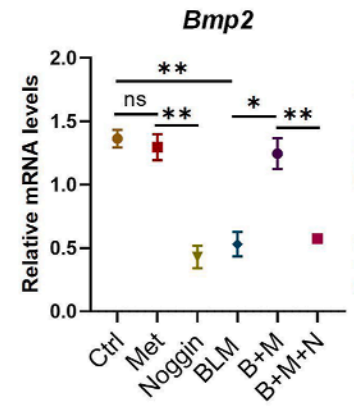
Met alone did not significantly alter the expression of Bmp2 or Pparg in the lung tissue of control mice, but Noggin or BLM treatment significantly reduced their expression levels.
-
Cell Rep Med
An Automated Organoid Platform with Inter-organoid Homogeneity and Inter-patient Heterogeneity. [Abstract]2020 Dec 22;1(9):100161. PMID: 33377132 -
Small
2020 Jun;16(22):e2001371. PMID: 32338439 -
Environ Int
Dynamic non-coding RNA biomarker reveals lung injury and repair induced by polystyrene nanoplastics. [Abstract]2025 Jan:195:109266. PMID: 39824028 -
-
Ecotoxicol Environ Saf
Melatonin mediates the BMP4/MAPK signaling pathway to alleviate zearalenone-induced abnormal embryonic development in mice. [Abstract]2025 Apr 1:294:118068. PMID: 40120487 -
Ecotoxicol Environ Saf
Prenatal triclosan exposure impairs mammalian lung branching morphogenesis through activating Bmp4 signaling. [Abstract]2023 May:256:114896. PMID: 37054474 -
ACS Pharmacol Transl Sci
Bone Morphogenetic Protein Signaling Agonist SB4 (BMPSB4) Inhibits Corticotroph Pituitary Neuroendocrine Tumors by Activation of Autophagy via a BMP4/SMADs-Dependent Pathway. [Abstract]2024 Jun 24;7(7):1951-1970. PMID: 39022361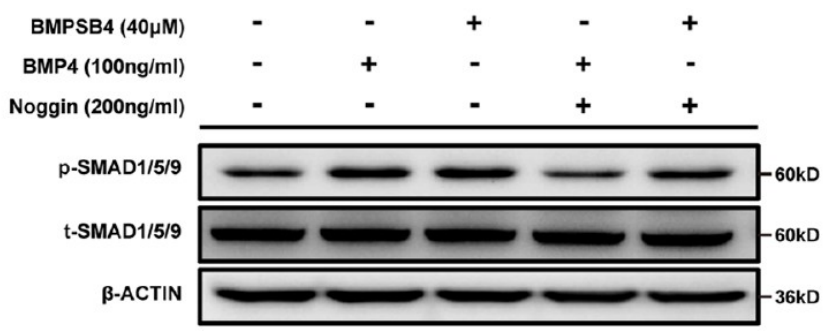
Noggin Protein, Mouse (CHO) purchased from MedChemExpress. Usage Cited in: ACS Pharmacol Transl Sci. 2024 Jun 24;7(7):1951-1970. [Abstract]
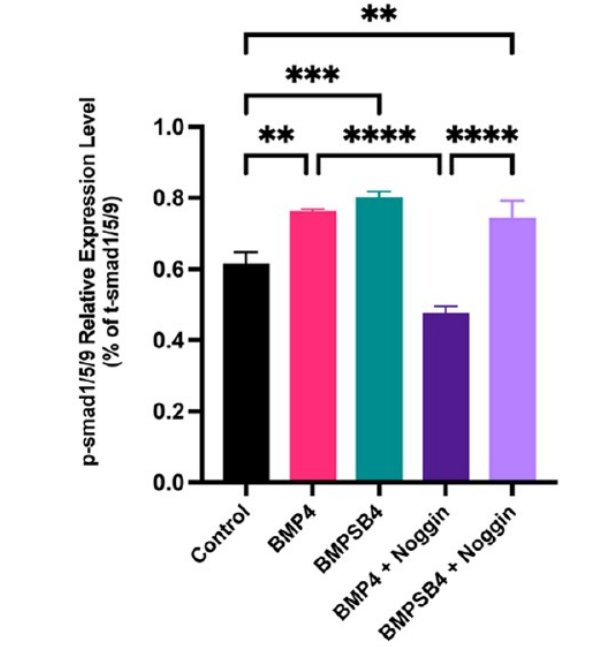
We evaluated the phosphorylation of SMAD1/5/9 by BMPSB4 compared to that by the BMP4 recombinant protein in the presence of NOGGIN (200 ng/mL), a BMP4 signaling pathway inhibitor.
Noggin Protein, Mouse (CHO) purchased from MedChemExpress. Usage Cited in: ACS Pharmacol Transl Sci. 2024 Jun 24;7(7):1951-1970. [Abstract]
200 ng/mL NOGGIN completely blocked the phosphorylation of SMAD1/5/9 induced by 100 ng/mL BMP4 but had no effect on the phosphorylation of SMAD1/5/9 induced by BMPSB4.
Noggin Protein, Mouse (CHO) purchased from MedChemExpress. Usage Cited in: ACS Pharmacol Transl Sci. 2024 Jun 24;7(7):1951-1970. [Abstract]
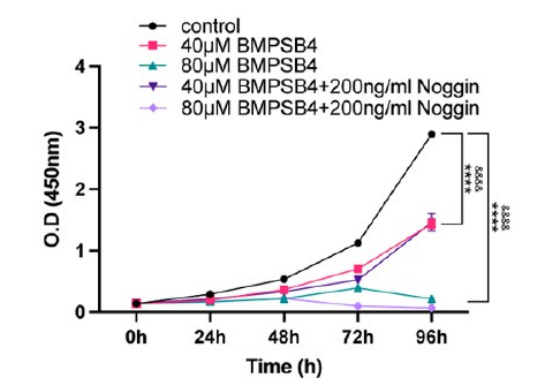
Comparison of the inhibitory effects of BMP4 and BMPSB4, and the effect of NOGGIN (200 ng/mL, 0-96 h) on these inhibitory effects. Cell viability was assessed via the CCK-8 assay.
-
J Cell Physiol
2019 Dec;234(12):22819-22832. PMID: 31124138 -
J Orthop Surg Res
Juglans regia L. extract promotes osteogenesis of human bone marrow mesenchymal stem cells through BMP2/Smad/Runx2 and Wnt/β-catenin pathways. [Abstract]2022 Feb 14;17(1):88. PMID: 35164786 -
J Bone Oncol
Identification of GPC3 mutation and upregulation in a multidrug resistant osteosarcoma and its spheroids as therapeutic target. [Abstract]2021 Sep 20:30:100391. PMID: 34611509 -
J Gastroenterol Hepatol
The Role of BMP2/4 in Intestinal Ischemia-Reperfusion Injury: Bridging Smad1/5 and Notch Pathways via Smad6. [Abstract]2025 Mar 26. PMID: 40134367


Technical Parameters
-
Species Mouse
-
Source CHO
-
Tag Tag Free
-
Accession
P97466 (L20-C232)
-
Molecular Construction
-
N-term
-
Noggin (L20-C232)
Accession # P97466 -
C-term
-
-
Protein Length
Partial
-
Synonyms
NOG; Symphalangism 1 (Proximal); Prev. SYNS1; SYNS1A; Prev. SYM1; Noggin; Synostoses (Multiple) Syndrome 1
-
AA Sequence
LRAAPAGGQHYLHIRPAPSDNLPLVDLIEHPDPIFDPKEKDLNETLLRSLLGGHYDPGFMATSPPEDRPGGGGGPAGGAEDLAELDQLLRQRPSGAMPSEIKGLEFSEGLAQGKKQRLSKKLRRKLQMWLWSQTFCPVLYAWNDLGSRFWPRYVKVGSCFSKRSCSVPEGMVCKPSKSVHLTVLRWRCQRRGGQRCGWIPIQYPIISECKCSC
-
Predicted Molecular Mass
23.8 kDa
-
Molecular Weight
Approximately 28-31 kDa, based on SDS-PAGE under reducing conditions, due to the glycosylation.
-
Glycosylation
Yes
-
Purity
≥ 95%, as determined by reducing SDS-PAGE.


Product Properties
Lyophilized powder
1.Lyophilized from a 0.22 μm filtered solution of PBS.
2.Lyophilized from a 0.22 μm filtered solution of PBS, pH 7.4.
3.Lyophilized from a 0.22 μm filtered solution of PBS, pH 7.4, 8% trehalose.
4.Lyophilized from a 0.22 μm filtered solution of 20 mM PB, 500 mM NaCl , pH 7.4, 5% trehalose, mannitol, 0.01% Tween 80.
4.Lyophilized from a 0.22 μm filtered solution of 20 mM PB, 150 mM NaCl, pH 7.4, 8% trehalose.
Please refer to the lot-specific COA for specific buffer information.
<0.2 EU/μg, determined by LAL method.
It is not recommended to reconstitute to a concentration less than 100 μg/mL in ddH2O. For long term storage it is recommended to add a carrier protein (0.1% BSA, 5% HSA, 10% FBS or 5% Trehalose).
Stored at -20°C for 2 years from date of receipt. After reconstitution, it is stable at 4°C for 1 week or -20°C for longer (with carrier protein). It is recommended to freeze aliquots at -20°C or -80°C for extended storage.
Room temperature in continental US; may vary elsewhere.


Documentation
-
Data Sheet (264 KB)
-
SDS (252 KB)
- English - EN (252 KB)
- Français - FR (252 KB)
- Deutsch - DE (252 KB)
- Norwegian - NO (252 KB)
- Español - ES (252 KB)
- Swedish - SV (252 KB)
- Italian - IT (252 KB)
- Korean - KR (252 KB)
- Portuguese - PT (252 KB)
-
Handling Instructions (2659 KB)


References
[1]. Valenzuela DM, et al. Identification of mammalian noggin and its expression in the adult nervous system. J Neurosci. 1995 Sep;15(9):6077-84. [Content Brief]
[2]. Brunet LJ, et al. Noggin, cartilage morphogenesis, and joint formation in the mammalian skeleton. Science. 1998 May 29;280(5368):1455-7. [Content Brief]
[3]. Smith WC, et al. Secreted noggin protein mimics the Spemann organizer in dorsalizing Xenopus mesoderm. Nature. 1993 Feb 11;361(6412):547-9. [Content Brief]
[4]. Groppe J, et al. Structural basis of BMP signalling inhibition by the cystine knot protein Noggin. Nature. 2002 Dec 12;420(6916):636-42. [Content Brief]
[5]. Rifas L. The role of noggin in human mesenchymal stem cell differentiation. J Cell Biochem. 2007 Mar 1;100(4):824-34. [Content Brief]
[6]. Matsuura I, et al., BMP inhibition enhances axonal growth and functional recovery after spinal cord injury. J Neurochem. 2008 May;105(4):1471-9 [Content Brief]

Calculators
Concentration (start) × Volume (start) = Concentration (final) × Volume (final)


 Powered by Bioz

