



PSMA Protein, Human (HEK293, His)
Based on 1 Customer Validation
PSMA protein, with a preference for tri-alpha-glutamate peptides, acts as a folate hydrolase and NAALADase enzyme. It uptakes folate in the intestines, modulates excitatory neurotransmission by hydrolyzing NAAG to release glutamate in the brain, and exhibits dipeptidyl-peptidase IV type activity by cleaving Gly-Pro-AMC in vitro. PSMA Protein, Human (HEK293, His) is the recombinant human-derived PSMA protein, expressed by HEK293 , with N-6*His labeled tag.
- Species: Human
- Source: HEK293
-
Storage:Stored at -20°C for 2 years from date of receipt. After reconstitution, it is stable at 4°C for 1 week or -20°C for longer (with carrier protein). It is recommended to freeze aliquots at -20°C or -80°C for extended storage.


To place orders, for customer services and technical support, please contact: MedChemExpress USA
Tel: 609-228-6898 E-mail: [email protected] [email protected]


-
 Biological Activity
-
Technical Parameters
-
Product Properties
- Documentation
- Help & FAQs




Biological Activity
Description
PSMA protein, with a preference for tri-alpha-glutamate peptides, acts as a folate hydrolase and NAALADase enzyme. It uptakes folate in the intestines, modulates excitatory neurotransmission by hydrolyzing NAAG to release glutamate in the brain, and exhibits dipeptidyl-peptidase IV type activity by cleaving Gly-Pro-AMC in vitro. PSMA Protein, Human (HEK293, His) is the recombinant human-derived PSMA protein, expressed by HEK293 , with N-6*His labeled tag.
Background
PSMA, a multifaceted enzyme, showcases both folate hydrolase and N-acetylated-alpha-linked-acidic dipeptidase (NAALADase) activities, displaying a notable preference for tri-alpha-glutamate peptides. It plays a crucial role in the intestinal uptake of folate, contributing to essential metabolic processes. Within the brain, PSMA acts as a modulator of excitatory neurotransmission by hydrolyzing the neuropeptide N-acetylaspartylglutamate (NAAG), leading to the release of glutamate. Notably, PSMA's involvement in prostate tumor progression highlights its potential significance in cancer biology. Additionally, the enzyme exhibits dipeptidyl-peptidase IV type activity and effectively cleaves Gly-Pro-AMC in vitro, further emphasizing its diverse enzymatic functions.
Verified Bioactivity
1.Measured by its ability to hydrolyze the substrate N-acetyl-L-Asp-L-Glu into N-acetyl-L-Asp and L-Glu. The L-Glu product is measured by fluorescence after its derivatization by ortho-phthaldialdehyde. The specific activity is 558.1 pmol/min/μg, as measured under the described conditions.
2.Measured by its ability to hydrolyze 10 µM substrate Spaglumic Acid (HY-100921) into N-acetyl-L-Asp and L- Glu. The L-Glu product is measured by fluorescence after its derivatization by ortho-phthaldialdehyde. that incubate at 37°C for 60 minutes.The specific activity is 550-682 pmol/min/μg.
MCE Validation Data
-
Purity - SDS-PAGE
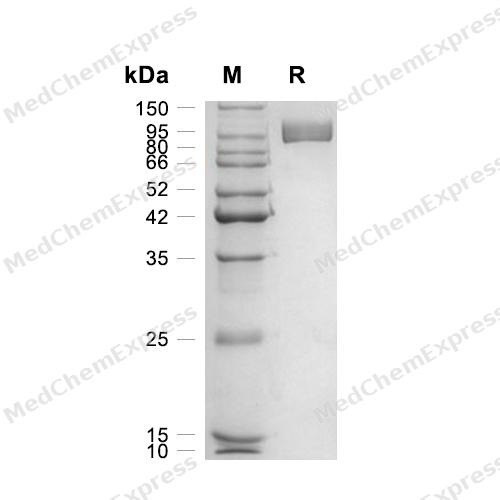
Purity - SDS-PAGE


Technical Parameters
-
Species Human
-
Source HEK293
-
Tag N-6*His
-
Accession
Q04609-1 (K44-A750)
-
Gene ID2346
-
Molecular Construction
-
N-term
-
6*His
-
PSMA (K44-A750)
Accession # Q04609-1 -
C-term
-
-
Protein Length
Extracellular Domain
-
Synonyms
FOLH1; Folylpoly-Gamma-Glutamate Carboxypeptidase; Prev. FOLH; Membrane Glutamate Carboxypeptidase; NAALAD1; Glutamate Carboxylase II; GCPII; NAALADase I; PSMA; NAALAdase; PSM; FGCP; Glutamate Carboxypeptidase II; MGCP; Glutamate Carboxypeptidase 2; Folat
-
AA Sequence
KSSNEATNITPKHNMKAFLDELKAENIKKFLYNFTQIPHLAGTEQNFQLAKQIQSQWKEFGLDSVELAHYDVLLSYPNKTHPNYISIINEDGNEIFNTSLFEPPPPGYENVSDIVPPFSAFSPQGMPEGDLVYVNYARTEDFFKLERDMKINCSGKIVIARYGKVFRGNKVKNAQLAGAKGVILYSDPADYFAPGVKSYPDGWNLPGGGVQRGNILNLNGAGDPLTPGYPANEYAYRRGIAEAVGLPSIPVHPIGYYDAQKLLEKMGGSAPPDSSWRGSLKVPYNVGPGFTGNFSTQKVKMHIHSTNEVTRIYNVIGTLRGAVEPDRYVILGGHRDSWVFGGIDPQSGAAVVHEIVRSFGTLKKEGWRPRRTILFASWDAEEFGLLGSTEWAEENSRLLQERGVAYINADSSIEGNYTLRVDCTPLMYSLVHNLTKELKSPDEGFEGKSLYESWTKKSPSPEFSGMPRISKLGSGNDFEVFFQRLGIASGRARYTKNWETNKFSGYPLYHSVYETYELVEKFYDPMFKYHLTVAQVRGGMVFELANSIVLPFDCRDYAVVLRKYADKIYSISMKHPQEMKTYSVSFDSLFSAVKNFTEIASKFSERLQDFDKSNPIVLRMMNDQLMFLERAFIDPLGLPDRPFYRHVIYAPSSHNKYAGESFPGIYDALFDIESKVDPSKAWGEVKRQIYVAAFTVQAAAETLSEVA
-
Molecular Weight
Approximately 95-115 kDa, based on SDS-PAGE under reducing conditions, due to the glycosylation.
-
Glycosylation
Yes
-
Purity
≥ 95%, as determined by reducing SDS-PAGE.


Product Properties
Lyophilized powder
1.Lyophilized from a 0.22 μm filtered solution of 20 mM PB, 150 mM NaCl, pH 7.4.
2.Lyophilized from a 0.22 μm filtered solution of 20 mM MES, 150 mM NaCl, pH 5.5.
3.Lyophilized from a 0.22 μm filtered solution of 20 mM MES, 150 mM NaCl, pH 5.5, 8% trehalose.
Please refer to the lot-specific COA for specific buffer information.
<1 EU/μg, determined by LAL method.
It is not recommended to reconstitute to a concentration less than 100 μg/mL in ddH2O. For long term storage it is recommended to add a carrier protein (0.1% BSA, 5% HSA, 10% FBS or 5% Trehalose).
Stored at -20°C for 2 years from date of receipt. After reconstitution, it is stable at 4°C for 1 week or -20°C for longer (with carrier protein). It is recommended to freeze aliquots at -20°C or -80°C for extended storage.
Room temperature in continental US; may vary elsewhere.


Documentation
-
Data Sheet (240 KB)
-
SDS (251 KB)
- English - EN (251 KB)
- Français - FR (251 KB)
- Deutsch - DE (251 KB)
- Norwegian - NO (251 KB)
- Español - ES (251 KB)
- Swedish - SV (251 KB)
- Italian - IT (251 KB)
- Korean - KR (251 KB)
- Portuguese - PT (251 KB)
-
Handling Instructions (2659 KB)

Calculators
Concentration (start) × Volume (start) = Concentration (final) × Volume (final)


 Powered by Bioz

