



RON/MSPR Protein, Human (HEK293, C-His)

Based on 1 Customer Validation
RON/MSPR protein is a receptor tyrosine kinase that transduces signals by binding to MST1 ligand and regulates cell survival, migration, and differentiation. Ligand binding induces RON autophosphorylation, creating docking sites for downstream molecules. RON/MSPR Protein, Human (HEK293, C-His) is the recombinant human-derived RON/MSPR, expressed by HEK293, with C-10*His labeled tag.
- Species: Human
- Source: HEK293
-
Storage:Stored at -20°C for 2 years from date of receipt. After reconstitution, it is stable at 4°C for 1 week or -20°C for longer (with carrier protein). It is recommended to freeze aliquots at -20°C or -80°C for extended storage.


To place orders, for customer services and technical support, please contact: MedChemExpress USA
Tel: 609-228-6898 E-mail: [email protected] [email protected]


-
 Biological Activity
-
Technical Parameters
-
Product Properties
- Documentation
- Help & FAQs




Biological Activity
Description
RON/MSPR protein is a receptor tyrosine kinase that transduces signals by binding to MST1 ligand and regulates cell survival, migration, and differentiation. Ligand binding induces RON autophosphorylation, creating docking sites for downstream molecules. RON/MSPR Protein, Human (HEK293, C-His) is the recombinant human-derived RON/MSPR, expressed by HEK293, with C-10*His labeled tag.
Background
The RON/MSPR protein, a receptor tyrosine kinase, functions as a signal transducer from the extracellular matrix by binding to MST1 ligand. It plays a crucial role in regulating various physiological processes, including cell survival, migration, and differentiation. Ligand binding at the cell surface induces autophosphorylation of RON on its intracellular domain, creating docking sites for downstream signaling molecules. Following activation by ligand, RON interacts with the PI3-kinase subunit PIK3R1, PLCG1, or the adapter GAB1, leading to the activation of multiple signaling cascades, such as RAS-ERK, PI3 kinase-AKT, and PLCgamma-PKC. RON signaling contributes to the wound healing response by promoting epithelial cell migration, proliferation, and survival at the wound site. Additionally, RON plays a role in the innate immune response by regulating the migration and phagocytic activity of macrophages. Alternatively, RON can also promote signals such as cell migration and proliferation in response to growth factors other than MST1 ligand.
Verified Bioactivity
1.This product does not contain protein kinase domain.
2.Measured by its binding ability in a functional ELISA. Immobilized MSP at 0.5 µg/mL (100 µL/well) can bind Biotinylated Recombinant Human RON. The ED50 for this effect is 0.2613 μg/mL.
MCE Validation Data
-
Purity - SDS-PAGE
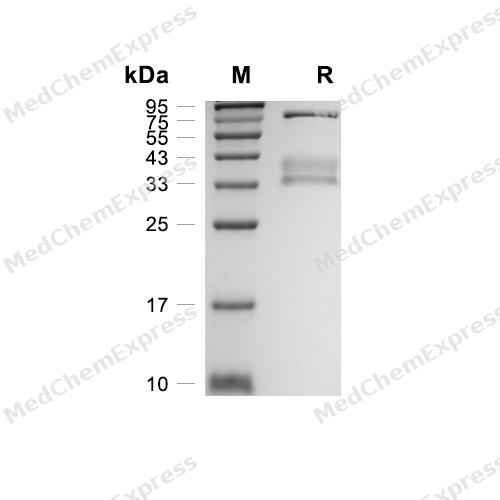
Purity - SDS-PAGE
-
Bioactivity - ELISA
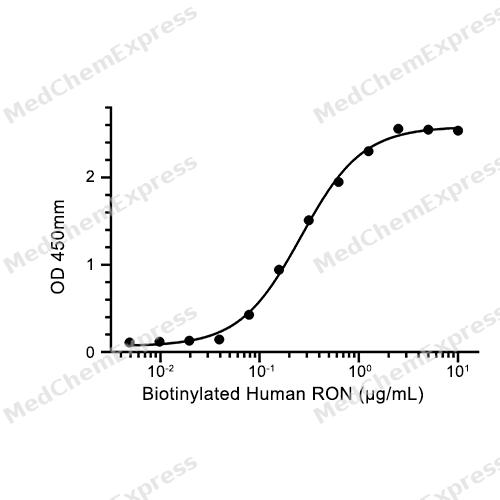
Bioactivity - ELISA


Technical Parameters
-
Species Human
-
Source HEK293
-
Tag C-10*His
-
Accession
Q04912 (E25-L571)
-
Gene ID4486
-
Protein Length
Partial Extracellular Domain
-
Synonyms
MST1R; S13 Avian Erythroblastosis Oncogene Homolog; Prev. PTK8; C-Met-Related Tyrosine Kinase; Prev. RON; MSP Receptor; Prev. SEA; S13 Erythroblastosis (Avian) Oncogene Homolog; CDw136; S13 Erythroblastosis Oncogene Homolog; Macrophage-Stimulating Protein
-
AA Sequence
EDWQCPRTPYAASRDFDVKYVVPSFSAGGLVQAMVTYEGDRNESAVFVAIRNRLHVLGPDLKSVQSLATGPAGDPGCQTCAACGPGPHGPPGDTDTKVLVLDPALPALVSCGSSLQGRCFLHDLEPQGTAVHLAAPACLFSAHHNRPDDCPDCVASPLGTRVTVVEQGQASYFYVASSLDAAVAASFSPRSVSIRRLKADASGFAPGFVALSVLPKHLVSYSIEYVHSFHTGAFVYFLTVQPASVTDDPSALHTRLARLSATEPELGDYRELVLDCRFAPKRRRRGAPEGGQPYPVLRVAHSAPVGAQLATELSIAEGQEVLFGVFVTGKDGGPGVGPNSVVCAFPIDLLDTLIDEGVERCCESPVHPGLRRGLDFFQSPSFCPNPPGLEALSPNTSCRHFPLLVSSSFSRVDLFNGLLGPVQVTALYVTRLDNVTVAHMGTMDGRILQVELVRSLNYLLYVSNFSLGDSGQPVQRDVSRLGDHLLFASGDQVFQVPIQGPGCRHFLTCGRCLRAWHFMGCGWCGNMCGQQKECPGSWQQDHCPPKL
-
Molecular Weight
Approximately 33-35 kDa & 36-43 kDa, based on SDS-PAGE under reducing conditions, due to the glycosylation.
-
Purity
≥ 95%, as determined by reducing SDS-PAGE.


Product Properties
Lyophilized powder.
Lyophilized from a 0.22 μm filtered solution of PBS, pH 7.4.
<1 EU/μg, determined by LAL method.
It is not recommended to reconstitute to a concentration less than 100 μg/mL in ddH2O. For long term storage it is recommended to add a carrier protein (0.1% BSA, 5% HSA, 10% FBS or 5% Trehalose).
Stored at -20°C for 2 years from date of receipt. After reconstitution, it is stable at 4°C for 1 week or -20°C for longer (with carrier protein). It is recommended to freeze aliquots at -20°C or -80°C for extended storage.
Room temperature in continental US; may vary elsewhere.


Documentation
-
Data Sheet (239 KB)
-
SDS (251 KB)
- English - EN (251 KB)
- Français - FR (251 KB)
- Deutsch - DE (251 KB)
- Norwegian - NO (251 KB)
- Español - ES (251 KB)
- Swedish - SV (251 KB)
- Italian - IT (251 KB)
- Korean - KR (251 KB)
- Portuguese - PT (251 KB)
-
Handling Instructions (2659 KB)

Calculators
Concentration (start) × Volume (start) = Concentration (final) × Volume (final)


 Powered by Bioz

