



Stathmin Protein, Human (C-His)

Based on 1 Customer Validation
Stathmin proteins critically regulate the microtubule filament system by actively destabilizing microtubules, inhibiting assembly, and promoting disassembly. Phosphorylation of Ser-16 is critical for axon formation during neurogenesis, highlighting its importance in neuronal development. Stathmin Protein, Human (C-His) is the recombinant human-derived Stathmin protein, expressed by E. coli , with C-6*His labeled tag.
- Species: Human
- Source: E. coli
-
Storage:Stored at -20°C for 2 years from date of receipt. After reconstitution, it is stable at 4°C for 1 week or -20°C for longer (with carrier protein). It is recommended to freeze aliquots at -20°C or -80°C for extended storage.


To place orders, for customer services and technical support, please contact: MedChemExpress USA
Tel: 609-228-6898 E-mail: [email protected] [email protected]


-
 Biological Activity
-
Technical Parameters
-
Product Properties
- Documentation
- Help & FAQs




Biological Activity
Description
Stathmin proteins critically regulate the microtubule filament system by actively destabilizing microtubules, inhibiting assembly, and promoting disassembly. Phosphorylation of Ser-16 is critical for axon formation during neurogenesis, highlighting its importance in neuronal development. Stathmin Protein, Human (C-His) is the recombinant human-derived Stathmin protein, expressed by E. coli , with C-6*His labeled tag.
Background
The Stathmin Protein plays a crucial role in regulating the microtubule filament system by actively destabilizing microtubules, thereby preventing their assembly and promoting disassembly. The phosphorylation of Stathmin at Ser-16 may be a key requirement for axon formation during neurogenesis, emphasizing its significance in neuronal development. Beyond its role in cellular architecture, Stathmin is implicated in the control of both learned and innate fear, indicating its potential involvement in complex behavioral processes. The protein binds to two alpha/beta-tubulin heterodimers, forming interactions critical for its microtubule-regulating functions. Additionally, Stathmin interacts with KIST, further expanding its network of molecular associations and suggesting its involvement in diverse cellular processes.
MCE Validation Data
-
Purity - SDS-PAGE
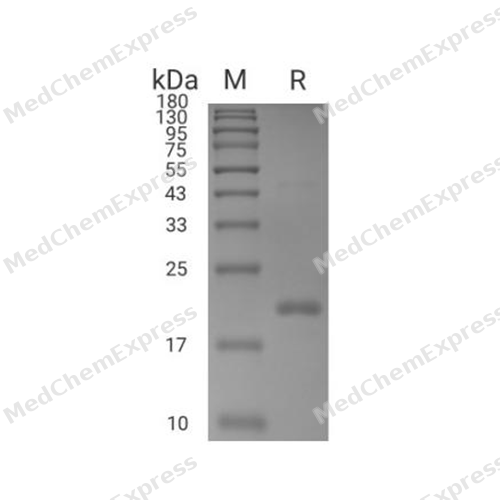
Purity - SDS-PAGE


Technical Parameters
-
Species Human
-
Source E. coli
-
Tag C-6*His
-
Accession
P16949-1 (A2-D149)
-
Molecular Construction
-
N-term
-
Stathmin (A2-D149)
Accession # P16949-1 -
6*His
-
C-term
-
-
Protein Length
Full Length of Isoform-1
-
Synonyms
STMN1; Stathmin 1/Oncoprotein 18; Prev. C1orf215; Metablastin; Prev. LAP18; FLJ32206; OP18; Prosolin; Oncoprotein 18; Chromosome 1 Open Reading Frame 215; Stathmin; Testicular Tissue Protein Li 189; PR22; Transmembrane Protein C1orf215; PP19; Phosphoprote
-
AA Sequence
ASSDIQVKELEKRASGQAFELILSPRSKESVPEFPLSPPKKKDLSLEEIQKKLEAAEERRKSHEAEVLKQLAEKREHEKEVLQKAIEENNNFSKMAEEKLTHKMEANKENREAQMAAKLERLREKDKHIEEVRKNKESKDPADETEAD
-
Predicted Molecular Mass
18.4 kDa
-
Molecular Weight
Approximately 20 kDa, based on SDS-PAGE under reducing conditions.
-
Purity
≥ 95%, as determined by reducing SDS-PAGE.


Product Properties
Lyophilized powder.
Lyophilized from a 0.2 μm filtered solution of 20 mM PB, 150 mM NaCl, pH 7.4.
<1 EU/μg, determined by LAL method.
It is not recommended to reconstitute to a concentration less than 100 μg/mL in ddH2O. For long term storage it is recommended to add a carrier protein (0.1% BSA, 5% HSA, 10% FBS or 5% Trehalose).
Stored at -20°C for 2 years from date of receipt. After reconstitution, it is stable at 4°C for 1 week or -20°C for longer (with carrier protein). It is recommended to freeze aliquots at -20°C or -80°C for extended storage.
Room temperature in continental US;may vary elsewhere.


Documentation
-
Data Sheet (235 KB)
-
SDS (251 KB)
- English - EN (251 KB)
- Français - FR (251 KB)
- Deutsch - DE (251 KB)
- Norwegian - NO (251 KB)
- Español - ES (251 KB)
- Swedish - SV (251 KB)
- Italian - IT (251 KB)
- Korean - KR (251 KB)
- Portuguese - PT (251 KB)
-
Handling Instructions (2659 KB)

Calculators
Concentration (start) × Volume (start) = Concentration (final) × Volume (final)


 Powered by Bioz

