



TLE3 Protein, Human (His)

Based on 1 Customer Validation
The TLE3 protein is a transcriptional corepressor that inhibits Wnt signaling by binding to transcription factors such as CTNNB1 and TCF family members. It forms homotetramers, hetero-oligomers, and interacts with AES.TLE3 Protein, Human (His) is the recombinant human-derived TLE3 protein, expressed by E. coli , with N-GST labeled tag.
- Species: Human
- Source: E. coli
-
Storage:Stored at -20°C for 2 years from date of receipt. After reconstitution, it is stable at 4°C for 1 week or -20°C for longer (with carrier protein). It is recommended to freeze aliquots at -20°C or -80°C for extended storage.


To place orders, for customer services and technical support, please contact: MedChemExpress USA
Tel: 609-228-6898 E-mail: [email protected] [email protected]


-
 Biological Activity
-
Technical Parameters
-
Product Properties
- Documentation
- Help & FAQs




Biological Activity
Description
The TLE3 protein is a transcriptional corepressor that inhibits Wnt signaling by binding to transcription factors such as CTNNB1 and TCF family members. It forms homotetramers, hetero-oligomers, and interacts with AES.TLE3 Protein, Human (His) is the recombinant human-derived TLE3 protein, expressed by E. coli , with N-GST labeled tag.
Background
TLE3, a transcriptional corepressor, intricately regulates gene expression by binding to various transcription factors and exerting inhibitory effects on transcriptional activation mediated by CTNNB1 and TCF family members in the Wnt signaling pathway. TLE3 forms homotetramers and heterooligomers with other family members, and its regulatory influence may be modulated by its association with the dominant-negative factor AES. Among its molecular interactions, TLE3 binds to LEF1, TCF7, and TCF7L1, establishing its involvement in modulating the transcriptional activities of these crucial factors. Additionally, TLE3 engages in protein-protein interactions with FOXA2, XIAP/BIRC4, and TCF7L2/TCF4. Notably, its interaction with TBX18, involving the engrailed homology 1 repressor motif, leads to a reduction in TBX18's transcriptional activity, underscoring TLE3's role in finely tuning specific transcriptional responses.
MCE Validation Data
-
Purity - SDS-PAGE
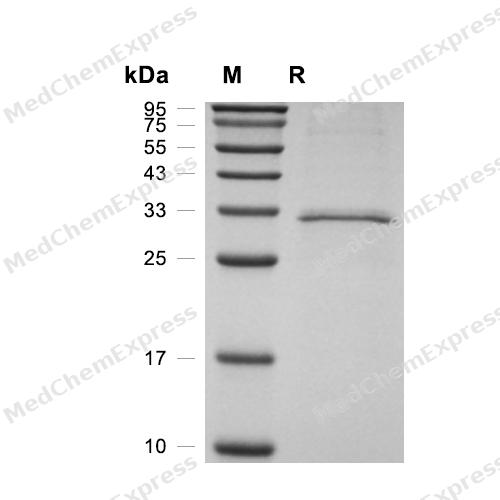
Purity - SDS-PAGE


Technical Parameters
-
Species Human
-
Source E. coli
-
Tag N-6*His;N-GST
-
Accession
Q04726 (S484-Y772)
-
Molecular Construction
-
N-term
-
His
-
TLE3 (S484-Y772)
Accession # Q04726 -
C-term
-
-
Protein Length
Partial
-
Synonyms
TLE3; Enhancer Of Split Groucho-Like Protein 3; TLE Family Member 3, Transcriptional Corepressor; Transducin Like Enhancer Of Split 3; ESG3; Transducin-Like Enhancer Protein 3; HsT18976; Transducin-Like Enhancer Of Split 3, Homolog Of Drosophila E(Sp1); K
-
AA Sequence
SHGEVVCAVTISNPTRHVYTGGKGCVKIWDISQPGSKSPISQLDCLNRDNYIRSCKLLPDGRTLIVGGEASTLTIWDLASPTPRIKAELTSSAPACYALAISPDAKVCFSCCSDGNIAVWDLHNQTLVRQFQGHTDGASCIDISHDGTKLWTGGLDNTVRSWDLREGRQLQQHDFTSQIFSLGYCPTGEWLAVGMESSNVEVLHHTKPDKYQLHLHESCVLSLKFAYCGKWFVSTGKDNLLNAWRTPYGASIFQSKESSSVLSCDISADDKYIVTGSGDKKATVYEVIY
-
Predicted Molecular Mass
31.7 kDa
-
Molecular Weight
Approximately 32 kDa, based on SDS-PAGE under reducing conditions.
-
Purity
≥ 95%, as determined by reducing SDS-PAGE.


Product Properties
Lyophilized powder.
Lyophilized from a 0.22 μm filtered solution of 20 mM Tris-HCl, 150 mM NaCl, 5 mM GSH, pH 7.5.
Note: For SPR assay, please replace the buffer. Primary amine components (e.g., Tris, imidazole) can affect protein-coupled chips.
<1 EU/μg, determined by LAL method.
It is not recommended to reconstitute to a concentration less than 100 μg/mL in ddH2O. For long term storage it is recommended to add a carrier protein (0.1% BSA, 5% HSA, 10% FBS or 5% Trehalose).
Stored at -20°C for 2 years from date of receipt. After reconstitution, it is stable at 4°C for 1 week or -20°C for longer (with carrier protein). It is recommended to freeze aliquots at -20°C or -80°C for extended storage.
Room temperature in continental US; may vary elsewhere.


Documentation
-
Data Sheet (237 KB)
-
SDS (251 KB)
- English - EN (251 KB)
- Français - FR (251 KB)
- Deutsch - DE (251 KB)
- Norwegian - NO (251 KB)
- Español - ES (251 KB)
- Swedish - SV (251 KB)
- Italian - IT (251 KB)
- Korean - KR (251 KB)
- Portuguese - PT (251 KB)
-
Handling Instructions (2659 KB)

Calculators
Concentration (start) × Volume (start) = Concentration (final) × Volume (final)


 Powered by Bioz

