



TNF RII/TNFRSF1B Protein, Human (HEK293, hFc)
Based on 1 publication(s) in Google Scholar
TNFRII (TNFRSF1B) protein has a high ability to bind with tumor necrosis factor-alpha (TNF-α). TNFRII has pro-apoptotic function. TNFRII recruits TRAF2, induces gene expression and intensively crosstalks with TNF-R1. TNFRII selectively enhances the induction of apoptosis by the death receptor TNFRI. TNFRII Protein, Human (HEK293, hFc) is expressed by HEK293 and has a transmembrane region (L23-D257) with hFc tag at the C-terminus.
- Species: Human
- Source: HEK293
-
Storage:Stored at -20°C for 2 years from date of receipt. After reconstitution, it is stable at 4°C for 1 week or -20°C for longer (with carrier protein). It is recommended to freeze aliquots at -20°C or -80°C for extended storage.


To place orders, for customer services and technical support, please contact: MedChemExpress USA
Tel: 609-228-6898 E-mail: [email protected] [email protected]


-
 Biological Activity
-
Technical Parameters
-
Product Properties
- Documentation
- References
- Help & FAQs




Biological Activity
Description
TNFRII (TNFRSF1B) protein has a high ability to bind with tumor necrosis factor-alpha (TNF-α). TNFRII has pro-apoptotic function. TNFRII recruits TRAF2, induces gene expression and intensively crosstalks with TNF-R1. TNFRII selectively enhances the induction of apoptosis by the death receptor TNFRI. TNFRII Protein, Human (HEK293, hFc) is expressed by HEK293 and has a transmembrane region (L23-D257) with hFc tag at the C-terminus[1].
Background
TNFRII (TNFRSF1B) protein is a single-pass type I membrane protein belonging to the tumor necrosis factor (TNF) family. TNFRII is the major signaling receptor for TNF-α. TNFRII protein is highly regulated and typically found in immune system cells[1].
The amino acid sequence of mouse TNFRII protein has low homology between human and rhesus macaque TNFRII protein (less than 85%). The amino acid sequence of TNFRII protein in human and rhesus macaque is very similar (percent identity matrix of 95.88%).
TNFRII induces apoptosis. TNFRII does not directly engage the apoptotic program, but relies on the induction of endogenous, membrane-bound TNF, which subsequently activates TNFRI. TNFRII stimulates the action of the endogenously produced membrane-bound TNF on TNFRI is drastically enhanced. TNFRII competes with TNFRI for the recruitment of newly synthesized TRAF2-bound anti-apoptotic factors, thereby promoting the formation of a caspase-8-activating TNFRI complex. TNFRII competes with TNFRI for binding of TRAF2 and the TRAF2-associated anti-apoptotic cIAP1 and cIAP2 proteins. cIAP1-initiated degradation of TRAF2, which in turn enhances receptor competition for the remaining TRAF2, cIAP1 and cIAP2 molecules. cIAP1 would have an anti-apoptotic function upon recruitment into the TNFRI signalling complex, but would switch to a net proapoptotic function upon recruitment into the TNFRII signalling complex[1][2][3].
Verified Bioactivity
1.Measured by its ability to inhibit the TNF-alpha mediated cytotoxicity in the L-929 mouse fibroblast cells in the presence of the metabolic inhibitor actinomycin D. The ED50 for this effect, in the presence of 0.25 ng/mL of TNF-alpha, is 0.0014 µg/mL corresponding to a specific activity is 7.143×10⁵ units/mg.
2.Measured by its binding ability in a functional ELISA. Immobilized TNF-α at 0.5 μg/mL can bind human TNFR2, the EC50 of human TNFR2 protein is 1-15 ng/mL.
MCE Validation Data
-
Bioactivity - Cell-Based Assay
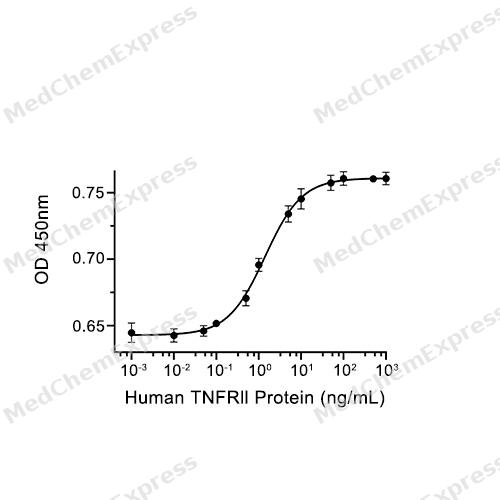
Bioactivity - Cell-Based Assay


Publications (1)
-
Journal Impact Factor
-
Most Recent
-
J Immunother Cancer
HSP47 inhibition-induced CD155 expression through TRAF2 deubiquitination promotes tumor immune evasion. [Abstract]2025 Nov 28;13(11):e011976. PMID: 41314980


Technical Parameters
-
Species Human
-
Source HEK293
-
Tag C-hFc
-
Accession
P20333-1 (L23-D257)
-
Molecular Construction
-
N-term
-
TNFRII (L23-D257)
Accession # P20333 -
hFc
-
C-term
-
-
Protein Length
Extracellular Domain
-
Synonyms
TNFRSF1B; TNF-R2; Prev. TNFR2; Tumor Necrosis Factor Receptor Superfamily, Member 1B; TNFBR; Tumor Necrosis Factor Receptor Superfamily, Member 1b; P75; Tumor Necrosis Factor Binding Protein 2; TNF-R-II; Tumor Necrosis Factor Beta Receptor; TNF-R75; Solub
-
AA Sequence
LPAQVAFTPYAPEPGSTCRLREYYDQTAQMCCSKCSPGQHAKVFCTKTSDTVCDSCEDSTYTQLWNWVPECLSCGSRCSSDQVETQACTREQNRICTCRPGWYCALSKQEGCRLCAPLRKCRPGFGVARPGTETSDVVCKPCAPGTFSNTTSSTDICRPHQICNVVAIPGNASMDAVCTSTSPTRSMAPGAVHLPQPVSTRSQHTQPTPEPSTAPSTSFLLPMGPSPPAEGSTGD
-
Predicted Molecular Mass
54.1 kDa
-
Molecular Weight
Approximately 66-80 kDa, based on SDS-PAGE under reducing conditions, due to the glycosylation.
-
Glycosylation
Yes
-
Purity
≥ 95%, as determined by reducing SDS-PAGE.


Product Properties
Lyophilized powder
Lyophilized from a 0.22 μm filtered solution of PBS, 6% trehalose, pH 7.4.
<1 EU/μg, determined by LAL method.
It is not recommended to reconstitute to a concentration less than 100 μg/mL in ddH2O.
Stored at -20°C for 2 years from date of receipt. After reconstitution, it is stable at 4°C for 1 week or -20°C for longer (with carrier protein). It is recommended to freeze aliquots at -20°C or -80°C for extended storage.
Room temperature in continental US; may vary elsewhere.


Documentation
-
Data Sheet (264 KB)
-
SDS (252 KB)
- English - EN (252 KB)
- Français - FR (252 KB)
- Deutsch - DE (252 KB)
- Norwegian - NO (252 KB)
- Español - ES (252 KB)
- Swedish - SV (252 KB)
- Italian - IT (252 KB)
- Korean - KR (252 KB)
- Portuguese - PT (252 KB)
-
Handling Instructions (2659 KB)


References
[1]. Wajant H, et, al. Tumor necrosis factor signaling. Cell Death Differ. 2003 Jan;10(1):45-65. [Content Brief]
[2]. Fotin-Mleczek M, et, al. Apoptotic crosstalk of TNF receptors: TNF-R2-induces depletion of TRAF2 and IAP proteins and accelerates TNF-R1-dependent activation of caspase-8. J Cell Sci. 2002 Jul 1;115(Pt 13):2757-70. [Content Brief]
[3]. Masli S, et, al. Anti-inflammatory effects of tumour necrosis factor (TNF)-alpha are mediated via TNF-R2 (p75) in tolerogenic transforming growth factor-beta-treated antigen-presenting cells. Immunology. 2009 May;127(1):62-72. [Content Brief]

Calculators
Concentration (start) × Volume (start) = Concentration (final) × Volume (final)


 Powered by Bioz

