



Kinesin-7/CENP-E
CENP-E/KIF10 is a kinesin-7 kinetochore motor that positions chromosomes at the metaphase plate and supports kinetochore-microtubule attachment during mitosis[1][2]. Mechanistically, CENP-E acts in chromosome congression, bioriented spindle attachment, and spindle assembly checkpoint control, because CENP-E loss produces aligned and unaligned chromosomes with mitotic arrest[2][3]. CENP-E also behaves as a processive microtubule plus-end motor and a bidirectional tracker of dynamic microtubule tips, linking chromosome movement with stable kinetochore-microtubule end attachment[4]. In meiotic models, CENP-E inhibition or depletion causes chromosome misalignment, metaphase arrest, spindle elongation, spindle disorganization, and chromosome instability in mouse spermatocytes[5]. Compared with related mitotic motors, Kid and CENP-E make different contributions to chromosome congression, and CENP-E can suppress congression when microtubules remain short and unstable[6]. Recent cancer-cell data further distinguish CENP-E from KIF18A, because KIF18A promotes chromosome congression in cooperation with CENP-E downstream of CENP-C[7]. For experimental applications, GSK923295 inhibits CENP-E ATPase activity, locks the motor domain on microtubules, disrupts metaphase chromosome alignment, induces mitotic arrest, and supports aneuploidy-generation assays[8][9].
References:
- [1]. Wood KW, et al. CENP-E is a plus end-directed kinetochore motor required for metaphase chromosome alignment. Cell. 1997 Oct 31;91(3):357-66. [Content Brief]
- [2]. Schaar BT, et al. CENP-E function at kinetochores is essential for chromosome alignment. J Cell Biol. 1997 Dec 15;139(6):1373-82. [Content Brief]
- [3]. McEwen BF, et al. CENP-E is essential for reliable bioriented spindle attachment, but chromosome alignment can be achieved via redundant mechanisms in mammalian cells. Mol Biol Cell. 2001 Sep;12(9):2776-89. [Content Brief]
- [4]. Gudimchuk N, et al. Kinetochore kinesin CENP-E is a processive bi-directional tracker of dynamic microtubule tips. Nat Cell Biol. 2013 Sep;15(9):1079-1088. [Content Brief]
- [5]. She ZY, et al. Kinesin-7 CENP-E is essential for chromosome alignment and spindle assembly of mouse spermatocytes. Biochim Biophys Acta Mol Cell Res. 2022 Sep;1869(9):119306. [Content Brief]
- [6]. Iemura K, et al. Chromokinesin Kid and kinetochore kinesin CENP-E differentially support chromosome congression without end-on attachment to microtubules. Nat Commun. 2015 Mar 6;6:6447. [Content Brief]
- [7]. Miao J, et al. KIF18A promotes chromosome congression in cooperation with CENP-E downstream of CENP-C. Cell Rep. 2025 Nov 25;44(11):116515. [Content Brief]
- [8]. Wood KW, et al. Antitumor activity of an allosteric inhibitor of centromere-associated protein-E. Proc Natl Acad Sci U S A. 2010 Mar 30;107(13):5839-44. [Content Brief]
- [9]. Bennett A, et al. Cenp-E inhibitor GSK923295: Novel synthetic route and use as a tool to generate aneuploidy. Oncotarget. 2015 Aug 28;6(25):20921-32. [Content Brief]
All Product Categories
-
Kinesin-7/CENP-E Related Products (6)
Related Products (6)

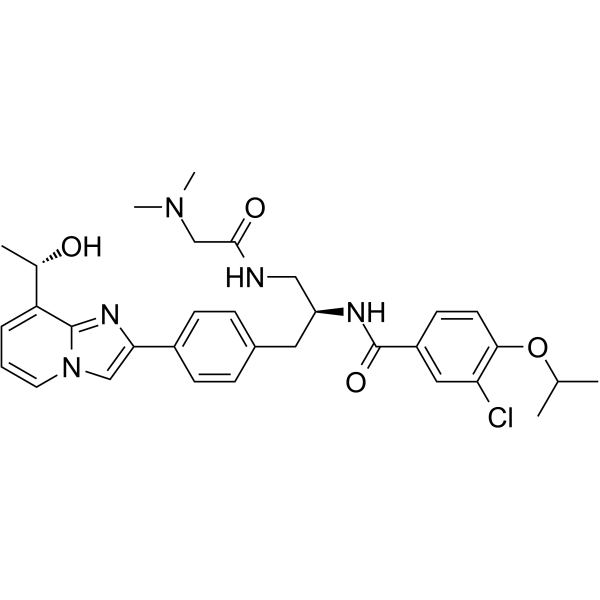
-
PF-2771
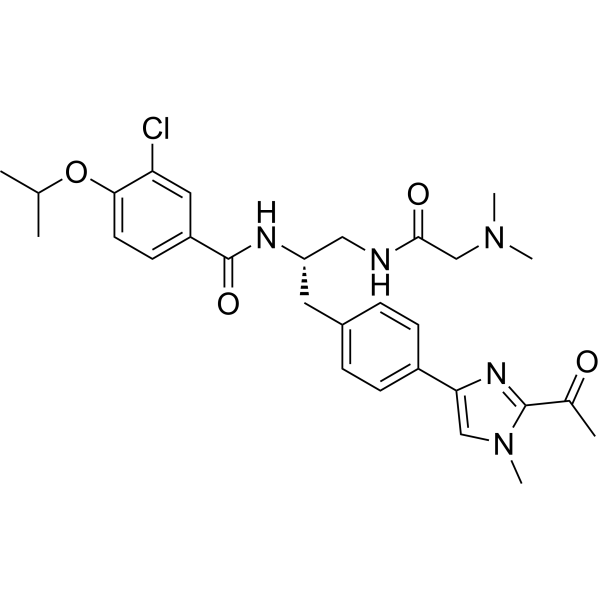 0 ImagesPF-2771 is a potent and selective centromere protein E (CENP-E) inhibitor, inhibiting CENP-E motor activity with an IC50 of 16.1 nM; PF-2771 is used as an anticancer agent.
-
Syntelin
 0 ImagesSyntelin is a selective centromere protein E (CENP-E) inhibitor with IC50 at 160 nM. Syntelin has antitumor activity.

-
CENP-E-IN-1
 0 ImagesCat. No.: HY-125106CAS No.: 1446399-26-3CENP-E-IN-1 is a CENP-E inhibitor. CENP-E-IN-1 acts as a Mitotic arrest inducer and Apoptosis inducer, which causes abnormal alignment of chromosomes on the metaphase plate, activates the spindle assembly checkpoint and triggers apoptosis. CENP-E-IN-1 exhibits anti-tumor activity in colorectal adenocarcinoma xenograft models. CENP-E-IN-1 can be used in cancer-related research.




