



BCL2 Protein, Human (His)
Based on 1 publication(s) in Google Scholar
BCL2 Protein regulates the mitochondrial membrane permeability, and inhibits the caspase activity, thereby suppressing the apoptosis in various cell types. BCL2 Protein interacts with BECN1 and AMBRA1, and inhibits the autophagy. BCL2 Protein, Human (His) is the human-derived resombinant BCL2 Protein that is expressed in in E. coli with a His tag at the C-terminus.
- Species: Human
- Source: E. coli
-
Storage:Stored at -80°C for 1 year from date of receipt. It is stable at -20°C for 3 months after opening. It is recommended to freeze aliquots at -80°C for extended storage. Avoid repeated freeze-thaw cycles.


To place orders, for customer services and technical support, please contact: MedChemExpress USA
Tel: 609-228-6898 E-mail: [email protected] [email protected]


-
 Biological Activity
-
Technical Parameters
-
Product Properties
- Documentation
- References
- Help & FAQs




Biological Activity
Description
BCL2 Protein regulates the mitochondrial membrane permeability, and inhibits the caspase activity, thereby suppressing the apoptosis in various cell types. BCL2 Protein interacts with BECN1 and AMBRA1, and inhibits the autophagy. BCL2 Protein, Human (His) is the human-derived resombinant BCL2 Protein that is expressed in in E. coli with a His tag at the C-terminus.
Background
Key regulators include proteins of the Bcl-2 family, some of which (e.g., Bcl-2, Bcl-xL, Mcl-1, and A1) promote cell survival while others (e.g., Bax and Bak) antagonize it. Disrupted regulation of apoptosis is implicated strongly in cancer and in autoimmune and degenerative diseases[1].
In Vivo
BCL2 Protein, Human (1 mg/mouse, ip, every 12 hours for 3 days) reduces the number of apoptotic cells in the heart and intestine, improves the survival rate of mice in cecal ligation and puncture (CLP)-induced sepsis models[2].
BCL2 Protein, Human (1 mg/mouse, ip, single dose) reduces cell apoptosis after ischemia-reperfusion (I/R) injury, attenuates the I/R injury of hindlimb skeletal muscle and myocardium in mouse ischemia-reperfusion model[3].
Verified Bioactivity
Immobilized Human Human BCL2 at 10 μg/mL (100 μL/well) can bind biotinylated Mouse Bcl-XL. The ED50 for this effect is 0.07-0.15 μg/mL.
MCE Validation Data
-
Purity - SDS-PAGE
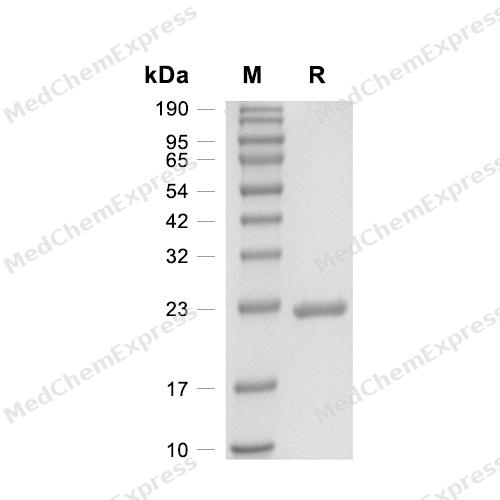
Purity - SDS-PAGE
-
Bioactivity - ELISA
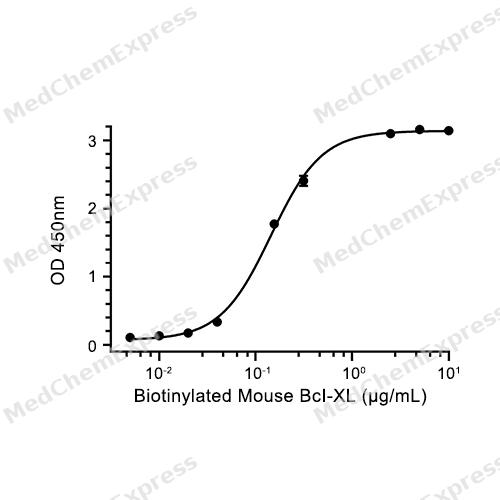
Bioactivity - ELISA


Publications (1)
-
Journal Impact Factor
-
Most Recent
-
Nat Commun
2026 Jun 17;17(1):5359. PMID: 42309990


Technical Parameters
-
Species Human
-
Source E. coli
-
Tag C-6*His
-
Accession
P10415-1 (M1-D211)
-
Molecular Construction
-
N-term
-
BCL2 (M1-D211)
Accession # P10415 -
6*His
-
C-term
-
-
Protein Length
Partial
-
Synonyms
BCL2; Protein Phosphatase 1, Regulatory Subunit 50; BCL2 Apoptosis Regulator; B-Cell CLL/Lymphoma 2; Apoptosis Regulator Bcl-2; BCL2, Apoptosis Regulator; PPP1R50; BCL2 Protein; Bcl-2
-
AA Sequence
MAHAGRTGYDNREIVMKYIHYKLSQRGYEWDAGDVGAAPPGAAPAPGIFSSQPGHTPHPAASRDPVARTSPLQTPAAPGAAAGPALSPVPPVVHLTLRQAGDDFSRRYRRDFAEMSSQLHLTPFTARGRFATVVEELFRDGVNWGRIVAFFEFGGVMCVESVNREMSPLVDNIALWMTEYLNRHLHTWIQDNGGWDAFVELYGPSMRPLFD
-
Molecular Weight
Approximately 22-27 kDa, based on SDS-PAGE under reducing conditions.
-
Purity
≥ 95%, as determined by reducing SDS-PAGE.


Product Properties
Solution
1.Supplied as a 0.22 μm filtered solution of 50 mM Tris-HCl, 150 mM NaCl, 100 mM arginine, pH 8.0, 20% glycerol.
2.Supplied as a 0.22 μm filtered solution of 50 mM Tris-HCl, pH 8.0, 10% glycerol.
Please refer to the lot-specific COA for specific buffer information.
Note: For SPR assay, please replace the buffer. Primary amine components (e.g., Tris, imidazole) can affect protein-coupled chips.
<1 EU/μg, determined by LAL method.
Stored at -80°C for 1 year from date of receipt. It is stable at -20°C for 3 months after opening. It is recommended to freeze aliquots at -80°C for extended storage. Avoid repeated freeze-thaw cycles.
Shipping with dry ice.


Documentation
-
Data Sheet (263 KB)
-
SDS (252 KB)
- English - EN (252 KB)
- Français - FR (252 KB)
- Deutsch - DE (252 KB)
- Norwegian - NO (252 KB)
- Español - ES (252 KB)
- Swedish - SV (252 KB)
- Italian - IT (252 KB)
- Korean - KR (252 KB)
- Portuguese - PT (252 KB)
-
Handling Instructions (2659 KB)


References
[1]. Print CG, et al. Apoptosis regulator bcl-w is essential for spermatogenesis but appears otherwise redundant. Proc Natl Acad Sci U S A. 1998 Oct 13;95(21):12424-31. [Content Brief]
[2]. Iwata A, et al., Extracellular administration of BCL2 protein reduces apoptosis and improves survival in a murine model of sepsis. PLoS One. 2011 Feb 24;6(2):e14729. [Content Brief]
[3]. Iwata A, et al., Extracellular BCL2 proteins are danger-associated molecular patterns that reduce tissue damage in murine models of ischemia-reperfusion injury. PLoS One. 2010 Feb 8;5(2):e9103. [Content Brief]

Calculators
Concentration (start) × Volume (start) = Concentration (final) × Volume (final)


 Powered by Bioz

