



BDNF Protein, Mouse (R129A, R130A, HEK293, C-His)
Based on 1 Customer Validation
BDNF protein is an important signaling molecule that activates NTRK2 downstream cascades and affects multiple roles in neuronal development and function. It promotes survival and differentiation of the peripheral and central nervous system, affecting axonal and dendritic growth. BDNF Protein, Mouse (R129A, R130A, HEK293, C-His) is the recombinant mouse-derived BDNF protein, expressed by HEK293 , with C-6*His labeled tag and R129A, R130A mutation.
- Species: Mouse
- Source: HEK293
-
Storage:Stored at -20°C for 2 years from date of receipt. After reconstitution, it is stable at 4°C for 1 week or -20°C for longer (with carrier protein). It is recommended to freeze aliquots at -20°C or -80°C for extended storage.


To place orders, for customer services and technical support, please contact: MedChemExpress USA
Tel: 609-228-6898 E-mail: [email protected] [email protected]


-
 Biological Activity
-
Technical Parameters
-
Product Properties
- Documentation
- Help & FAQs





Biological Activity
Description
BDNF protein is an important signaling molecule that activates NTRK2 downstream cascades and affects multiple roles in neuronal development and function. It promotes survival and differentiation of the peripheral and central nervous system, affecting axonal and dendritic growth. BDNF Protein, Mouse (R129A, R130A, HEK293, C-His) is the recombinant mouse-derived BDNF protein, expressed by HEK293 , with C-6*His labeled tag and R129A, R130A mutation.
Background
The BDNF protein serves as a pivotal signaling molecule, activating cascades downstream of NTRK2 and playing diverse roles in neuronal development and function. During development, BDNF promotes the survival and differentiation of specific neuronal populations in both the peripheral and central nervous systems, influencing axonal growth, pathfinding, and the modulation of dendritic growth and morphology. It emerges as a major regulator of synaptic transmission and plasticity in various regions of the CNS, contributing to adaptive neuronal responses such as long-term potentiation (LTP), long-term depression (LTD), certain forms of short-term synaptic plasticity, and the homeostatic regulation of intrinsic neuronal excitability. This versatility underscores its integral role in shaping neuronal connectivity and function. Additionally, BDNF activates signaling cascades through the heterodimeric receptor formed by NGFR and SORCS2, further influencing synaptic plasticity and long-term depression. Notably, its interaction with NGFR and SORCS2 is implicated in promoting neuronal apoptosis and growth cone collapse, highlighting its multifaceted impact on neuronal physiology and development.
Verified Bioactivity
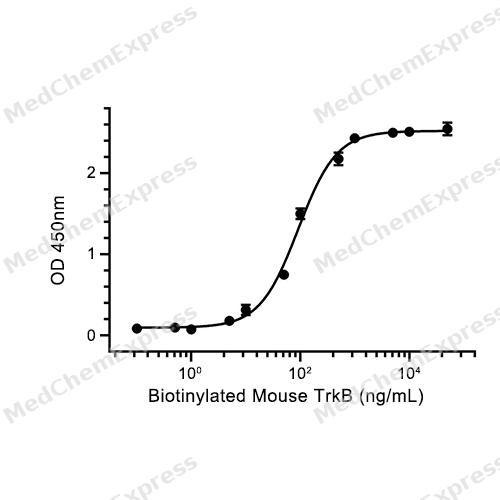
Immobilized Recombinant Mouse BDNF at 1 μg/mL (100 μL/well) can bind Biotinylated Recombinant Mouse TrkB. The ED50 for this effect is <100 ng/mL.
MCE Validation Data
-
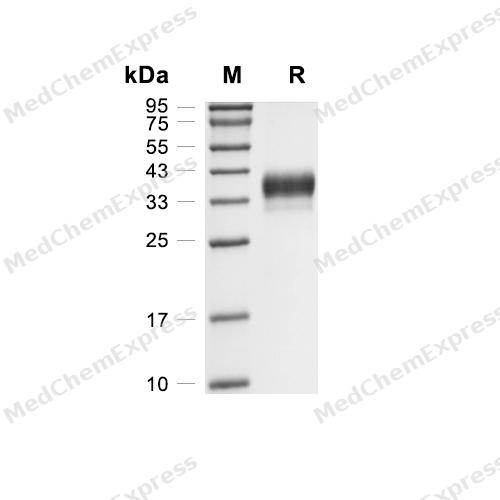
Purity - SDS-PAGE
Purity - SDS-PAGE
-
Bioactivity - ELISA
Bioactivity - ELISA


Technical Parameters
-
Species Mouse
-
Source HEK293
-
Tag C-6*His
-
Accession
P21237-1 (A19-R249, R129A, R130A)
-
Gene ID12064
-
Molecular Construction
-
N-term
-
BDNF (A19-R249, R129A, R130A)
Accession # P21237 -
6*His
-
C-term
-
-
Protein Length
Full Length of Neurotrophic factor BDNF, precursor form
-
Synonyms
BDNF; Abrineurin; Brain Derived Neurotrophic Factor; Brain-Derived Neurotrophic Factor Preproprotein Isoform 2; ProBDNF; Brain-Derived Neurotrophic Factor Isoform 1; Neurotrophic Factor BDNF Precursor Form; ANON2; Brain-Derived Neurotrophic Factor; BULN2;
-
AA Sequence
APMKEVNVHGQGNLAYPGVRTHGTLESVNGPRAGSRGLTTTSLADTFEHVIEELLDEDQKVRPNEENHKDADLYTSRVMLSSQVPLEPPLLFLLEEYKNYLDAANMSMRVAAHSDPARRGELSVCDSISEWVTAADKKTAVDMSGGTVTVLEKVPVSKGQLKQYFYETKCNPMGYTKEGCRGIDKRHWNSQCRTTQSYVRALTMDSKKRIGWRFIRIDTSCVCTLTIKRGR
-
Predicted Molecular Mass
26.7 kDa
-
Molecular Weight
Approximately 35-42 kDa, based on SDS-PAGE under reducing conditions, due to the glycosylation.
-
Glycosylation
Yes
-
Purity
≥ 95%, as determined by reducing SDS-PAGE.


Product Properties
Lyophilized powder
1.Lyophilized from a 0.22 μm filtered solution of 20 mM PB, 150 mM NaCl, pH 7.4.
2.Lyophilized from a 0.22 μm filtered solution of PBS, pH 7.4.
Please refer to the lot-specific COA for specific buffer information.
<1 EU/μg, determined by LAL method.
It is not recommended to reconstitute to a concentration less than 100 μg/mL in ddH2O. For long term storage it is recommended to add a carrier protein (0.1% BSA, 5% HSA, 10% FBS or 5% Trehalose).
Stored at -20°C for 2 years from date of receipt. After reconstitution, it is stable at 4°C for 1 week or -20°C for longer (with carrier protein). It is recommended to freeze aliquots at -20°C or -80°C for extended storage.
Room temperature in continental US; may vary elsewhere.


Documentation
-
Data Sheet (237 KB)
-
SDS (254 KB)
- English - EN (254 KB)
- Français - FR (254 KB)
- Deutsch - DE (254 KB)
- Norwegian - NO (254 KB)
- Español - ES (254 KB)
- Swedish - SV (254 KB)
- Italian - IT (254 KB)
- Korean - KR (254 KB)
- Portuguese - PT (254 KB)
-
Handling Instructions (2659 KB)

Calculators
Concentration (start) × Volume (start) = Concentration (final) × Volume (final)


 Powered by Bioz

