



BMP-15 Protein, Human (His, Myc)
Based on 1 publication(s) in Google Scholar
Bone morphogenetic protein 15 (BMP-15; GDF9B), also known as growth differentiation factor 9B (GDF9B), is a polymorphic ligand protein of the TGFβ family and is only expressed in follicular cells. BMP15 is closely related to GDF9 and synergistically regulates the genetic development of follicles. BMP15 is involved in p38 MAPK and HIF-1α/SCF signaling pathway, respectively, and can up-regulate the expression of anti-Mullerian hormone (AMH) and polycystic ovarian syndrome (PCOS) related stem cell factor (SCF) in granulosa cells.
- Species: Human
- Source: E. coli
-
Storage:Stored at -20°C for 2 years from date of receipt. After reconstitution, it is stable at 4°C for 1 week or -20°C for longer (with carrier protein). It is recommended to freeze aliquots at -20°C or -80°C for extended storage.


To place orders, for customer services and technical support, please contact: MedChemExpress USA
Tel: 609-228-6898 E-mail: [email protected] [email protected]


-
 Biological Activity
-
Technical Parameters
-
Product Properties
- Documentation
- References
- Help & FAQs




Biological Activity
Description
Bone morphogenetic protein 15 (BMP-15; GDF9B), also known as growth differentiation factor 9B (GDF9B), is a polymorphic ligand protein of the TGFβ family and is only expressed in follicular cells. BMP15 is closely related to GDF9 and synergistically regulates the genetic development of follicles. BMP15 is involved in p38 MAPK and HIF-1α/SCF signaling pathway, respectively, and can up-regulate the expression of anti-Mullerian hormone (AMH) and polycystic ovarian syndrome (PCOS) related stem cell factor (SCF) in granulosa cells.
Background
Bone morphogenetic protein 15 (BMP-15; GDF9B), also known as growth and differentiation factor 9B (GDF9B), is a polymorphic ligand protein belonging to the TGFβ family and expresses exclusively in the oocyte[1].
BMP15 is closely related to GDF9, which is essential for early ovarian folliculogenesis[1].
BMP15 and GDF9 involve in the genetic control of follicular development. Their main functions include regulating cellular proliferation/differentiation, follicular survival/atresia, and oocyte maturation, to creat an environment supporting follicle selection and growth[2].
BMP15 involves in p38 MAPK pathway to up-regulate anti-Mullerian hormone (AMH) expression in granulosa cells, which is produced by granulosa cells (GCs) of preantral and small antral follicles and plays a role in regulating the recruitment of primordial follicles and the FSH-dependent development of follicles[3].
Otherwise, BMP15 binds HIF-1α/SCF signaling pathway to induce stem cell factor (SCF) expression in human GCs of polycystic ovary syndrome (PCOS) related follicles[4].
BMP-15 is widely found in different animals, while the sequence in human is different from rat (63.66%), and mouse (64.01).
In Vitro
BMP-15 (huamn; 500 ng/mL; 48 h) induces FSHR expression in HGrC1 cells[5].
BMP-15 (huamn; 500 ng/mL; 0-90 min) increases phosphorylation of Smad 1/5/8 in HGrC1 cells[5].
Verified Bioactivity
Measured by its ability to induce Smad3 phosphorylation in P19 mouse embryonal carcinoma cells. Approximately 10 ng/mL can effectively induce Smad3 phosphorylation.
MCE Validation Data
-
Bioactivity - Cell-Based Assay
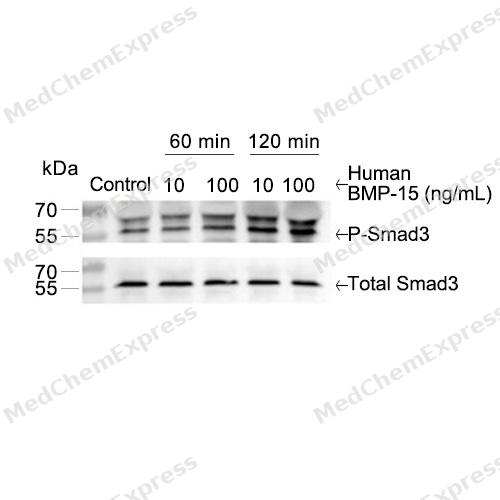
Bioactivity - Cell-Based Assay


Publications (1)
-
Journal Impact Factor
-
Most Recent
-
Ecotoxicol Environ Saf
Dibutyl phthalate promotes central precocious puberty through primordial follicle activation by downregulating BMP15. [Abstract]2025 Jul 15:300:118460. PMID: 40472697


Technical Parameters
-
Species Human
-
Source E. coli
-
Tag C-Myc;N-10*His
-
Accession
O95972 (Q268-R392)
-
Molecular Construction
-
N-term
-
10*His
-
BMP-15 (Q268-R392)
Accession # O95972 -
C-term
-
-
Protein Length
Full Length of Mature Protein
-
Synonyms
BMP15; GDF-9B; Bone Morphogenetic Protein 15; BMP-15; GDF9B; ODG2; Growth/Differentiation Factor 9B; POF4
-
AA Sequence
QADGISAEVTASSSKHSGPENNQCSLHPFQISFRQLGWDHWIIAPPFYTPNYCKGTCLRVLRDGLNSPNHAIIQNLINQLVDQSVPRPSCVPYKYVPISVLMIEANGSILYKEYEGMIAESCTCR
-
Predicted Molecular Mass
21.4 kDa
-
Molecular Weight
Approximately 23 kDa, based on SDS-PAGE under reducing conditions.
-
Purity
≥ 90%, as determined by reducing SDS-PAGE.


Product Properties
Lyophilized powder
Lyophilized from a 0.22 μm filtered solution of PBS, 6% trehalose, pH 7.4.
<1 EU/μg, determined by LAL method.
It is not recommended to reconstitute to a concentration less than 100 μg/mL in ddH2O.
Stored at -20°C for 2 years from date of receipt. After reconstitution, it is stable at 4°C for 1 week or -20°C for longer (with carrier protein). It is recommended to freeze aliquots at -20°C or -80°C for extended storage.
Room temperature in continental US; may vary elsewhere.


Documentation
-
Data Sheet (264 KB)
-
SDS (251 KB)
- English - EN (251 KB)
- Français - FR (251 KB)
- Deutsch - DE (251 KB)
- Norwegian - NO (251 KB)
- Español - ES (251 KB)
- Swedish - SV (251 KB)
- Italian - IT (251 KB)
- Korean - KR (251 KB)
- Portuguese - PT (251 KB)
-
Handling Instructions (2659 KB)


References
[1]. Galloway SM, et al. Bmp15 mutations and ovarian function. Mol Cell Endocrinol. 2002 May 31;191(1):15-8. [Content Brief]
[2]. Liu MN, et al. The role of BMP15 and GDF9 in the pathogenesis of primary ovarian insufficiency. Hum Fertil (Camb). 2021 Dec;24(5):325-332. [Content Brief]
[3]. Zhao Z, et al. BMP15 regulates AMH expression via the p38 MAPK pathway in granulosa cells from goat. Theriogenology. 2018 Sep 15;118:72-79. [Content Brief]
[4]. Cao LY, et al. Aberrant BMP15/HIF-1α/SCF signaling pathway in human granulosa cells is involved in the PCOS related abnormal follicular development. Gynecol Endocrinol. 2022 Sep 23:1-7. [Content Brief]
[5]. Shimizu K, et al. Molecular mechanism of FSHR expression induced by BMP15 in human granulosa cells. J Assist Reprod Genet. 2019 Jun;36(6):1185-1194. [Content Brief]

Calculators
Concentration (start) × Volume (start) = Concentration (final) × Volume (final)


 Powered by Bioz

