



C1QA Protein, Mouse (His-SUMO)

Based on 1 Customer Validation
The C1QA protein helps form C1, the starting component of the serum complement system. C1q binds to the zymogens C1r and C1s, resulting in C1 assembly. C1QA Protein, Mouse (His-SUMO) is the recombinant mouse-derived C1QA protein, expressed by E. coli , with N-6*His, N-SUMO labeled tag.
- Species: Mouse
- Source: E. coli
-
Storage:Stored at -20°C for 2 years from date of receipt. After reconstitution, it is stable at 4°C for 1 week or -20°C for longer (with carrier protein). It is recommended to freeze aliquots at -20°C or -80°C for extended storage.


To place orders, for customer services and technical support, please contact: MedChemExpress USA
Tel: 609-228-6898 E-mail: [email protected] [email protected]


-
 Biological Activity
-
Technical Parameters
-
Product Properties
- Documentation
- Help & FAQs




Biological Activity
Description
The C1QA protein helps form C1, the starting component of the serum complement system. C1q binds to the zymogens C1r and C1s, resulting in C1 assembly. C1QA Protein, Mouse (His-SUMO) is the recombinant mouse-derived C1QA protein, expressed by E. coli , with N-6*His, N-SUMO labeled tag.
Background
C1QA protein plays a pivotal role in the formation of C1, the initiating component of the serum complement system. C1q associates with the proenzymes C1r and C1s, resulting in the assembly of C1. The collagen-like regions of C1q engage with the Ca(2+)-dependent C1r(2)C1s(2) proenzyme complex, and efficient activation of C1 occurs upon the interaction of the globular heads of C1q with the Fc regions of IgG or IgM antibodies within immune complexes. Active C1 constitutes a calcium-dependent trimolecular complex composed of C1q, C1r, and C1s in a molar ratio of 1:2:2. The C1q subcomponent consists of nine subunits, with six forming disulfide-linked dimers of the A and B chains, and the remaining three forming disulfide-linked dimers of the C chain. Additionally, C1QA interacts via its C-terminus with CD33, activating CD33 inhibitory motifs.
MCE Validation Data
-
Purity - SDS-PAGE
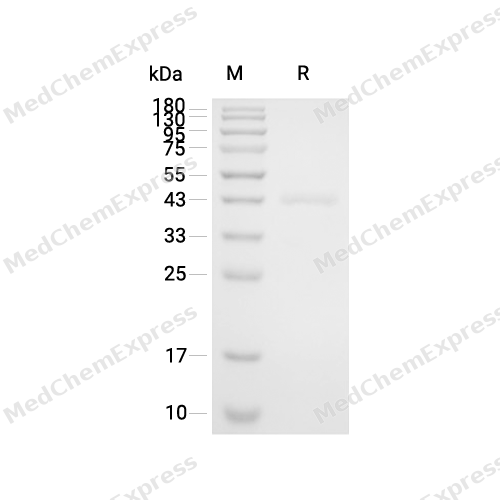
Purity - SDS-PAGE


Technical Parameters
-
Species Mouse
-
Source E. coli
-
Tag N-6*His;N-SUMO
-
Accession
P98086 (E23-A245)
-
Molecular Construction
-
N-term
-
6*His-SUMO
-
C1QA (E23-A245)
Accession # P98086 -
C-term
-
-
Protein Length
Full Length of Mature Protein
-
Synonyms
C1QA; Complement Component 1, Q Subcomponent, A Chain; Complement C1q A Chain; Complement C1q Chain A; Complement C1q Subcomponent Subunit A; Complement Component C1q, A Chain; Complement Component 1, Q Subcomponent, Alpha Polypeptide; C1QD1
-
AA Sequence
EDVCRAPNGKDGAPGNPGRPGRPGLKGERGEPGAAGIRTGIRGFKGDPGESGPPGKPGNVGLPGPSGPLGDSGPQGLKGVKGNPGNIRDQPRPAFSAIRQNPMTLGNVVIFDKVLTNQESPYQNHTGRFICAVPGFYYFNFQVISKWDLCLFIKSSSGGQPRDSLSFSNTNNKGLFQVLAGGTVLQLRRGDEVWIEKDPAKGRIYQGTEADSIFSGFLIFPSA
-
Molecular Weight
Approximately 42 kDa, based on SDS-PAGE under reducing conditions.
-
Purity
≥ 90%, as determined by reducing SDS-PAGE.


Product Properties
Lyophilized powder
Lyophilized from a 0.22 μm solution of 10 mM Tris-HCl, 1 mM EDTA, 6% Trehalose, pH 8.0.
Note: For SPR assay, please replace the buffer. Primary amine components (e.g., Tris, imidazole) can affect protein-coupled chips.
<1 EU/μg, determined by LAL method.
It is not recommended to reconstitute to a concentration less than 100 μg/mL in ddH2O.
Stored at -20°C for 2 years from date of receipt. After reconstitution, it is stable at 4°C for 1 week or -20°C for longer (with carrier protein). It is recommended to freeze aliquots at -20°C or -80°C for extended storage.
Room temperature in continental US; may vary elsewhere.


Documentation
-
Data Sheet (236 KB)
-
SDS (252 KB)
- English - EN (252 KB)
- Français - FR (252 KB)
- Deutsch - DE (252 KB)
- Norwegian - NO (252 KB)
- Español - ES (252 KB)
- Swedish - SV (252 KB)
- Italian - IT (252 KB)
- Korean - KR (252 KB)
- Portuguese - PT (252 KB)
-
Handling Instructions (2659 KB)

Calculators
Concentration (start) × Volume (start) = Concentration (final) × Volume (final)


 Powered by Bioz

