



Cathepsin D Protein, Human (HEK293, His)
Based on 1 publication(s) in Google Scholar
Cathepsin D protein is an acidic protease that actively participates in intracellular protein breakdown. Studies have shown that it is critical in the processing of amyloid precursor protein (APP), with ADAM30-mediated cleavage and activation leading to APP degradation. Cathepsin D Protein, Human (HEK293, His) is the recombinant human-derived Cathepsin D protein, expressed by HEK293 , with C-6*His labeled tag.
- Species: Human
- Source: HEK293
-
Storage:Stored at -20°C for 2 years from date of receipt. After reconstitution, it is stable at 4°C for 1 week or -20°C for longer (with carrier protein). It is recommended to freeze aliquots at -20°C or -80°C for extended storage.


To place orders, for customer services and technical support, please contact: MedChemExpress USA
Tel: 609-228-6898 E-mail: [email protected] [email protected]


-
 Biological Activity
-
Technical Parameters
-
Product Properties
- Documentation
- Help & FAQs




Biological Activity
Description
Cathepsin D protein is an acidic protease that actively participates in intracellular protein breakdown. Studies have shown that it is critical in the processing of amyloid precursor protein (APP), with ADAM30-mediated cleavage and activation leading to APP degradation. Cathepsin D Protein, Human (HEK293, His) is the recombinant human-derived Cathepsin D protein, expressed by HEK293 , with C-6*His labeled tag.
Background
Cathepsin D, an acid protease, exerts its activity in the intracellular breakdown of proteins. This protease is implicated in the processing of amyloid precursor protein (APP), with its cleavage and activation by ADAM30 leading to the degradation of APP, as evidenced in studies. Cathepsin D's involvement extends to the pathogenesis of various diseases, including breast cancer, and it is suggested to play a role in Alzheimer's disease, highlighting its significance in cellular processes and potential connections to pathological conditions.
Verified Bioactivity
Measured by its ability to cleave a peptide substrate, Mca-PLGL-Dpa-AR-NH2. The specific activity is 4624.96 pmol/min/µg, as measured under the described conditions.
MCE Validation Data
-
Purity - SDS-PAGE
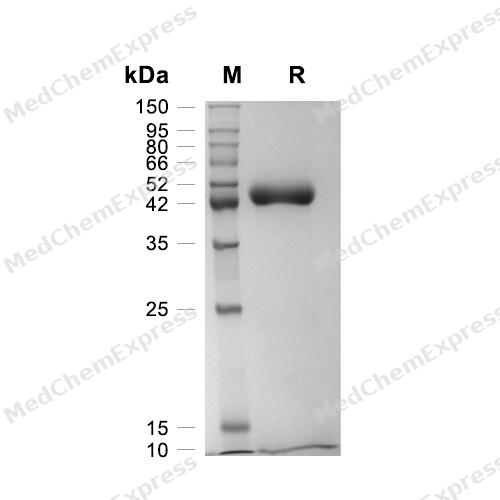
Purity - SDS-PAGE


Publications (1)
-
Journal Impact Factor
-
Most Recent
-
J Med Chem
Design and Preclinical Evaluation of First 68Ga-Labeled Cathepsin D-Targeted Radiotracers. [Abstract]2025 Dec 11;68(23):25143-25156. PMID: 41296505


Technical Parameters
-
Species Human
-
Source HEK293
-
Tag C-6*His
-
Accession
P07339 (L21-L412)
-
Molecular Construction
-
N-term
-
Cathepsin D (L21-L412)
Accession # P07339 -
6*His
-
C-term
-
-
Protein Length
Full Length of Mature Protein (with Propeptide)
-
Synonyms
CTSD; Cathepsin D (Lysosomal Aspartyl Protease); Prev. CPSD; Lysosomal Aspartyl Protease; CLN10; Cathepsin D Isoform 2; Ceroid-Lipofuscinosis, Neuronal 10; HEL-S-130P; Epididymis Secretory Sperm Binding Protein Li 130P; Cathepsin D; Lysosomal Aspartyl Pep
-
AA Sequence
LVRIPLHKFTSIRRTMSEVGGSVEDLIAKGPVSKYSQAVPAVTEGPIPEVLKNYMDAQYYGEIGIGTPPQCFTVVFDTGSSNLWVPSIHCKLLDIACWIHHKYNSDKSSTYVKNGTSFDIHYGSGSLSGYLSQDTVSVPCQSASSASALGGVKVERQVFGEATKQPGITFIAAKFDGILGMAYPRISVNNVLPVFDNLMQQKLVDQNIFSFYLSRDPDAQPGGELMLGGTDSKYYKGSLSYLNVTRKAYWQVHLDQVEVASGLTLCKEGCEAIVDTGTSLMVGPVDEVRELQKAIGAVPLIQGEYMIPCEKVSTLPAITLKLGGKGYKLSPEDYTLKVSQAGKTLCLSGFMGMDIPPPSGPLWILGDVFIGRYYTVFDRDNNRVGFAEAARL
-
Molecular Weight
Approximately 45-50 kDa, based on SDS-PAGE under reducing conditions, due to the glycosylation.
-
Glycosylation
Yes
-
Purity
≥ 95%, as determined by reducing SDS-PAGE.


Product Properties
Lyophilized powder.
Lyophilized from a 0.2 μm filtered solution of 20 mM MES, 150 mM NaCl, pH 5.5.
<1 EU/μg, determined by LAL method.
It is not recommended to reconstitute to a concentration less than 100 μg/mL in ddH2O. For long term storage it is recommended to add a carrier protein (0.1% BSA, 5% HSA, 10% FBS or 5% Trehalose).
Stored at -20°C for 2 years from date of receipt. After reconstitution, it is stable at 4°C for 1 week or -20°C for longer (with carrier protein). It is recommended to freeze aliquots at -20°C or -80°C for extended storage.
Room temperature in continental US; may vary elsewhere.


Documentation
-
Data Sheet (237 KB)
-
SDS (252 KB)
- English - EN (252 KB)
- Français - FR (252 KB)
- Deutsch - DE (252 KB)
- Norwegian - NO (252 KB)
- Español - ES (252 KB)
- Swedish - SV (252 KB)
- Italian - IT (252 KB)
- Korean - KR (252 KB)
- Portuguese - PT (252 KB)
-
Handling Instructions (2659 KB)

Calculators
Concentration (start) × Volume (start) = Concentration (final) × Volume (final)


 Powered by Bioz

