



CD3E-CD3G Heterodimer Protein, Mouse (HEK293, Fc)

Based on 1 Customer Validation
CD3E protein has predicted functions such as SH3 domain binding and protein heterodimerization, and plays a crucial role in nervous system development and cell adhesion. It is involved in T cell activation, cytokine production and signal transduction. CD3E-CD3G Heterodimer Protein, Mouse (HEK293, Fc) is a recombinant protein dimer complex containing mouse-derived CD3E-CD3G Heterodimer protein, expressed by HEK293 , with C-hFc labeled tag. CD3E-CD3G Heterodimer Protein, Mouse (HEK293, Fc), has molecular weight of ~38-40 kDa.
- Species: Mouse
- Source: HEK293
-
Storage:Stored at -20°C for 2 years from date of receipt. After reconstitution, it is stable at 4°C for 1 week or -20°C for longer (with carrier protein). It is recommended to freeze aliquots at -20°C or -80°C for extended storage.


To place orders, for customer services and technical support, please contact: MedChemExpress USA
Tel: 609-228-6898 E-mail: [email protected] [email protected]


-
 Biological Activity
-
Technical Parameters
-
Product Properties
- Documentation
- Help & FAQs




Biological Activity
Description
CD3E protein has predicted functions such as SH3 domain binding and protein heterodimerization, and plays a crucial role in nervous system development and cell adhesion. It is involved in T cell activation, cytokine production and signal transduction. CD3E-CD3G Heterodimer Protein, Mouse (HEK293, Fc) is a recombinant protein dimer complex containing mouse-derived CD3E-CD3G Heterodimer protein, expressed by HEK293 , with C-hFc labeled tag. CD3E-CD3G Heterodimer Protein, Mouse (HEK293, Fc), has molecular weight of ~38-40 kDa.
Background
The CD3E protein, predicted to possess various functions such as SH3 domain binding activity, identical protein binding activity, and protein heterodimerization activity, plays a crucial role in nervous system development and the positive regulation of cell adhesion. It is actively involved upstream of multiple processes, including positive regulation of T cell activation, positive regulation of cytokine production, and regulation of signal transduction. The protein is located in diverse cellular components, including dendritic spines, the external side of the plasma membrane, and immunological synapses. As part of the alpha-beta T cell receptor complex, its expression is observed in the colon and hemolymphoid system. The human ortholog of this gene, CD3E, has implications in immunodeficiency 18, highlighting its significance in immune system functionality. Biased expression is evident in tissues such as the thymus and spleen, underscoring its role in immune processes.
Verified Bioactivity
Immobilized Human CD3E-CD3G at 2 μg/mL (100 μL/well) can bind Anti-CD3 Antibody. The ED50 for this effect is 1.792 ng/mL.
MCE Validation Data
-
Purity - SDS-PAGE
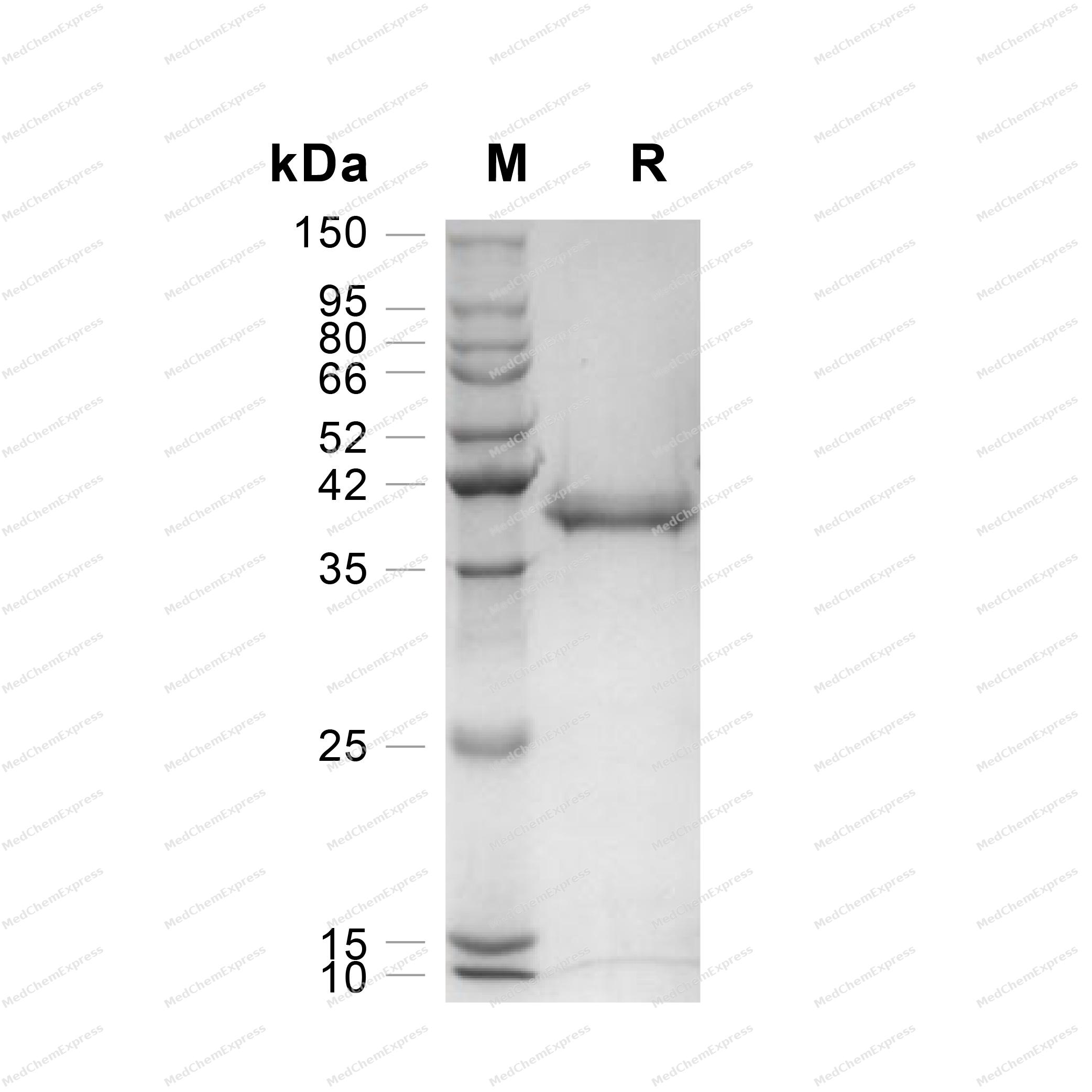
Purity - SDS-PAGE
-
Bioactivity - ELISA
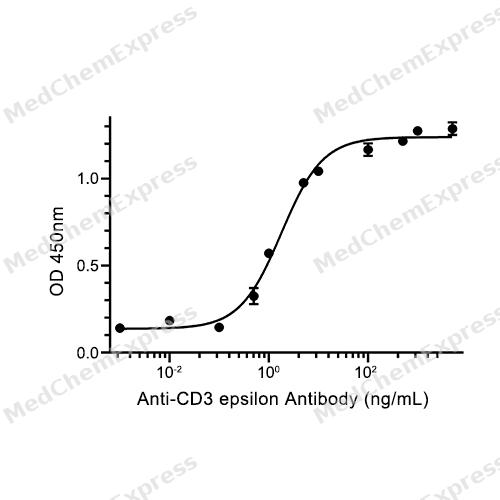
Bioactivity - ELISA


Technical Parameters
-
Species Mouse
-
Source HEK293
-
Tag C-hFc
-
Accession
NP_031674.1 (D23-D108)&NP_033980.1 (Q23-S116)
-
Synonyms
CD3E; T3E; CD3 Epsilon Subunit Of T-Cell Receptor Complex; T-Cell Antigen Receptor Complex, Epsilon Subunit Of T3; T-Cell Surface Glycoprotein CD3 Epsilon Chain; CD3e Molecule; CD3-Epsilon; CD3e Antigen; CD3epsilon; CD3E Protein; CD3e Antigen, Epsilon Pol
-
AA Sequence
DAENIEYKVSISGTSVELTCPLDSDENLKWEKNGQELPQKHDKHLVLQDFSEVEDSGYYVCYTPASNKNTYLYLKARVCEYCVEVD
&:
QTNKAKNLVQVDGSRGDGSVLLTCGLTDKTIKWLKDGSIISPLNATKNTWNLGNNAKDPRGTYQCQGAKETSNPLQVYYRMCENCIELNIGTIS -
Molecular Weight
Approximately 38-40 kDa, based on SDS-PAGE under reducing conditions, due to the glycosylation.
-
Glycosylation
Yes
-
Purity
≥ 95%, as determined by reducing SDS-PAGE.


Product Properties
Lyophilized powder
Lyophilized from a 0.2 μm filtered solution of 20 mM PB, 150 mM NaCl, pH 7.4.
<1 EU/μg, determined by LAL method.
It is not recommended to reconstitute to a concentration less than 100 μg/mL in ddH2O. For long term storage it is recommended to add a carrier protein (0.1% BSA, 5% HSA, 10% FBS or 5% Trehalose).
Stored at -20°C for 2 years from date of receipt. After reconstitution, it is stable at 4°C for 1 week or -20°C for longer (with carrier protein). It is recommended to freeze aliquots at -20°C or -80°C for extended storage.
Room temperature in continental US; may vary elsewhere.


Documentation
-
Data Sheet (237 KB)
-
SDS (254 KB)
- English - EN (254 KB)
- Français - FR (254 KB)
- Deutsch - DE (254 KB)
- Norwegian - NO (254 KB)
- Español - ES (254 KB)
- Swedish - SV (254 KB)
- Italian - IT (254 KB)
- Korean - KR (254 KB)
- Portuguese - PT (254 KB)
-
Handling Instructions (2659 KB)

Calculators
Concentration (start) × Volume (start) = Concentration (final) × Volume (final)


 Powered by Bioz

