



Creatine kinase B-type/CKB Protein, Human (His)

Based on 1 Customer Validation
Creatine kinaseB-type/CKB Protein, Human (His) is the most abundant creatine kinase isoenzyme in purified brown adipocytes. CKB reversibly catalyzes the transfer of phosphate between ATP and various phosphogens.
- Species: Human
- Source: E. coli
-
Storage:Stored at -80°C for 1 year from date of receipt. It is stable at -20°C for 3 months after opening. It is recommended to freeze aliquots at -80°C for extended storage. Avoid repeated freeze-thaw cycles.


To place orders, for customer services and technical support, please contact: MedChemExpress USA
Tel: 609-228-6898 E-mail: [email protected] [email protected]


-
 Biological Activity
-
Technical Parameters
-
Product Properties
- Documentation
- References
- Help & FAQs




Biological Activity
Description
Creatine kinaseB-type/CKB Protein, Human (His) is the most abundant creatine kinase isoenzyme in purified brown adipocytes. CKB reversibly catalyzes the transfer of phosphate between ATP and various phosphogens.
Background
Creatine kinase B (CKB) is indispensable for thermogenesis resulting from the futile creatine cycle, during which it traffics to mitochondria using an internal mitochondrial targeting sequence. CKB is powerfully induced by thermogenic stimuli in both mouse and human adipocytes. Adipocyte-selective inactivation of Ckb in mice diminishes thermogenic capacity, increases predisposition to obesity, and disrupts glucose homeostasis. CKB is therefore a key effector of the futile creatine cycle[1].
Verified Bioactivity
Measured by its ability to phosphorylate creatine. The specific activity is 248.967 pmol/min/μg, as measured under the described conditions.
MCE Validation Data
-
Purity - SDS-PAGE
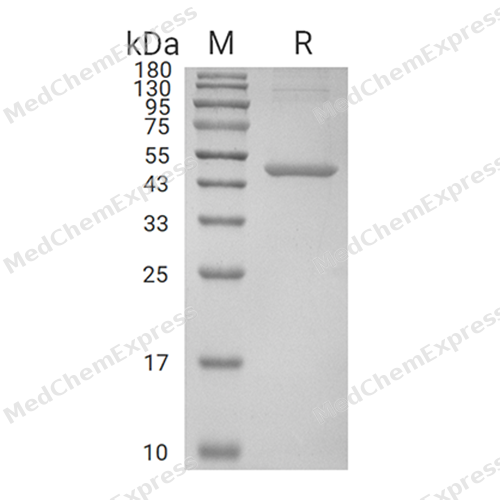
Purity - SDS-PAGE


Technical Parameters
-
Species Human
-
Source E. coli
-
Tag N-6*His
-
Accession
P12277 (M1-K381)
-
Molecular Construction
-
N-term
-
6*His
-
CKB (M1-K381)
Accession # P12277 -
C-term
-
-
Protein Length
Full Length
-
Synonyms
CKB; B-CK; Prev. CKBB; Epididymis Luminal Protein 211; Creatine Kinase B Chain; Creatine Kinase, Brain; Creatine Kinase B-Type; Creatine Kinase Brain; Creatine Phosphokinase B-Type; HEL-S-29; Creatine Kinase Brain-Type; HEL-211; Brain Creatine Kinase; BCK
-
AA Sequence
MPFSNSHNALKLRFPAEDEFPDLSAHNNHMAKVLTPELYAELRAKSTPSGFTLDDVIQTGVDNPGHPYIMTVGCVAGDEESYEVFKDLFDPIIEDRHGGYKPSDEHKTDLNPDNLQGGDDLDPNYVLSSRVRTGRSIRGFCLPPHCSRGERRAIEKLAVEALSSLDGDLAGRYYALKSMTEAEQQQLIDDHFLFDKPVSPLLLASGMARDWPDARGIWHNDNKTFLVWVNEEDHLRVISMQKGGNMKEVFTRFCTGLTQIETLFKSKDYEFMWNPHLGYILTCPSNLGTGLRAGVHIKLPNLGKHEKFSEVLKRLRLQKRGTGGVDTAAVGGVFDVSNADRLGFSEVELVQMVVDGVKLLIEMEQRLEQGQAIDDLMPAQK
-
Predicted Molecular Mass
44.8 kDa
-
Molecular Weight
Approximately 50 kDa, based on SDS-PAGE under reducing conditions.
-
Purity
≥ 90%, as determined by reducing SDS-PAGE.


Product Properties
Solution
Supplied as a 0.22 μm filtered solution of 20 mM Tris-HCl, 150 mM NaCl, 10% glycerol, pH 7.5.
Note: For SPR assay, please replace the buffer. Primary amine components (e.g., Tris, imidazole) can affect protein-coupled chips.
<1 EU/μg, determined by LAL method.
Stored at -80°C for 1 year from date of receipt. It is stable at -20°C for 3 months after opening. It is recommended to freeze aliquots at -80°C for extended storage. Avoid repeated freeze-thaw cycles.
Shipping with dry ice.


Documentation
-
Data Sheet (263 KB)
-
SDS (254 KB)
- English - EN (254 KB)
- Français - FR (254 KB)
- Deutsch - DE (254 KB)
- Norwegian - NO (254 KB)
- Español - ES (254 KB)
- Swedish - SV (254 KB)
- Italian - IT (254 KB)
- Korean - KR (254 KB)
- Portuguese - PT (254 KB)
-
Handling Instructions (2659 KB)


References

Calculators
Concentration (start) × Volume (start) = Concentration (final) × Volume (final)


 Powered by Bioz

