



DR6/TNFRSF21 Protein, Cynomolgus (HEK293, His)

Based on 1 Customer Validation
Tnfrsf21 Protein, also known as death receptor 6 (DR6), CD358, or BM-018, is highly expressed in differentiating neurons as well as in the adult brain, and is upregulated in injured neurons. DR6 negatively regulates neuron, axon, and oligodendrocyte survival, hinders axondendrocyte and oligodendrocyte regeneration and its inhibition has a neuro-protective effect in nerve injury. It activates nuclear factor kappa-B (NFkB) and mitogen-activated protein kinase 8 (MAPK8, also called c-Jun N-terminal kinase 1), and induces cell apoptosis by associating with TNFRSF1A-associated via death domain (TRADD), which is known to mediate signal transduction of tumor necrosis factor receptors. DR6/TNFRSF21 Protein, Cynomolgus (HEK293, His) is the recombinant cynomolgus-derived DR6/TNFRSF21 protein, expressed by HEK293 , with C-His labeled tag.
- Species: Cynomolgus
- Source: HEK293
-
Storage:Stored at -20°C for 2 years from date of receipt. After reconstitution, it is stable at 4°C for 1 week or -20°C for longer (with carrier protein). It is recommended to freeze aliquots at -20°C or -80°C for extended storage.


To place orders, for customer services and technical support, please contact: MedChemExpress USA
Tel: 609-228-6898 E-mail: [email protected] [email protected]


-
 Biological Activity
-
Technical Parameters
-
Product Properties
- Documentation
- Help & FAQs




Biological Activity
Description
Tnfrsf21 Protein, also known as death receptor 6 (DR6), CD358, or BM-018, is highly expressed in differentiating neurons as well as in the adult brain, and is upregulated in injured neurons. DR6 negatively regulates neuron, axon, and oligodendrocyte survival, hinders axondendrocyte and oligodendrocyte regeneration and its inhibition has a neuro-protective effect in nerve injury. It activates nuclear factor kappa-B (NFkB) and mitogen-activated protein kinase 8 (MAPK8, also called c-Jun N-terminal kinase 1), and induces cell apoptosis by associating with TNFRSF1A-associated via death domain (TRADD), which is known to mediate signal transduction of tumor necrosis factor receptors. DR6/TNFRSF21 Protein, Cynomolgus (HEK293, His) is the recombinant cynomolgus-derived DR6/TNFRSF21 protein, expressed by HEK293 , with C-His labeled tag.
Background
Tnfrsf21 Protein promotes apoptosis, possibly via a pathway that involves the activation of NF-kappa-B, and can promote apoptosis mediated by BAX and by the release of cytochrome c from the mitochondria into the cytoplasm. Tnfrsf21 Protein plays a role in neuronal apoptosis, including apoptosis in response to amyloid peptides derived from APP, and is required for both normal cell body death and axonal pruning. Tnfrsf21 Protein also acts as a regulator of pyroptosis: recruits CASP8 in response to reactive oxygen species (ROS) and subsequent oxidation, leading to activation of GSDMC[1][2][3].
Verified Bioactivity
Measured by its binding ability in a functional ELISA. When recombinant human APP770 is coated at 2 μg/mL (100 μL/well) can bind Recombinant Cynomolgus DR6. The ED50 for this effect is 368.4 ng/mL.
MCE Validation Data
-
Purity - SDS-PAGE
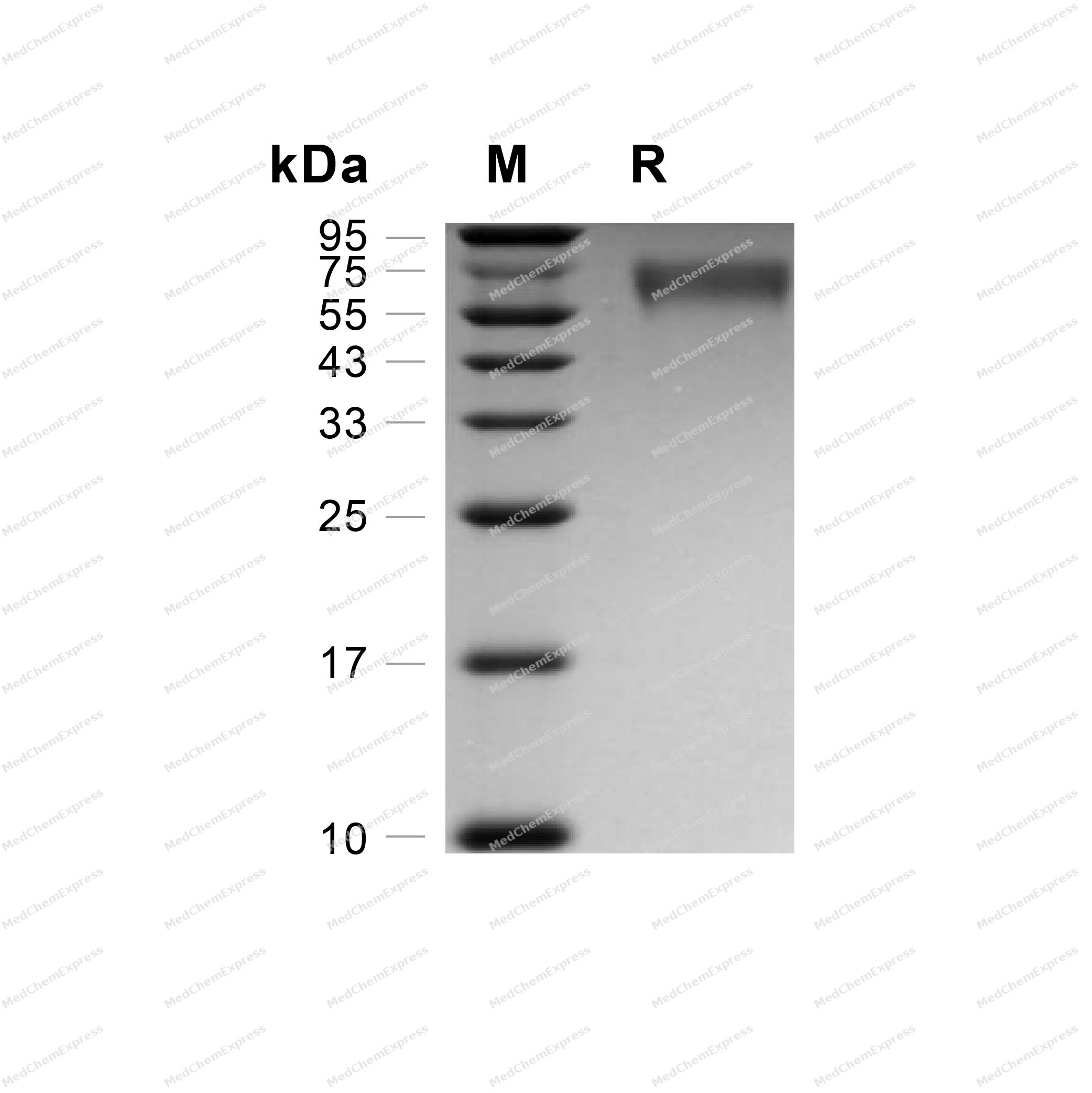
Purity - SDS-PAGE
-
Bioactivity - ELISA
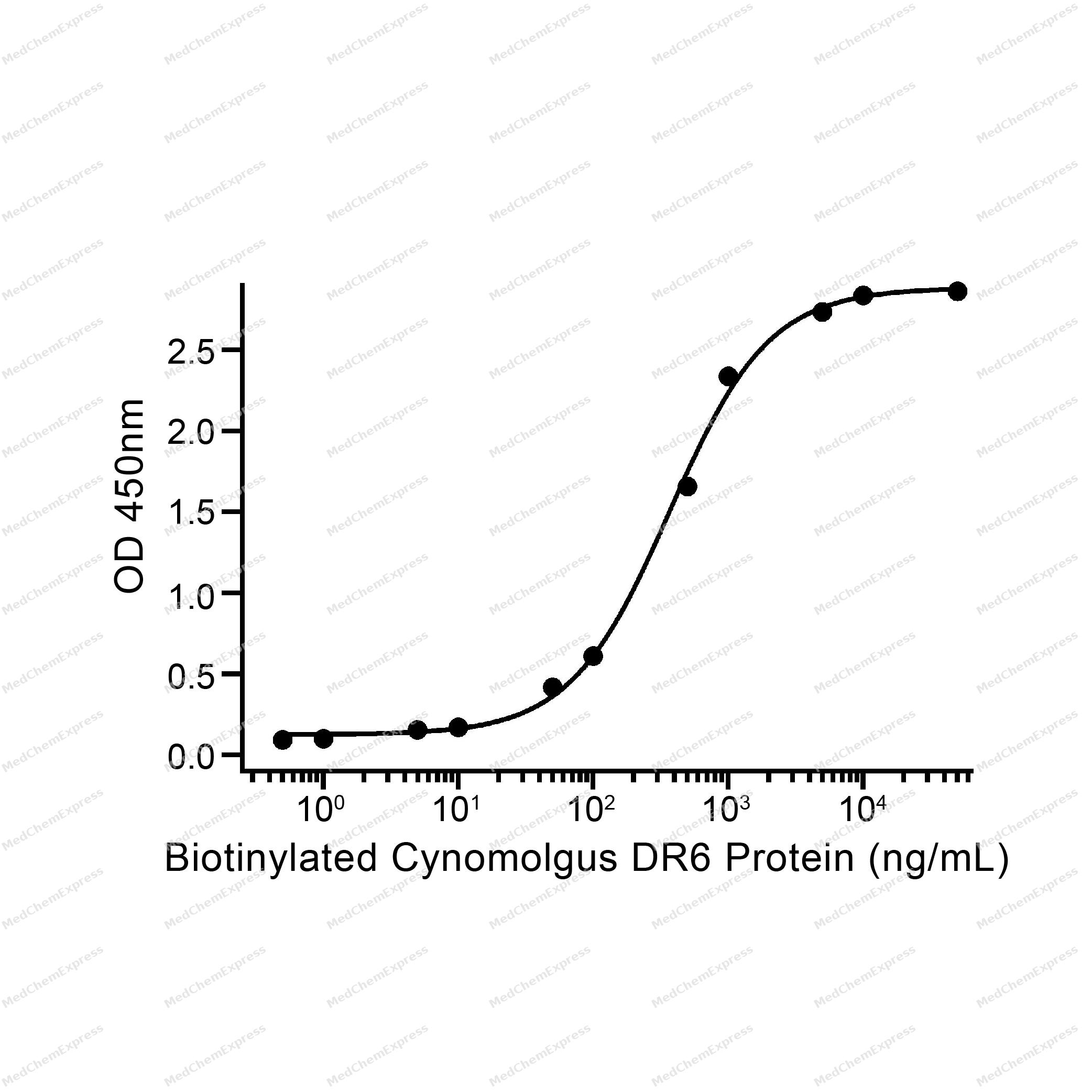
Bioactivity - ELISA


Technical Parameters
-
Species Cynomolgus
-
Source HEK293
-
Tag C-His
-
Accession
XP_005552846 (Q42-L350)
-
Molecular Construction
-
N-term
-
DR6 (Q42-L350)
Accession # XP_005552846 -
His
-
C-term
-
-
Protein Length
Partial
-
Synonyms
TNFRSF21; BM-018; TNF Receptor Superfamily Member 21; Tumor Necrosis Factor Receptor Superfamily, Member 21; DR6; TNFR-Related Death Receptor 6; Death Receptor 6; Alternative Protein TNFRSF21; CD358; TNFRSF21 Protein; Tumor Necrosis Factor Receptor Superf
-
AA Sequence
QPEQKASNLIGTYRHVDRATGQVLTCDKCPAGTYVSEHCTNTSLRVCSSCPVGTFTRHENGIEKCHDCSQPCPWPMIEKLPCAALTDRECTCPPGMFQSNATCAPHTVCPVGWGVRKKGTETEDVRCKQCARGTFSDVPSSVMKCKAYTDCLSQNLVVIKPGTKEADNVCGTLPSFSSSTSPSPGTAIFSRPEHMDSHEVPSSTYVPKGMNSTESNSSASVRPKVLSSIQEGTVPDNTSSARGKEDVNKTLPNLQVVNHQQGPHHRHILKLLPSMEATGGEKSSTPIKGPKRGHPRQNLHKHFDINEHL
-
Predicted Molecular Mass
33.5 kDa
-
Molecular Weight
Approximately 55-75 kDa, based on SDS-PAGE under reducing conditions.
-
Purity
≥ 95%, as determined by reducing SDS-PAGE.


Product Properties
Lyophilized powder.
Lyophilized from a 0.22 μm filtered solution of PBS, pH 7.4.
<1 EU/μg, determined by LAL method.
It is not recommended to reconstitute to a concentration less than 100 μg/mL in ddH2O. For long term storage it is recommended to add a carrier protein (0.1% BSA, 5% HSA, 10% FBS or 5% Trehalose).
Stored at -20°C for 2 years from date of receipt. After reconstitution, it is stable at 4°C for 1 week or -20°C for longer (with carrier protein). It is recommended to freeze aliquots at -20°C or -80°C for extended storage.
Room temperature in continental US; may vary elsewhere.


Documentation
-
Data Sheet (237 KB)
-
SDS (252 KB)
- English - EN (252 KB)
- Français - FR (252 KB)
- Deutsch - DE (252 KB)
- Norwegian - NO (252 KB)
- Español - ES (252 KB)
- Swedish - SV (252 KB)
- Italian - IT (252 KB)
- Korean - KR (252 KB)
- Portuguese - PT (252 KB)
-
Handling Instructions (2659 KB)

Calculators
Concentration (start) × Volume (start) = Concentration (final) × Volume (final)


 Powered by Bioz

