



GDNF Protein, Mouse (CHO)
Based on 2 publication(s) in Google Scholar
Glial-cell-line-derived neurotrophic factor (GDNF), a neurotrophic factor belongs to the GDNF family ligands (GFLs)., promotes survival of dopamine neurons. GDNF demonstrates a variety of neuroprotective roles for mammalian neurons. GDNF Protein, Mouse (CHO) is produced in CHO cells, and consists of 134 amino acids (S78-I211).
- Species: Mouse
- Source: CHO
-
Storage:Stored at -20°C for 2 years from date of receipt. After reconstitution, it is stable at 4°C for 1 week or -20°C for longer (with carrier protein). It is recommended to freeze aliquots at -20°C or -80°C for extended storage.

To place orders, for customer services and technical support, please contact: MedChemExpress USA
Tel: 609-228-6898 E-mail: [email protected] [email protected]


-
 Biological Activity
-
Technical Parameters
-
Product Properties
- Documentation
- References
- Help & FAQs


-

HY-P7147
CNTF Protein, Mouse -
HY-P73317
Beta-NGF Protein, Mouse (CHO) -
HY-15371
ForskolinAdenylate Cyclase Activator -
HY-P7066
FGF-2 Protein, Mouse (145a.a) -
HY-B0351
TaurineAutophagy Inducer -
HY-P7116A
BDNF Protein, Human/Mouse/Rat -
HY-14649
Retinoic acidRAR Agonist -
HY-10182
LaduviglusibGSK-3 Inhibitor -
HY-13418A
DorsomorphinAMPK Inhibitor -
HY-10254
MirdametinibMEK Inhibitor -
HY-P74383
BDNF Protein, Mouse (R129A, R130A, HEK293, His, Solution) -
HY-P7182
GDNF Protein, Human


Biological Activity
Description
Glial-cell-line-derived neurotrophic factor (GDNF), a neurotrophic factor belongs to the GDNF family ligands (GFLs)., promotes survival of dopamine neurons. GDNF demonstrates a variety of neuroprotective roles for mammalian neurons[1]. GDNF Protein, Mouse (CHO) is produced in CHO cells, and consists of 134 amino acids (S78-I211).
Background
Glial cell line-derived neurotrophic factor (GDNF) is a 134 amino acid protein belonging in the GDNF family ligands (GFLs). GDNF protein is widely distributed throughout both the central and peripheral nervous systems. Synthesis and secretion of GDNF occur in many cell types such as glial cells like astrocytes, oligodendrocytes, and Schwann cells; motor neurons (MNs); and skeletal muscle[1].
Mature human GDNF shares 91-92% amino acid sequence identity with mouse, rat, and Canine GDNF proteins. While, mouse GDNF shares 99% aa sequence identity with rat GDNF protein.
GDNF is originally isolated from cultured B49 rat glial cells and found to enhance the survival and differentiation of dopaminergic neurons in primary cultures by promoting dopamine uptake. Similar to other members of the TGF-β superfamily, GDNF is first synthesized as a precursor protein (pro-GDNF). After a series of protein cleavage and processing, the 211 amino acid pro-GDNF is finally converted into the active and mature form of GDNF. GDNF has the ability to trigger receptor tyrosine kinase RET phosphorylation, whose downstream effects have been found to promote neuronal health and survival. The binding of GDNF to its receptors triggers several intracellular signaling pathways which play roles in promoting the development, survival, and maintenance of neuron-neuron and neuron-target tissue interactions. The synthesis and regulation of GDNF have been shown to be altered in many diseases, aging, exercise, and addiction. The neuroprotective effects of GDNF may be used to develop treatments and therapies to ameliorate neurodegenerative diseases such as amyotrophic lateral sclerosis (ALS)[1].
GDNF is a potent neurotrophic factor for regulating MN survival in the peripheral nervous system. GDNF prevents apoptosis of MNs during development in vivo, decreases the loss of MNs in animal models of motor neuropathy and degeneration, rescues MNs from axotomy-induced cell death, and protects MNs from chronic degeneration. Intracerebral GDNF administration exerts both protective and reparative effects on the nigrostriatal dopamine system, which may have implications for the development of new treatment strategies for Parkinson's disease[1][2].
In Vitro
Recombinant rat GDNF (10 ng/mL) maintains proliferation and self-renewal of mouse spermatogonial stem cells[3].
In Vivo
In a mouse Parkinson's disease model, recombinant mouse GDNF (10 μg/2 μL) injected over the substantia nigra or in striatum before MPTP potently protects the dopamine system, as shown by numbers of mesencephalic dopamine nerve cell bodies, dopamine nerve terminal densities and dopamine levels. When GDNF is given after MPTP, dopamine levels and fibre densities are significantly restored[1].
Verified Bioactivity
The ED50 is <8 µg/mL as measured by C6 cells.


Publications (2)
-
Journal Impact Factor
-
Most Recent
-
Brain Behav Immun
Chronic psychological stress-orchestrated glial-ILC3 circuit exacerbates intestinal inflammation and depression. [Abstract]2025 Nov:130:106118. PMID: 40987409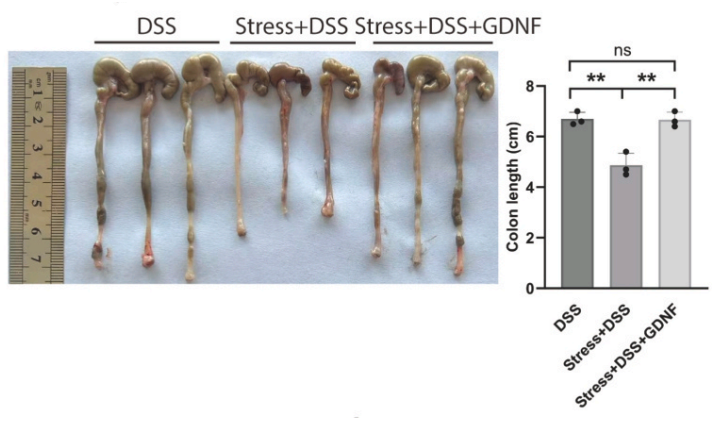
GDNF Protein, Mouse (CHO) purchased from MedChemExpress. Usage Cited in: Brain Behav Immun. 2025 Nov:130:106118. [Abstract]
Macroscopic appearance and length of the GDNF Protein, Mouse (CHO) (GDNF, 100 μg/kg; i.p.; once every other day for 6 times starting from the 26th day of restraint stress)-treated mice colon (n = 3 per group). Abbreviations: DSS, dextran sulfate sodium.
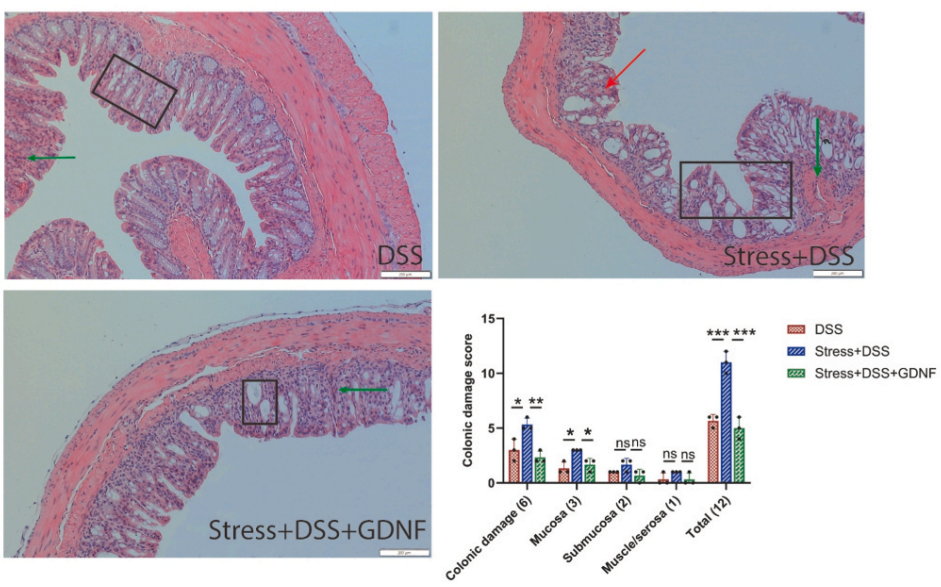
GDNF Protein, Mouse (CHO) purchased from MedChemExpress. Usage Cited in: Brain Behav Immun. 2025 Nov:130:106118. [Abstract]
HE staining and pathological scoring of sections in the GDNF Protein, Mouse (CHO) (GDNF, 100 μg/kg; i.p.; once every other day for 6 times starting from the 26th day of restraint stress)-treated mice distal colon (red arrows delineate the shedding of colonic epithelial cells; green arrows delineate inflammatory cell infiltration; and the black rectangular box highlights the loss of colonic crypts) (n = 3 per group, Scale bar = 200 μm). Abbreviations: DSS, dextran sulfate sodium.
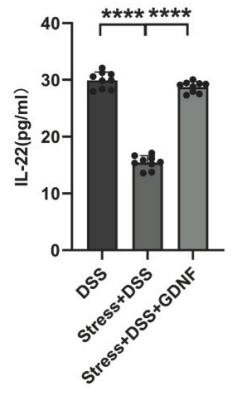
GDNF Protein, Mouse (CHO) purchased from MedChemExpress. Usage Cited in: Brain Behav Immun. 2025 Nov:130:106118. [Abstract]
Protein expression levels of IL-22 in the GDNF Protein, Mouse (CHO) (GDNF, 100 μg/kg; i.p.; once every other day for 6 times starting from the 26th day of restraint stress)-treated mice colon (n = 9 per group). Abbreviations: DSS, dextran sulfate sodium.
-
Int J Mol Sci
2025 Sep 29;26(19):9522. PMID: 41096789


Technical Parameters
-
Species Mouse
-
Source CHO
-
Tag Tag Free
-
Accession
P48540 (S78-I211)
-
Molecular Construction
-
N-term
-
GDNF (S78-I211)
Accession # P48540 -
C-term
-
-
Protein Length
Full Length of Mature Protein
-
Synonyms
GDNF; ATF2; Glial Cell Derived Neurotrophic Factor; ATF; Astrocyte-Derived Trophic Factor; Glial Cell Line Derived Neurotrophic Factor; Glial Cell Line-Derived Neurotrophic Factor; Glial Derived Neurotrophic Factor; HFB1-GDNF; HSCR3; ATF1; HGDNF
-
AA Sequence
SPDKQAAALPRRERNRQAAAASPENSRGKGRRGQRGKNRGCVLTAIHLNVTDLGLGYETKEELIFRYCSGSCESAETMYDKILKNLSRSRRLTSDKVGQACCRPVAFDDDLSFLDDNLVYHILRKHSAKRCGCI
-
Molecular Weight
Approximately 17-22 kDa, based on SDS-PAGE under reducing conditions.
-
Glycosylation
Yes
-
Purity
≥ 95%, as determined by reducing SDS-PAGE.


Product Properties
Lyophilized powder
Lyophilized from a 0.22 μm filtered solution of PBS.
<0.2 EU/μg, determined by LAL method.
It is not recommended to reconstitute to a concentration less than 100 μg/mL in ddH2O. For long term storage it is recommended to add a carrier protein (0.1% BSA, 5% HSA, 10% FBS or 5% Trehalose).
Stored at -20°C for 2 years from date of receipt. After reconstitution, it is stable at 4°C for 1 week or -20°C for longer (with carrier protein). It is recommended to freeze aliquots at -20°C or -80°C for extended storage.
Room temperature in continental US; may vary elsewhere.


Documentation
-
Data Sheet (264 KB)
-
SDS (252 KB)
- English - EN (252 KB)
- Français - FR (252 KB)
- Deutsch - DE (252 KB)
- Norwegian - NO (252 KB)
- Español - ES (252 KB)
- Swedish - SV (252 KB)
- Italian - IT (252 KB)
- Korean - KR (252 KB)
- Portuguese - PT (252 KB)
-
Handling Instructions (2659 KB)


References
[1]. Alberto F Cintrón-Colón, et al. GDNF synthesis, signaling, and retrograde transport in motor neurons. Cell Tissue Res. 2020 Oct;382(1):47-56. [Content Brief]
[2]. Merighi A. Targeting the glial-derived neurotrophic factor and related molecules for controlling normal and pathologic pain. Expert Opin Ther Targets. 2016;20(2):193-208. [Content Brief]
[3]. Tomac A, et al. Protection and repair of the nigrostriatal dopaminergic system by GDNF in vivo. Nature.1995;373 (6512): 335-339. [Content Brief]
[4]. Hannu Sariola, et al. GDNF maintains mouse spermatogonial stem cells in vivo and in vitro. Methods Mol Biol. 2008;450:127-35. [Content Brief]

Calculators
Concentration (start) × Volume (start) = Concentration (final) × Volume (final)


 Powered by Bioz

