



HE4/WFDC2 Protein, Human (HEK293, His)
Based on 1 publication(s) in Google Scholar
The HE4/WFDC2 protein is a homotrimeric broad-spectrum protease inhibitor that regulates food intake, energy expenditure, and body weight in response to metabolic and toxin-induced stress. As a brainstem-restricted receptor, it binds to GDF15 and interacts with RET, activating MAPK and AKT signaling pathways. HE4/WFDC2 Protein, Human (HEK293, His) is the recombinant human-derived HE4/WFDC2 protein, expressed by HEK293 , with C-6*His labeled tag.
- Species: Human
- Source: HEK293
-
Storage:Stored at -20°C for 2 years from date of receipt. After reconstitution, it is stable at 4°C for 1 week or -20°C for longer (with carrier protein). It is recommended to freeze aliquots at -20°C or -80°C for extended storage.


To place orders, for customer services and technical support, please contact: MedChemExpress USA
Tel: 609-228-6898 E-mail: [email protected] [email protected]


-
 Biological Activity
-
Technical Parameters
-
Product Properties
- Documentation
- Help & FAQs




Biological Activity
Description
The HE4/WFDC2 protein is a homotrimeric broad-spectrum protease inhibitor that regulates food intake, energy expenditure, and body weight in response to metabolic and toxin-induced stress. As a brainstem-restricted receptor, it binds to GDF15 and interacts with RET, activating MAPK and AKT signaling pathways. HE4/WFDC2 Protein, Human (HEK293, His) is the recombinant human-derived HE4/WFDC2 protein, expressed by HEK293 , with C-6*His labeled tag.
Background
HE4/WFDC2 protein is a broad range protease inhibitor that forms homotrimers through disulfide linkages. It is involved in various physiological processes, including regulation of food intake, energy expenditure, and body weight in response to metabolic and toxin-induced stresses. This protein acts as a brainstem-restricted receptor and interacts with its ligand, GDF15. Upon binding, HE4/WFDC2 protein interacts with RET and activates MAPK- and AKT-signaling pathways. The extracellular domain of HE4/WFDC2 protein is responsible for interacting with GDF15 and RET, functioning as a receptor for GDF15 and mediating cellular signaling through the interaction with RET following GDF15 binding. Notably, the interaction with RET is dependent on prior binding of GDF15.
MCE Validation Data
-
Purity - SDS-PAGE
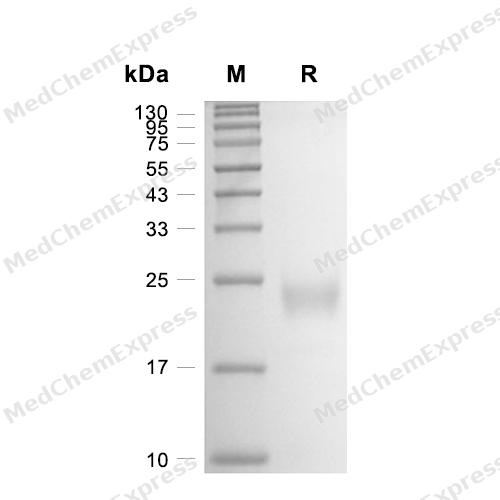
Purity - SDS-PAGE


Publications (1)
-
Journal Impact Factor
-
Most Recent


Technical Parameters
-
Species Human
-
Source HEK293
-
Tag C-6*His
-
Accession
Q14508 (E31-F124)
-
Molecular Construction
-
N-term
-
HE4 (E31-F124)
Accession # Q14508 -
6*His
-
C-term
-
-
Protein Length
Full Length of Mature Protein
-
Synonyms
WFDC2; WAP Four-Disulfide Core Domain 2; WAP5; HE4; WAP Four-Disulfide Core Domain Protein 2; DJ461P17.6; EDDM4; Major Epididymis-Specific Protein E4; Putative Protease Inhibitor WAP5; Epididymal Secretory Protein E4; Human Epididymis Protein 4; Epididyma
-
AA Sequence
EKTGVCPELQADQNCTQECVSDSECADNLKCCSAGCATFCSLPNDKEGSCPQVNINFPQLGLCRDQCQVDSQCPGQMKCCRNGCGKVSCVTPNF
-
Predicted Molecular Mass
11.1 kDa
-
Molecular Weight
Approximately 18-22 kDa, based on SDS-PAGE under reducing conditions.
-
Glycosylation
Yes
-
Purity
≥ 95%, as determined by reducing SDS-PAGE.


Product Properties
Lyophilized powder
Lyophilized from a 0.2 μm filtered solution of 20 mM PB, 150 mM NaCl, pH 7.2 or PBS, pH 7.4, 8% trehalose.
<1 EU/μg, determined by LAL method.
It is not recommended to reconstitute to a concentration less than 100 μg/mL in ddH2O. For long term storage it is recommended to add a carrier protein (0.1% BSA, 5% HSA, 10% FBS or 5% Trehalose).
Stored at -20°C for 2 years from date of receipt. After reconstitution, it is stable at 4°C for 1 week or -20°C for longer (with carrier protein). It is recommended to freeze aliquots at -20°C or -80°C for extended storage.
Room temperature in continental US; may vary elsewhere.


Documentation
-
Data Sheet (236 KB)
-
SDS (252 KB)
- English - EN (252 KB)
- Français - FR (252 KB)
- Deutsch - DE (252 KB)
- Norwegian - NO (252 KB)
- Español - ES (252 KB)
- Swedish - SV (252 KB)
- Italian - IT (252 KB)
- Korean - KR (252 KB)
- Portuguese - PT (252 KB)
-
Handling Instructions (2659 KB)

Calculators
Concentration (start) × Volume (start) = Concentration (final) × Volume (final)


 Powered by Bioz

