



IL-1RA/IL-1RN Protein, Mouse
Based on 9 publication(s) in Google Scholar
IL-1RN protein serves as an anti-inflammatory antagonist, targeting proinflammatory cytokines IL1B and IL1A within the interleukin-1 family. Playing a protective role, it prevents immune dysregulation and systemic inflammation induced by IL1, particularly in response to innate stimulatory agents. IL-1RN's regulatory activity contributes to a balanced immune response, safeguarding the host from the detrimental effects of excessive inflammation. IL-1RA/IL-1RN Protein, Mouse is the recombinant mouse-derived IL-1RA/IL-1RN protein, expressed by E. coli , with tag free.
- Species: Mouse
- Source: E. coli
-
Storage:Stored at -20°C for 2 years from date of receipt. After reconstitution, it is stable at 4°C for 1 week or -20°C for longer (with carrier protein). It is recommended to freeze aliquots at -20°C or -80°C for extended storage.


To place orders, for customer services and technical support, please contact: MedChemExpress USA
Tel: 609-228-6898 E-mail: [email protected] [email protected]


-
 Biological Activity
-
Technical Parameters
-
Product Properties
- Documentation
- Help & FAQs




Biological Activity
Description
IL-1RN protein serves as an anti-inflammatory antagonist, targeting proinflammatory cytokines IL1B and IL1A within the interleukin-1 family. Playing a protective role, it prevents immune dysregulation and systemic inflammation induced by IL1, particularly in response to innate stimulatory agents. IL-1RN's regulatory activity contributes to a balanced immune response, safeguarding the host from the detrimental effects of excessive inflammation. IL-1RA/IL-1RN Protein, Mouse is the recombinant mouse-derived IL-1RA/IL-1RN protein, expressed by E. coli , with tag free.
Background
The IL-1RN protein functions as an anti-inflammatory antagonist within the interleukin-1 family, specifically targeting proinflammatory cytokines like interleukin-1beta/IL1B and interleukin-1alpha/IL1A. Acting as a protective barrier, this protein plays a crucial role in preventing immune dysregulation and uncontrolled systemic inflammation induced by IL1, particularly in response to various innate stimulatory agents such as pathogens. Its regulatory activity contributes to maintaining a balanced immune response and safeguarding the host from the detrimental effects of excessive inflammation.
Verified Bioactivity
Measured by its ability to inhibit IL-1 alpha -dependent proliferation in CTLL-2 cells. The ED50 for this effect is ≤64.28 ng/mL in the presence of 50 pg/mL of recombinant human IL-1 alpha, corresponding to a specific activity is ≥1.56×10⁴ units/mg.
MCE Validation Data
-
Purity - SDS-PAGE
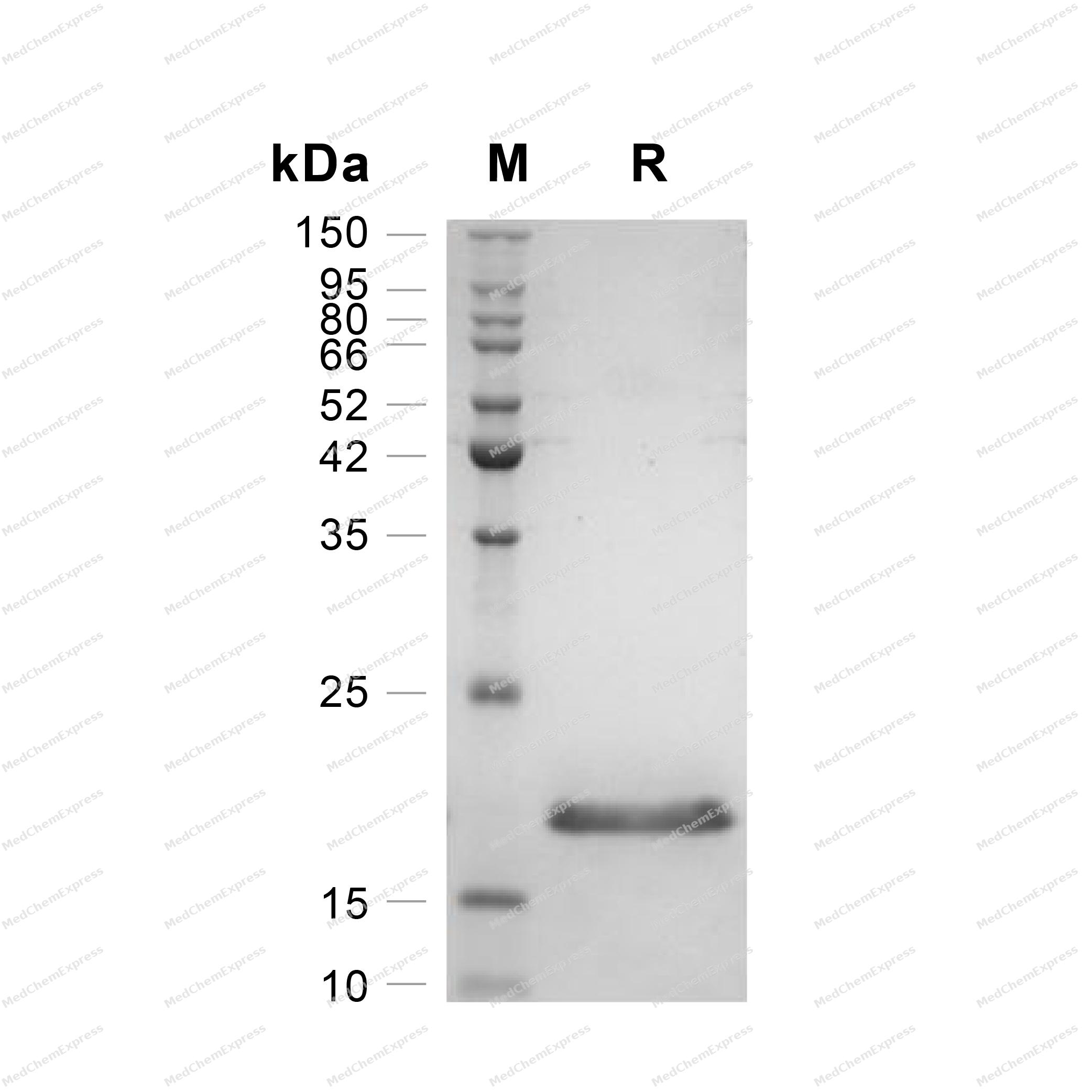
Purity - SDS-PAGE
-
Bioactivity - Cell-Based Assay
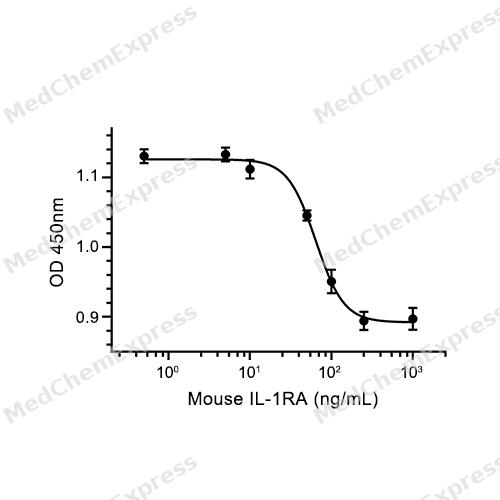
Bioactivity - Cell-Based Assay


Publications (9)
-
Journal Impact Factor
-
Most Recent
-
Immunity
Disruption of the Na+/K+-ATPase-purinergic P2X7 receptor complex in microglia promotes stress-induced anxiety. [Abstract]2024 Mar 12;57(3):495-512.e11. PMID: 38395698 -
Clin Mol Hepatol
2024 Jul;30(3):515-538. PMID: 38726504 -
Nat Commun
Pathogenic NLRP3 mutants form constitutively active inflammasomes resulting in immune-metabolic limitation of IL-1β production. [Abstract]2024 Feb 6;15(1):1096. PMID: 38321014 -
Acta Pharmacol Sin
Microglial NLRP3-dependent pyroptosis promotes cognitive dysfunction of diabetic encephalopathy by inhibiting adult hippocampal neurogenesis through the release of IL-1β. [Abstract]2026 Mar 20. PMID: 41862685 -
Antioxidants (Basel)
Bone Marrow Mesenchymal Stem Cell-Derived Exosomes Ameliorate Aging-Induced BTB Impairment in Porcine Testes by Activating Autophagy and Inhibiting ROS/NLRP3 Inflammasomes via the AMPK/mTOR Signaling Pathway. [Abstract]2024 Jan 31;13(2):183. PMID: 38397781 -
Int Immunopharmacol
Inhibiting HMGB1/AGER/NF-κB pathway prevents pro-inflammatory microglia polarization and protect photoreceptors in retinitis pigmentosa. [Abstract]2025 Mar 6:149:114192. PMID: 39904032 -
Toxics
Ginsenoside Rg1 Mitigates Porcine Intestinal Tight Junction Disruptions Induced by LPS through the p38 MAPK/ NLRP3 Inflammasome Pathway. [Abstract]2022 May 27;10(6):285. PMID: 35736894 -
J Inflamm Res
Secretory Autophagosomes from Alveolar Macrophages Exacerbate Acute Respiratory Distress Syndrome by Releasing IL-1β. [Abstract]2022 Jan 7;15:127-140. PMID: 35027836 -
Oxid Med Cell Longev
Curcumin Ameliorates Age-Induced Tight Junction Impaired in Porcine Sertoli Cells by Inactivating the NLRP3 Inflammasome through the AMPK/SIRT3/SOD2/mtROS Signaling Pathway. [Abstract]2023 Feb 17:2023:1708251. PMID: 36846717


Technical Parameters
-
Species Mouse
-
Source E. coli
-
Tag Tag Free
-
Accession
P25085-1 (R27-Q178)
-
Molecular Construction
-
N-term
-
IL-1RA (R27-Q178)
Accession # P25085-1 -
C-term
-
-
Protein Length
Full Length of Isoform-1
-
Synonyms
IL1RN; IL-1ra; Interleukin 1 Receptor Antagonist; Intracellular Interleukin-1 Receptor Antagonist (IcIL-1ra); ICIL-1RA; Intracellular Interleukin-1 Receptor Antagonist; IL-1RN; Intracellular IL-1 Receptor Antagonist Type II; IL1RA; Type II Interleukin-1 R
-
AA Sequence
RPSGKRPCKMQAFRIWDTNQKTFYLRNNQLIAGYLQGPNIKLEEKIDMVPIDLHSVFLGIHGGKLCLSCAKSGDDIKLQLEEVNITDLSKNKEEDKRFTFIRSEKGPTTSFESAACPGWFLCTTLEADRPVSLTNTPEEPLIVTKFYFQEDQ
-
Predicted Molecular Mass
17.5 kDa
-
Molecular Weight
Approximately 16 kDa, based on SDS-PAGE under reducing conditions.
-
Purity
≥ 95%, as determined by reducing SDS-PAGE.


Product Properties
Lyophilized powder
1.Lyophilized from a 0.22 μm filtered solution of 20 mM PB, 150 mM NaCl, pH 7.4.
2.Lyophilized from a 0.22 μm filtered solution of 20 mM Histidine-HCl, 10% trehalose, 0.05% Tween 80, pH 5.3.
Please refer to the lot-specific COA for specific buffer information.
<1 EU/μg, determined by LAL method.
It is not recommended to reconstitute to a concentration less than 100 μg/mL in ddH2O. For long term storage it is recommended to add a carrier protein (0.1% BSA, 5% HSA, 10% FBS or 5% Trehalose).
Stored at -20°C for 2 years from date of receipt. After reconstitution, it is stable at 4°C for 1 week or -20°C for longer (with carrier protein). It is recommended to freeze aliquots at -20°C or -80°C for extended storage.
Room temperature in continental US; may vary elsewhere.


Documentation
-
Data Sheet (236 KB)
-
SDS (251 KB)
- English - EN (251 KB)
- Français - FR (251 KB)
- Deutsch - DE (251 KB)
- Norwegian - NO (251 KB)
- Español - ES (251 KB)
- Swedish - SV (251 KB)
- Italian - IT (251 KB)
- Korean - KR (251 KB)
- Portuguese - PT (251 KB)
-
Handling Instructions (2659 KB)

Calculators
Concentration (start) × Volume (start) = Concentration (final) × Volume (final)


 Powered by Bioz

