



IL-27 Protein, Mouse (HEK293, C-His)

Based on 1 Customer Validation
IL-27 is a crucial pleiotropic immunoregulatory molecule within the IL-12 cytokine family, playing a pivotal role in "bidirectional regulation" to maintain immune homeostasis. IL-27 induces the differentiation of naive CD4+ T cells into Th1 cells and promotes the secretion of cytokines such as IFN-γ. Simultaneously, IL-27 restricts the differentiation of Th2 and Th17 cells and reduces the release of pro-inflammatory factors, thereby effectively suppressing autoimmune inflammation and allergic reactions. IL-27 Protein, Mouse (HEK293, C-His) is a recombinant protein consisting of IL27A and IL27B subunits expressed in HEK293 cells, featuring a C-terminal 10×His tag and a GSGSGGSGGSGSGKL peptide.
- Species: Mouse
- Source: HEK293
-
Storage:Stored at -20°C for 2 years from date of receipt. After reconstitution, it is stable at 4°C for 1 week or -20°C for longer (with carrier protein). It is recommended to freeze aliquots at -20°C or -80°C for extended storage.


To place orders, for customer services and technical support, please contact: MedChemExpress USA
Tel: 609-228-6898 E-mail: [email protected] [email protected]


-
 Biological Activity
-
Technical Parameters
-
Product Properties
- Documentation
- Help & FAQs




Biological Activity
Description
IL-27 is a crucial pleiotropic immunoregulatory molecule within the IL-12 cytokine family, playing a pivotal role in "bidirectional regulation" to maintain immune homeostasis. IL-27 induces the differentiation of naive CD4+ T cells into Th1 cells and promotes the secretion of cytokines such as IFN-γ. Simultaneously, IL-27 restricts the differentiation of Th2 and Th17 cells and reduces the release of pro-inflammatory factors, thereby effectively suppressing autoimmune inflammation and allergic reactions. IL-27 Protein, Mouse (HEK293, C-His) is a recombinant protein consisting of IL27A and IL27B subunits expressed in HEK293 cells, featuring a C-terminal 10×His tag and a GSGSGGSGGSGSGKL peptide.
Background
IL-27 is a heterodimer formed by two subunits linked via disulfide bonds: the IL-27-specific p28 subunit and the EBI3 subunit, which is shared with IL-35. It is primarily synthesized and secreted by antigen-presenting cells—such as dendritic cells, macrophages, and other myeloid cells—in response to stimulation by pathogens or inflammatory signals. IL-27 exerts its biological effects by binding to a heterodimeric receptor complex on the surface of target cells (composed of IL-27Rα and gp130), thereby activating downstream JAK/STAT signaling pathways (primarily involving STAT1 and STAT3).
Verified Bioactivity
Measured in a cell proliferation assay using TF-1 Human Erythroleukemia Cells. The ED50 this effect is 40-60 ng/mL.
MCE Validation Data
-
Purity - SDS-PAGE
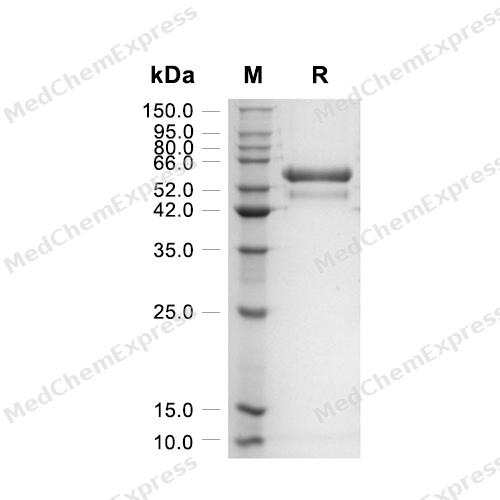
Purity - SDS-PAGE
-
Bioactivity - Cell-Based Assay
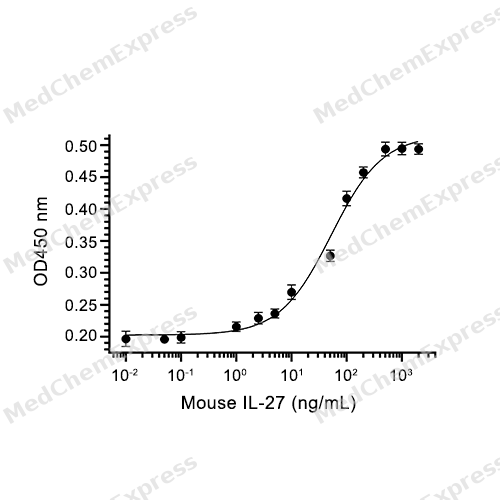
Bioactivity - Cell-Based Assay


Technical Parameters
-
Species Mouse
-
Source HEK293
-
Tag C-10*His
-
Accession
O35228 (Y19-P228) &GSGSGGSGGSGSGKL &Q8K3I6 (F29-S234)
-
Gene ID50498&246779
-
Synonyms
EBI3; IL-27 Subunit Beta; Epstein-Barr Virus Induced 3; IL27 Subunit; IL27B; IL35 Subunit; IL35B; IL-27B; Epstein-Barr Virus-Induced Gene 3 Protein; Epstein-Barr Virus Induced Gene 3; Interleukin-27 Subunit Beta; Cytokine Receptor; EBV-Induced Gene 3 Prot
-
AA Sequence
YTETALVALSQPRVQCHASRYPVAVDCSWTPLQAPNSTRSTSFIATYRLGVATQQQSQPCLQRSPQASRCTIPDVHLFSTVPYMLNVTAVHPGGASSSLLAFVAERIIKPDPPEGVRLRTAGQRLQVLWHPPASWPFPDIFSLKYRLRYRRRGASHFRQVGPIEATTFTLRNSKPHAKYCIQVSAQDLTDYGKPSDWSLPGQVESAPHKPGSGSGGSGGSGSGKLFPTDPLSLQELRREFTVSLYLARKLLSEVQGYVHSFAESRLPGVNLDLLPLGYHLPNVSLTFQAWHHLSDSERLCFLATTLRPFPAMLGGLGTQGTWTSSEREQLWAMRLDLRDLHRHLRFQVLAAGFKCSKEEEDKEEEEEEEEEEKKLPLGALGGPNQVSSQVSWPQLLYTYQLLHSLELVLSRAVRDLLLLSLPRRPGSAWDS
-
Predicted Molecular Mass
49.5 kDa
-
Molecular Weight
Approximately 58-65 kDa, based on SDS-PAGE under reducing conditions.
-
Glycosylation
Yes
-
Purity
≥ 95%, as determined by reducing SDS-PAGE.


Product Properties
Lyophilized powder
Lyophilized from a 0.22 μm filtered solution of 20 mM PB, 150 mM NaCl, pH 7.4, 8% trehalose.
<1 EU/μg, determined by LAL method.
It is not recommended to reconstitute to a concentration less than 100 μg/mL in ddH2O. For long term storage it is recommended to add a carrier protein (0.1% BSA, 5% HSA, 10% FBS or 5% Trehalose).
Stored at -20°C for 2 years from date of receipt. After reconstitution, it is stable at 4°C for 1 week or -20°C for longer (with carrier protein). It is recommended to freeze aliquots at -20°C or -80°C for extended storage.
Room temperature in continental US; may vary elsewhere.


Documentation
-
Data Sheet (238 KB)
-
SDS (252 KB)
- English - EN (252 KB)
- Français - FR (252 KB)
- Deutsch - DE (252 KB)
- Norwegian - NO (252 KB)
- Español - ES (252 KB)
- Swedish - SV (252 KB)
- Italian - IT (252 KB)
- Korean - KR (252 KB)
- Portuguese - PT (252 KB)
-
Handling Instructions (2659 KB)

Calculators
Concentration (start) × Volume (start) = Concentration (final) × Volume (final)


 Powered by Bioz

