



IL-2R alpha/CD25 Protein, Mouse (HEK293, His)

Based on 1 Customer Validation
IL-2R alpha (CD25) is an essential component of high-affinity IL-2 receptors. IL-2R alpha enhances binding of IL-2 to its receptor complex so that regulates T cell growth and other lymphoid functions.IL-2R alpha/CD25 Protein, Mouse (HEK293, His) is a recombinant mouse IL-2R alpha protein with a His tag at the C-terminus and is expressed in HEK293 cells.
- Species: Mouse
- Source: HEK293
-
Storage:Stored at -20°C for 2 years from date of receipt. After reconstitution, it is stable at 4°C for 1 week or -20°C for longer (with carrier protein). It is recommended to freeze aliquots at -20°C or -80°C for extended storage.


To place orders, for customer services and technical support, please contact: MedChemExpress USA
Tel: 609-228-6898 E-mail: [email protected] [email protected]


-
 Biological Activity
-
Technical Parameters
-
Product Properties
- Documentation
- References
- Help & FAQs




Biological Activity
Description
IL-2R alpha (CD25) is an essential component of high-affinity IL-2 receptors. IL-2R alpha enhances binding of IL-2 to its receptor complex so that regulates T cell growth and other lymphoid functions[1][2].IL-2R alpha/CD25 Protein, Mouse (HEK293, His) is a recombinant mouse IL-2R alpha protein with a His tag at the C-terminus and is expressed in HEK293 cells.
Background
IL-2R alpha (CD25) is a type I membrane protein. IL-2R alpha is expressed in peripheral activated T and B cells, triple-negative thymocytes, and bone marrow pre-B cells. In high tumor regulatory T (Treg) cells, IL-2R alpha is highly expressed and is a potential target for Treg deletion. The expression of IL-2R alpha is undetectable on resting T cells[1][2][3].
The sequence of amino acids in IL-2R alpha from different species is very different (less than 85% similarity among human, rat and mouse).
IL-2R alpha is an essential component of high-affinity IL-2 receptors and has no signal-transducing activity per se. IL-2R alpha functions through enhancing binding of IL-2 to its receptor complex and acts as a positive feedback regulator. IL-2 is a principal growth factor for T lymphocytes and plays an important role in T cell immune response. IL-2R alpha transcription is regulated by three positive regulatory regions (PRRs): PRRI, PRRII and PRRIII. PRRIII is an IL-2 response element[1][2].
IL-2R alpha regulates T cell growth, augments lymphocyte activation and proliferation. IL-2R alpha is involved in preventing type 1 diabetes and cancers[1][2][4].
In Vivo
Mouse IL-2 (mIL-2)/CD25 (0.5 mg/kg; s.c.; twice a week for 1 week) induces a robust regulatory T cells (Tregs) expansion without showing signs of increase in the numbers of NK, CD4+ Foxp3, or CD8+ T cells or significant increase in proinflammatory cytokines[5].
Mouse IL-2 (mIL-2)/CD25 (0.2-0.4 mg/kg; s.c.; twice a week for 1 week) demonstrates efficacy in inducing Treg expansion, CD25 upregulation, and inhibiting lupus nephritis based on the levels of proteinuria, autoantibody titers, and kidney histology scores in both NZB ◊ NZW and MRL/lpr mice[5].
Verified Bioactivity
1.Measured in a cell proliferation assay using MO7e cells. The ED50 for this effect is 0.3-1.5 μg/mL in the presence of 30 ng/mL of recombinant human IL-2.
2.Measured by its ability to inhibit the IL-2-dependent proliferation of MO7e human megakaryocytic leukemic cells. The ED50 for this effect is 0.1-1.0 μg/mL in the presence of 30 ng/mL of recombinant human IL-2.
MCE Validation Data
-
Purity - SDS-PAGE
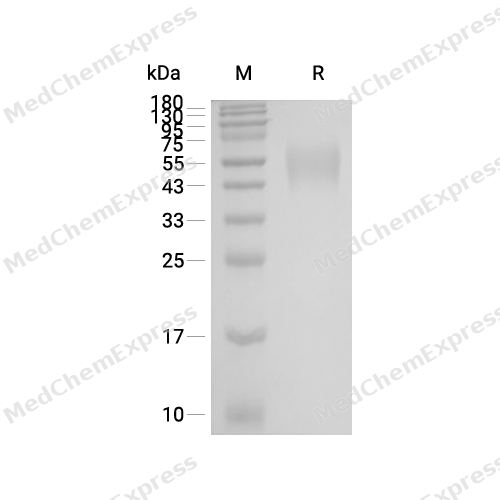
Purity - SDS-PAGE
-
Bioactivity - Cell-Based Assay
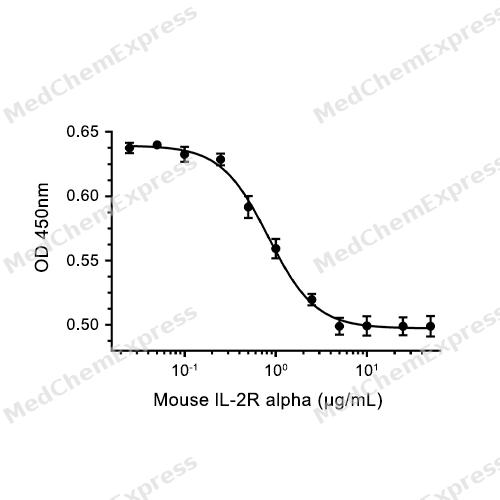
Bioactivity - Cell-Based Assay


Technical Parameters
-
Species Mouse
-
Source HEK293
-
Tag C-6*His
-
Accession
P01590/NP_032393.3 (E22-K236)
-
Protein Length
Extracellular Domain
-
Synonyms
IL2RA; TAC Antigen; Prev. IDDM10; Insulin-Dependent Diabetes Mellitus 10; Prev. IL2R; CD25 Antigen; Interleukin-2 Receptor Subunit Alpha; IL-2-RA; CD25; IL2-RA; Interleukin 2 Receptor, Alpha; IMD41; IL-2 Receptor Subunit Alpha; TCGFR; IL-2R Subunit Alpha; Interleukin 2 Receptor Subunit Alpha; P55
-
AA Sequence
ELCLYDPPEVPNATFKALSYKNGTILNCECKRGFRRLKELVYMRCLGNSWSSNCQCTSNSHDKSRKQVTAQLEHQKEQQTTTDMQKPTQSMHQENLTGHCREPPPWKHEDSKRIYHFVEGQSVHYECIPGYKALQRGPAISICKMKCGKTGWTQPQLTCVDEREHHRFLASEESQGSRNSSPESETSCPITTTDFPQPTETTAMTETFVLTMEYK
-
Predicted Molecular Mass
25.5 kDa
-
Molecular Weight
Approximately 40-65 kDa, based on SDS-PAGE under reducing conditions, due to the glycosylation.
-
Glycosylation
Yes
-
Purity
≥ 95%, as determined by reducing SDS-PAGE.


Product Properties
Lyophilized powder
1.Lyophilized from a 0.22 μm filtered solution of 20 mM PB, 150 mM NaCl, pH 7.4.
2.Lyophilized from a 0.22 μm filtered solution of PBS, pH 7.4, 8% trehalose.
3.Lyophilized from a 0.22 μm filtered solution of PBS, pH 7.4.
Please refer to the lot-specific COA for specific buffer information.
<1 EU/μg, determined by LAL method.
It is not recommended to reconstitute to a concentration less than 100 μg/mL in ddH2O. For long term storage it is recommended to add a carrier protein (0.1% BSA, 5% HSA, 10% FBS or 5% Trehalose).
Stored at -20°C for 2 years from date of receipt. After reconstitution, it is stable at 4°C for 1 week or -20°C for longer (with carrier protein). It is recommended to freeze aliquots at -20°C or -80°C for extended storage.
Room temperature in continental US; may vary elsewhere.


Documentation
-
Data Sheet (265 KB)
-
SDS (254 KB)
- English - EN (254 KB)
- Français - FR (254 KB)
- Deutsch - DE (254 KB)
- Norwegian - NO (254 KB)
- Español - ES (254 KB)
- Swedish - SV (254 KB)
- Italian - IT (254 KB)
- Korean - KR (254 KB)
- Portuguese - PT (254 KB)
-
Handling Instructions (2659 KB)


References
[1]. H.Asao. Interleukin-2. Reference Module in Biomedical Sciences. 2014. ISBN 9780128012383.
[2]. Kim HP, et al. The basis for IL-2-induced IL-2 receptor alpha chain gene regulation: importance of two widely separated IL-2 response elements. Immunity. 2001 Jul;15(1):159-72. [Content Brief]
[3]. Bell CJ, et al. Sustained in vivo signaling by long-lived IL-2 induces prolonged increases of regulatory T cells. J Autoimmun. 2015 Jan;56:66-80. [Content Brief]
[4]. Chistiakov DA, et al. The crucial role of IL-2/IL-2RA-mediated immune regulation in the pathogenesis of type 1 diabetes, an evidence coming from genetic and animal model studies. Immunol Lett. 2008 Jun 15;118(1):1-5. [Content Brief]
[5]. Xie JH, et al. Mouse IL-2/CD25 Fusion Protein Induces Regulatory T Cell Expansion and Immune Suppression in Preclinical Models of Systemic Lupus Erythematosus. J Immunol. 2021 Jul 1;207(1):34-43. [Content Brief]

Calculators
Concentration (start) × Volume (start) = Concentration (final) × Volume (final)


 Powered by Bioz

