



Insulin Protein, Human (P.pastoris)
Based on 30 publication(s) in Google Scholar
Insulin is an important hormone in glucose regulation, reducing blood glucose concentrations by increasing cellular permeability to simple sugars, amino acids, and fatty acids. Its multiple effects include accelerating glycolysis, promoting pentose phosphate cycle, and promoting hepatic glycogen synthesis. Insulin Protein, Human (P.pastoris) is the recombinant human-derived Insulin protein, expressed by P. pastoris, with tag free.
- Species: Human
- Source: P. pastoris
-
Storage:Stored at -80°C for 1 year from date of receipt. It is stable at -20°C for 3 months after opening. It is recommended to freeze aliquots at -80°C for extended storage. Avoid repeated freeze-thaw cycles.


To place orders, for customer services and technical support, please contact: MedChemExpress USA
Tel: 609-228-6898 E-mail: [email protected] [email protected]


-
 Biological Activity
-
Technical Parameters
-
Product Properties
- Documentation
- References
- Help & FAQs




Biological Activity
Description
Insulin is an important hormone in glucose regulation, reducing blood glucose concentrations by increasing cellular permeability to simple sugars, amino acids, and fatty acids. Its multiple effects include accelerating glycolysis, promoting pentose phosphate cycle, and promoting hepatic glycogen synthesis. Insulin Protein, Human (P.pastoris) is the recombinant human-derived Insulin protein, expressed by P. pastoris, with tag free.
Background
Insulin, a pivotal hormone in glucose regulation, effectively reduces blood glucose concentration by enhancing cellular permeability to monosaccharides, amino acids, and fatty acids. Its multifaceted actions include the acceleration of glycolysis, promotion of the pentose phosphate cycle, and facilitation of glycogen synthesis in the liver. The insulin molecule itself is composed of two subunits, a B chain and an A chain, intricately linked by two disulfide bonds. These structural features, as documented in recent studies, underpin the hormone's essential role in orchestrating metabolic processes critical for maintaining glucose homeostasis.
In Vivo
Insulin Protein, Human (15 pmol/kg/min; infusion) maintains plasma insulin within the physiological range in DIO mice[5].
Verified Bioactivity
Measured in a serum-free cell proliferation assay using MCF-7 human breast cancer cells and the ED50 is typically 0.2-1 µg/mL.


Publications (30)
-
Journal Impact Factor
-
Most Recent
-
Nat Cell Biol
Spermidine mediates acetylhypusination of RIPK1 to suppress diabetes onset and progression. [Abstract]2024 Dec;26(12):2099-2114. PMID: 39511379 -
Adv Sci (Weinh)
AKT1 Phosphorylates FDX1 to Promote Cuproptosis Resistance in Triple-Negative Breast Cancer. [Abstract]2025 Feb 20:e2408106. PMID: 39976173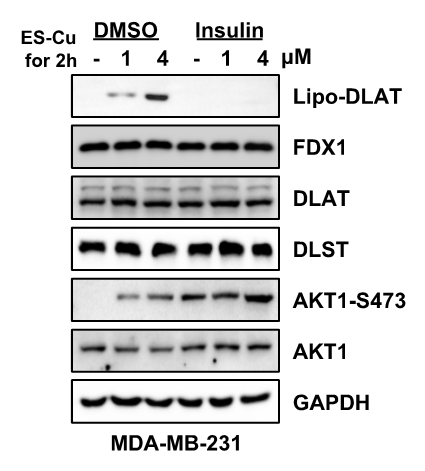
Insulin Protein, Human (P.pastoris) purchased from MedChemExpress. Usage Cited in: Adv Sci (Weinh). 2025 Feb 20:e2408106. [Abstract]
DLAT oligomerization was analyzed in MDA-MB-231 cells with or without Insulin Protein treatment following a 2-hour elesclomol-Cu pulse. Insulin Protein activated AKT1 and significantly reduced insoluble lipoylated expression and oligomerization of DLAT.
-
Sci Adv
Transition of cellular senescence to pyroptosis mediates recurrence of small cell lung cancer after chemotherapy. [Abstract]2025 Jul 11;11(28):eadw1553. PMID: 40644541 -
Sci Adv
FAM50A drives breast cancer brain metastasis through interaction with C9ORF78 to enhance ʟ-asparagine production. [Abstract]2025 Jun 20;11(25):eadt3075. PMID: 40531994 -
-
Phytomedicine
Targeting UBE2T by β-elemene inhibits prostate cancer stem cells and bone metastasis by blocking the TRIM28/pGSK3β/β-catenin signaling. [Abstract]2026 Jul:156:158242. PMID: 42070337 -
Phytomedicine
Ginsenoside Rg3 suppresses vasculogenic mimicry by impairing DVL3-maintained stemness via PAAD cell-derived exosomal miR-204 in pancreatic adenocarcinoma. [Abstract]2024 Apr:126:155402. PMID: 38350242 -
Phytomedicine
Curcumin treatment suppresses cachexia-associated adipose wasting in mice by blocking the cAMP/PKA/CREB signaling pathway. [Abstract]2023 Jan:109:154563. PMID: 36610148 -
-
-
Sci Signal
PARP1-mediated PARylation of TEAD4 stabilizes the YAP1-TEAD4 complex and promotes growth and immune evasion in breast cancer cells. [Abstract]2025 Oct 21;18(909):eadx2532. PMID: 41118450 -
-
Cell Mol Life Sci
Hypoxia drives cervical cancer progression via OCT4/ORAI3-dependent glycolysis and Ca2+ signaling. [Abstract]2025 Nov 6;82(1):390. PMID: 41196424 -
Biochem Pharmacol
WISP3 upregulates SDCBP expression to promote the progression of non-small cell lung cancer via the TGF-β signaling pathway. [Abstract]2025 Oct:240:117082. PMID: 40571215 -
-
-
Biol Direct
Phosphodiesterase type 5 inhibitor tadalafil reduces prostatic fibrosis via MiR-3126-3p/FGF9 axis in benign prostatic hyperplasia. [Abstract]2024 Aug 2;19(1):61. PMID: 39095835 -
Food Sci Nutr
Anti-Diabetic Effects of Ayanin, a Flavonoid Compound, in STZ/HFD-Induced Diabetic Mice by Upregulating GLUT4 and Suppressing Macrophage-Driven Inflammation in Adipose Tissues. [Abstract]2026 Jan 7;14(1):e71429. PMID: 41509193 -
Mol Med Rep
Tea seed saponin‑reduced extract ameliorates palmitic acid‑induced insulin resistance in HepG2 cells. [Abstract]2024 Feb;29(2):26. PMID: 38099345 -
Sci Rep
Triiodothyronine (T3) promotes browning of white adipose through inhibition of the PI3K/AKT signalling pathway. [Abstract]2024 Sep 2;14(1):20370. PMID: 39223267 -
J Inflamm Res
Mesenchymal Stem Cells Ameliorate DSS-Induced Experimental Colitis by Modulating the Gut Microbiota and MUC-1 Pathway. [Abstract]2023 May 11:16:2023-2039. PMID: 37197438 -
Front Biosci (Landmark Ed)
Increased expression of PD-L1 in endometrial cancer stem-like cells is regulated by hypoxia. [Abstract]2022 Jan 17;27(1):23. PMID: 35090328 -
Toxicol Appl Pharmacol
Drug screening reveals the mechanism of toyocamycin-induced apoptosis in triple-negative breast cancer organoids. [Abstract]2026 Jan:506:117659. PMID: 41314261 -
-
Mol Cell Endocrinol
Curcusone D improves metabolic dysfunction associated steatotic liver disease via activation of the AMPK signaling. [Abstract]2026 Oct:620:112847. PMID: 42264076 -
Exp Eye Res
Cyclosporin A improves the hyperosmotic response in an experimental dry eye model by inhibiting the HMGB1/TLR4/NF-κB signaling pathway. [Abstract]2023 Apr:229:109418. PMID: 36806672 -
Biochem Genet
Mechanisms of DDR1 in Reinforcing the Resistance to Radiotherapy in Breast Cancer Through the AMPK/SIRT1/PGC-1α Pathway. [Abstract]2026 Jan 20. PMID: 41557071 -
-
-


Technical Parameters
-
Species Human
-
Source P. pastoris
-
Tag Tag Free
-
Accession
P01308-1 (F25-K53&G90-N110)
-
Molecular Construction
-
N-term
-
Insulin (F25-K53&G90-N110)
Accession # P01308-1 -
C-term
-
-
Protein Length
Full Length of Insulin Chain
-
Synonyms
INS; Proinsulin; Prev. IDDM1; PNDM4; Prev. IDDM2; IDDM; Insulin-Dependent Diabetes Mellitus 2; ILPR; Preproinsulin; IRDN; Insulin; MODY10
-
Predicted Molecular Mass
7.1 kDa
-
Molecular Weight
Approximately 6 kDa, based on SDS-PAGE under reducing conditions.
-
Purity
≥ 95%, as determined by reducing SDS-PAGE.


Product Properties
Solution
Supplied as a 0.22 μm filtered solution of PBS, pH 7.4.
<1 EU/μg, determined by LAL method.
Stored at -80°C for 1 year from date of receipt. It is stable at -20°C for 3 months after opening. It is recommended to freeze aliquots at -80°C for extended storage. Avoid repeated freeze-thaw cycles.
Shipping with dry ice.


Documentation
-
Data Sheet (261 KB)
-
SDS (252 KB)
- English - EN (252 KB)
- Français - FR (252 KB)
- Deutsch - DE (252 KB)
- Norwegian - NO (252 KB)
- Español - ES (252 KB)
- Swedish - SV (252 KB)
- Italian - IT (252 KB)
- Korean - KR (252 KB)
- Portuguese - PT (252 KB)
-
Handling Instructions (2659 KB)


References
[1]. Chen S, et al. Single-cell analysis reveals transcriptomic remodellings in distinct cell types that contribute to human prostate cancer progression. Nat Cell Biol. 2021 Jan;23(1):87-98. [Content Brief]
[2]. Niu B , et al. Interplay between transforming growth factor-β and Nur77 in dual regulations of inhibitor of differentiation 1 for colonic tumorigenesis. Nat Commun. 2021 May 14;12(1):2809. [Content Brief]
[3]. Li S , et al. FUNDC2 promotes liver tumorigenesis by inhibiting MFN1-mediated mitochondrial fusion. Nat Commun. 2022 Jun 17;13(1):3486. [Content Brief]
[4]. Ladisch M R, et al. Recombinant human insulin[J]. Biotechnology progress, 1992, 8(6): 469-478.
[5]. Xu J , et al. Acute glucose-lowering and insulin-sensitizing action of FGF21 in insulin-resistant mouse models--association with liver and adipose tissue effects. Am J Physiol Endocrinol Metab. 2009 Nov;297(5):E1105-14. [Content Brief]

Calculators
Concentration (start) × Volume (start) = Concentration (final) × Volume (final)


 Powered by Bioz

