



SRSF1 Protein, Human (His-SUMO)

Based on 1 Customer Validation
The SRSF1 protein plays a crucial role in splicing regulation, preventing exon skipping and ensuring splicing accuracy. It interacts with spliceosome components and forms a bridge between 5'- and 3'-splice site binding elements. SRSF1 Protein, Human (His-SUMO) is the recombinant human-derived SRSF1 protein, expressed by E. coli , with N-SUMO, N-6*His labeled tag.
- Species: Human
- Source: E. coli
-
Storage:Stored at -20°C for 2 years from date of receipt. After reconstitution, it is stable at 4°C for 1 week or -20°C for longer (with carrier protein). It is recommended to freeze aliquots at -20°C or -80°C for extended storage.


To place orders, for customer services and technical support, please contact: MedChemExpress USA
Tel: 609-228-6898 E-mail: [email protected] [email protected]


-
 Biological Activity
-
Technical Parameters
-
Product Properties
- Documentation
- Help & FAQs




Biological Activity
Description
The SRSF1 protein plays a crucial role in splicing regulation, preventing exon skipping and ensuring splicing accuracy. It interacts with spliceosome components and forms a bridge between 5'- and 3'-splice site binding elements. SRSF1 Protein, Human (His-SUMO) is the recombinant human-derived SRSF1 protein, expressed by E. coli , with N-SUMO, N-6*His labeled tag.
Background
SRSF1 protein plays a crucial role in maintaining splicing fidelity by preventing exon skipping and regulating alternative splicing. Its interaction with spliceosomal components, facilitated by RS domains, establishes a bridge between the 5'- and 3'-splice site binding elements, U1 snRNP and U2AF. SRSF1 exhibits preferential binding to purine-rich RNA sequences, acting as a splicing enhancer in vitro through the ASF/SF2 splicing enhancer (ASE). While isoforms ASF-2 and ASF-3 function as splicing repressors, SRSF1 may also serve as an export adapter in mRNA nuclear export via the TAP/NXF1 pathway. Within the spliceosome C complex, it collaborates with other RNA-binding proteins, including DDX5, HNRNPH2, and splicing regulator ARVCF. SRSF1's extensive interactome involves proteins such as SAFB/SAFB1, PSIP1/LEDGF, RSRC1, ZRSR2/U2AF1-RS2, CCDC55, SRPK1, NXF1, CCNL1, CCNL2, CDK11B, and RRP1B, showcasing its multifaceted roles in RNA processing and cellular functions. Additionally, its interaction with TNPO3 facilitates nuclear import when phosphorylated in the RS domain, and it interacts with ILDR1 and ILDR2.
Verified Bioactivity
Measured by its binding ability in a functional ELISA. Immobilized Human SRSF1, at 2 μg/mL (100μL/well) can bind Anti-SRSF1 antibody. The ED50 for this effect is ≤6.802 ng/mL.
MCE Validation Data
-
Purity - SDS-PAGE
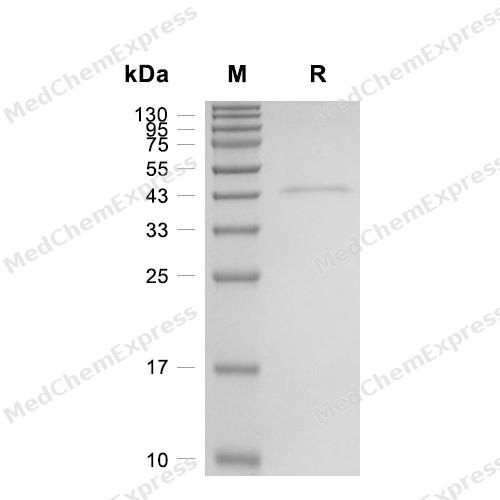
Purity - SDS-PAGE
-
Bioactivity - ELISA
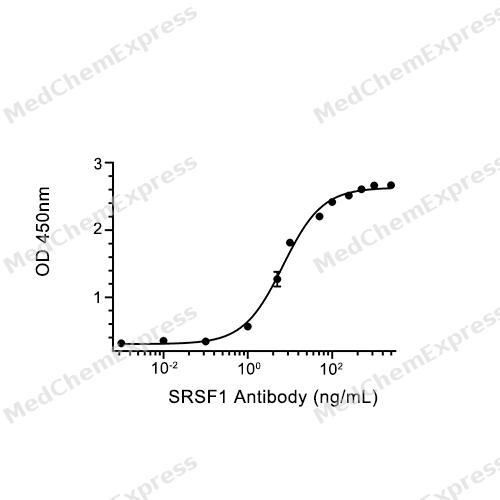
Bioactivity - ELISA


Technical Parameters
-
Species Human
-
Source E. coli
-
Tag N-SUMO;N-6*His
-
Accession
Q07955-1 (S2-T248)
-
Molecular Construction
-
N-term
-
6*His-SUMO
-
SRSF1 (S2-T248)
Accession # Q07955 -
C-term
-
-
Protein Length
Full Length of Isoform-1
-
Synonyms
SRSF1; SR Splicing Factor 1; Prev. SFRS1; MGC5228; Serine/Arginine-Rich Splicing Factor 1; Splicing Factor, Arginine/Serine-Rich 1 (Splicing Factor 2, Alternate Splicing Factor), Isoform CRA_f; ASF; Serine And Arginine Rich Splicing Factor 1 Transcript Va
-
AA Sequence
SGGGVIRGPAGNNDCRIYVGNLPPDIRTKDIEDVFYKYGAIRDIDLKNRRGGPPFAFVEFEDPRDAEDAVYGRDGYDYDGYRLRVEFPRSGRGTGRGGGGGGGGGAPRGRYGPPSRRSENRVVVSGLPPSGSWQDLKDHMREAGDVCYADVYRDGTGVVEFVRKEDMTYAVRKLDNTKFRSHEGETAYIRVKVDGPRSPSYGRSRSRSRSRSRSRSRSNSRSRSYSPRRSRGSPRYSPRHSRSRSRT
-
Predicted Molecular Mass
38.8 kDa
-
Molecular Weight
Approximately 43 kDa, based on SDS-PAGE under reducing conditions.
-
Purity
≥ 95%, as determined by reducing SDS-PAGE.


Product Properties
Lyophilized powder
Lyophilized from a 0.22 μm filtered solution of 50 mM Tris-HCl, 200 mM NaCl, 0.1%SKL, pH 8.0.
Note: For SPR assay, please replace the buffer. Primary amine components (e.g., Tris, imidazole) can affect protein-coupled chips.
<1 EU/μg, determined by LAL method.
It is not recommended to reconstitute to a concentration less than 100 μg/mL in ddH2O. For long term storage it is recommended to add a carrier protein (0.1% BSA, 5% HSA, 10% FBS or 5% Trehalose).
Stored at -20°C for 2 years from date of receipt. After reconstitution, it is stable at 4°C for 1 week or -20°C for longer (with carrier protein). It is recommended to freeze aliquots at -20°C or -80°C for extended storage.
Room temperature in continental US; may vary elsewhere.


Documentation
-
Data Sheet (237 KB)
-
SDS (251 KB)
- English - EN (251 KB)
- Français - FR (251 KB)
- Deutsch - DE (251 KB)
- Norwegian - NO (251 KB)
- Español - ES (251 KB)
- Swedish - SV (251 KB)
- Italian - IT (251 KB)
- Korean - KR (251 KB)
- Portuguese - PT (251 KB)
-
Handling Instructions (2659 KB)

Calculators
Concentration (start) × Volume (start) = Concentration (final) × Volume (final)


 Powered by Bioz

