



VEGF-C Protein, Mouse/Rat (HEK293, His)
Based on 7 publication(s) in Google Scholar
VEGF-C protein stimulates cell proliferation, migration, and vascular permeability, which are critical for angiogenesis and endothelial cell dynamics. It plays a crucial role in the development of the venous and lymphatic vasculature during embryogenesis and in the maintenance of adult lymphatic endothelium. VEGF-C Protein, Mouse/Rat (HEK293, His) is the recombinant mouse, rat-derived VEGF-C protein, expressed by HEK293 , with C-6*His labeled tag.
- Species: Mouse; Rat
- Source: HEK293
-
Storage:Stored at -20°C for 2 years from date of receipt. After reconstitution, it is stable at 4°C for 1 week or -20°C for longer (with carrier protein). It is recommended to freeze aliquots at -20°C or -80°C for extended storage.


To place orders, for customer services and technical support, please contact: MedChemExpress USA
Tel: 609-228-6898 E-mail: [email protected] [email protected]


-
 Biological Activity
-
Technical Parameters
-
Product Properties
- Documentation
- Help & FAQs




Biological Activity
Description
VEGF-C protein stimulates cell proliferation, migration, and vascular permeability, which are critical for angiogenesis and endothelial cell dynamics. It plays a crucial role in the development of the venous and lymphatic vasculature during embryogenesis and in the maintenance of adult lymphatic endothelium. VEGF-C Protein, Mouse/Rat (HEK293, His) is the recombinant mouse, rat-derived VEGF-C protein, expressed by HEK293 , with C-6*His labeled tag.
Background
VEGF-CC, a growth factor crucial in angiogenesis and endothelial cell dynamics, exerts stimulatory effects on cellular proliferation and migration, while also influencing the permeability of blood vessels. It plays a vital role in angiogenesis, particularly in the development of the venous and lymphatic vascular systems during embryogenesis. Additionally, VEGF-CC contributes to the maintenance of differentiated lymphatic endothelium in adults. The protein binds and activates the KDR/VEGFR2 and FLT4/VEGFR3 receptors, orchestrating essential signaling pathways for vascular development and homeostasis. Structurally, VEGF-CC forms a homodimer with a non-covalent and antiparallel arrangement. Its interaction with FLT4/VEGFR3 is imperative for FLT4/VEGFR3 homodimerization and subsequent activation, highlighting the intricacies of its regulatory role in vascular processes.
Verified Bioactivity
1. Immobilized mouse/rat VEGFC-His at 10 μg/mL (100 μL/well) can bind mouse VEGFR3-Fc, The EC50 of mouse VEGFR3-Fc is 17.4-40.6 ng/mL.
2. Measured in a cell proliferation assay using human umbilical vein endothelial cells (HUVEC).The ED50 for this effect is typically 0.1-2.7 μg/mL.
MCE Validation Data
-
Purity - SDS-PAGE
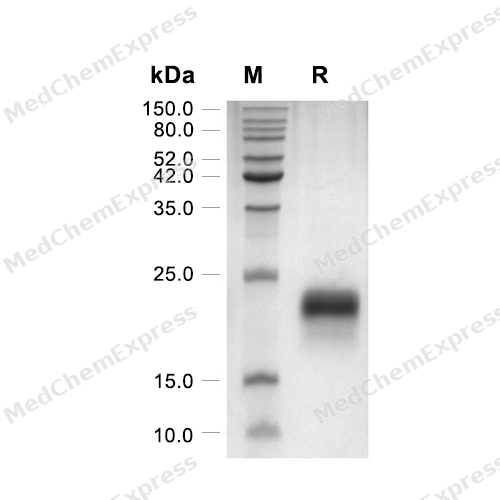
Purity - SDS-PAGE
-
Bioactivity - Cell-Based Assay
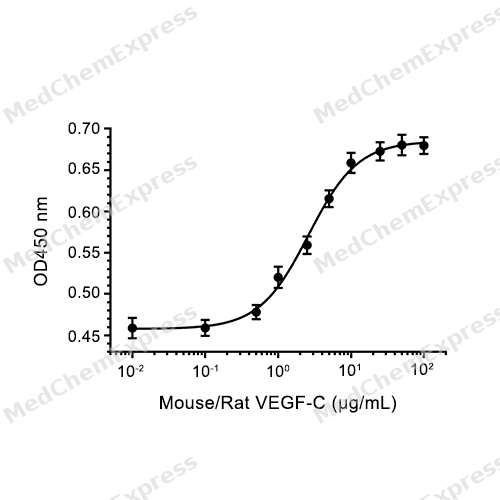
Bioactivity - Cell-Based Assay


Publications (7)
-
Journal Impact Factor
-
Most Recent
-
J Neuroinflammation
Spatiotemporal dynamic changes of meningeal microenvironment influence meningeal lymphatic function following subarachnoid hemorrhage: from inflammatory response to tissue remodeling. [Abstract]2025 May 16;22(1):131. PMID: 40380229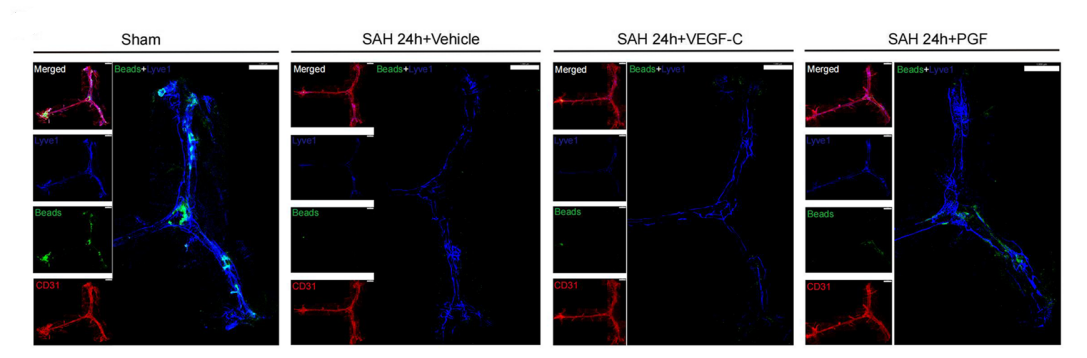
VEGF-C Protein, Mouse/Rat (HEK293, His) purchased from MedChemExpress. Usage Cited in: J Neuroinflammation. 2025 May 16;22(1):131. [Abstract]
Representative image of the mLVs area and beads area in Sham, SAH 24 h + Vehicle, SAH 24 h + VEGF-C (1 μg) and SAH 24 h + PGF group.
-
Neurotherapeutics
Meningeal lymphatic dysfunction drives cognitive impairment after experimental subarachnoid hemorrhage. [Abstract]2025 Dec 12:e00819. PMID: 41390288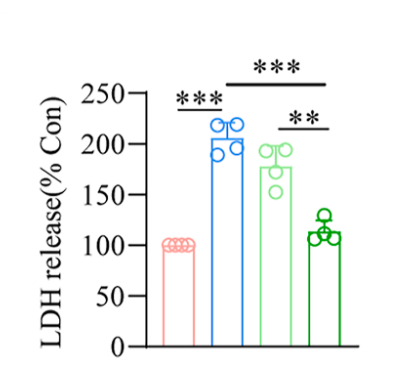
VEGF-C Protein, Mouse/Rat (HEK293, His) purchased from MedChemExpress. Usage Cited in: Neurotherapeutics. 2025 Dec 12:e00819. [Abstract]
Cytotoxicity was assessed using an LDH release assay, and 100 ng/mL VEGF-C reduced cell death.
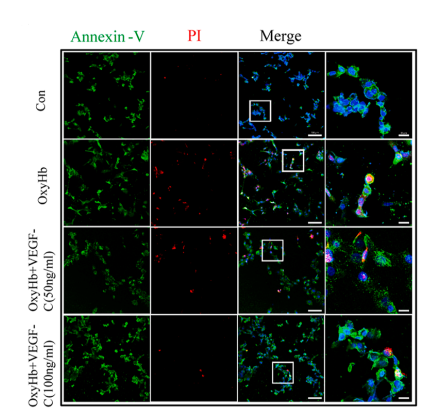
VEGF-C Protein, Mouse/Rat (HEK293, His) purchased from MedChemExpress. Usage Cited in: Neurotherapeutics. 2025 Dec 12:e00819. [Abstract]
In an in vitro hemoglobin injury model, VEGF-C inhibited apoptosis of lymphatic endothelial cells. Representative immunofluorescence images of lymphatic endothelial cells (LECs) stained with Annexin V (live cells, green) and PI (apoptotic cells, red).
-
Biochem Pharmacol
Naringin affects VEGFC/TGF-β1 to mediate intercellular communication in MASH through coordinated Src and p38 MAPK pathways. [Abstract]2026 Sep;251(Pt 1):118009. PMID: 42044813 -
Inflamm Res
Aldosterone induces renal lymphangiogenesis through macrophage-lymphatic endothelial cell transformation and Inhibition by esaxerenone. [Abstract]2025 May 24;74(1):85. PMID: 40413281 -
Int J Mol Sci
Esaxerenone Attenuates Aldosterone-Induced Renal Fibrosis by Suppressing Fibroblast-to-Lymphatic Endothelial-like Cell Transdifferentiation. [Abstract]2026 May 12;27(10):4297. PMID: 42196278 -
Aesthet Surg J
Lymphatic Vessel-Mediated Attenuation of Persistent Macrophage Infiltration Improves Fat Grafting Outcomes in Mice Models. [Abstract]2024 Sep 16;44(10):NP737-NP748. PMID: 38870037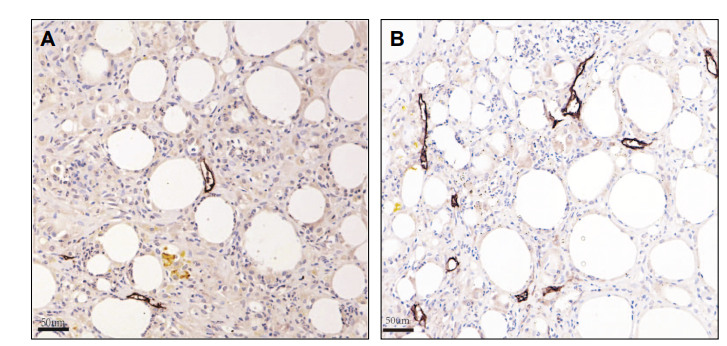
VEGF-C Protein, Mouse/Rat (HEK293, His) purchased from MedChemExpress. Usage Cited in: Aesthet Surg J. 2024 Sep 16;44(10):NP737-NP748. [Abstract]
Comparison of LYVE-1 staining and volume retention rates in fat grafting between the control and VEGF-C groups. Representative LYVE-1 histochemical staining images of the control and VEGF-C groups (1 µg/kg) on day 90.
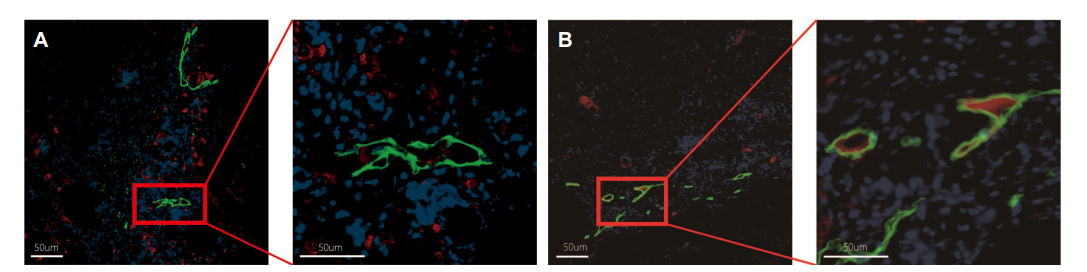
VEGF-C Protein, Mouse/Rat (HEK293, His) purchased from MedChemExpress. Usage Cited in: Aesthet Surg J. 2024 Sep 16;44(10):NP737-NP748. [Abstract]
Comparison of macrophage distribution and number between the VEGF-C group and the control group. Representative image on day 60 post-transplantation; the number of macrophages in the VEGF-C group (1 μg/kg) was less than that in the control group.
-
Int J Med Sci
Intrahepatic Lymphangiogenesis Is Associated with Early Post-Hepatectomy Liver Regeneration, in Part via IL-6/STAT3 Signaling. [Abstract]2026 Jan 14;23(2):646-660. PMID: 41583514


Technical Parameters
-
Species Mouse; Rat
-
Source HEK293
-
Tag C-6*His
-
Accession
P97953-1/NP_033532.1/O35757 (A108-R223)
-
Molecular Construction
-
N-term
-
VEGF-CC (A108-R223)
Accession # P97953-1/NP_033532.1/O35757 -
6*His
-
C-term
-
-
Protein Length
Full Length of Mature Protein
-
Synonyms
VEGFC; Vascular Endothelial Growth Factor C; Vascular Endothelial Growth Factor-Related Protein; VRP; VEGF-C; Flt4 Ligand; Flt4-L; FLT4 Ligand DHM; LMPH1D; LMPHM4
-
AA Sequence
AHYNTEILKSIDNEWRKTQCMPREVCIDVGKEFGAATNTFFKPPCVSVYRCGGCCNSEGLQCMNTSTGYLSKTLFEITVPLSQGPKPVTISFANHTSCRCMSKLDVYRQVHSIIRR
-
Predicted Molecular Mass
14.5 kDa
-
Molecular Weight
Approximately 18-23 kDa, based on SDS-PAGE under reducing conditions, due to the glycosylation.
-
Glycosylation
Yes
-
Purity
≥ 95%, as determined by reducing SDS-PAGE.


Product Properties
Lyophilized powder
1.Lyophilized from a 0.22 μm filtered solution of 20 mM PB, 150 mM NaCl, pH 7.4.
2.Lyophilized from a 0.22 μm filtered solution of PBS, pH 7.4.
3.Lyophilized from a 0.22 μm filtered solution of PBS, pH 7.4, 8% trehalose.
Please refer to the lot-specific COA for specific buffer information.
<1 EU/μg, determined by LAL method.
It is not recommended to reconstitute to a concentration less than 100 μg/mL in ddH2O. For long term storage it is recommended to add a carrier protein (0.1% BSA, 5% HSA, 10% FBS or 5% Trehalose).
Stored at -20°C for 2 years from date of receipt. After reconstitution, it is stable at 4°C for 1 week or -20°C for longer (with carrier protein). It is recommended to freeze aliquots at -20°C or -80°C for extended storage.
Room temperature in continental US; may vary elsewhere.


Documentation
-
Data Sheet (236 KB)
-
SDS (252 KB)
- English - EN (252 KB)
- Français - FR (252 KB)
- Deutsch - DE (252 KB)
- Norwegian - NO (252 KB)
- Español - ES (252 KB)
- Swedish - SV (252 KB)
- Italian - IT (252 KB)
- Korean - KR (252 KB)
- Portuguese - PT (252 KB)
-
Handling Instructions (2659 KB)

Calculators
Concentration (start) × Volume (start) = Concentration (final) × Volume (final)


 Powered by Bioz

