



Dimesna
Based on 1 publication(s) in Google Scholar
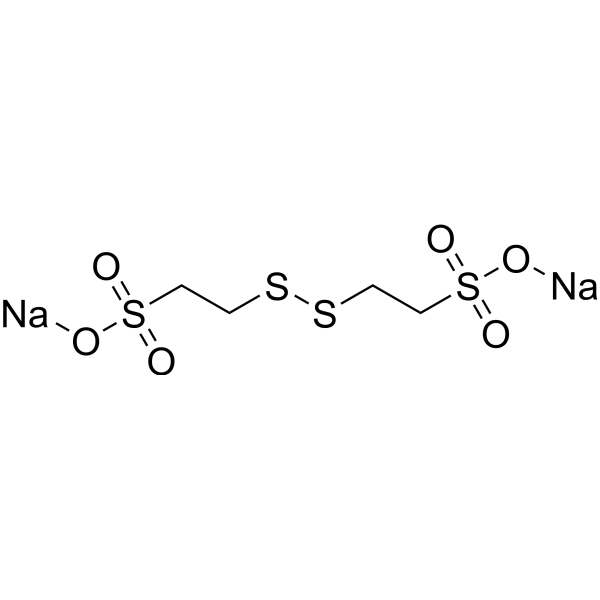
Dimesna (BNP-7787), the disulfide form of Mesna (HY-13679), is a platinum-related toxicity protective agent. Dimesna converts to Mesna, which in turn inactivates toxic platinum substances. Dimesna does not interfere with the antitumor activity of platinum compounds. Dimesna does not affect the antiproliferative effects of Cisplatin (HY-17394) or Carboplatin (HY-17393). Dimesna counteracts Cisplatin-induced nephrotoxicity. Dimesna exerts selective protective effects on the kidneys. Dimesna can be used in studies related to ovarian cancer and Cisplatin-induced nephrotoxicity.
For research use only. We do not sell to patients.
- Purity : 98.0%
- CAS No.: 16208-51-8
- Formula: C4H8Na2O6S4
- Molecular Weight:326.34
-
Storage:
4°C, sealed storage, away from moisture
* In solvent : -80°C, 6 months; -20°C, 1 month (sealed storage, away from moisture)

To place orders, for customer services and technical support, please contact: MedChemExpress USA
Tel: 609-228-6898 E-mail: [email protected] [email protected]


-
 Biological Activity
-
Chemical Information
-
Solvent & Solubility
- Protocols
- Purity & Documentation
- References
-
 Help & FAQs


Publications Citing Use of MedChemExpress (MCE) Dimesna
More

Biological Activity
Description
In Vitro
Dimesna (0-5.0 mmol/L; 1-24 h) alone exerts no effect on total protein, thymidine incorporation or uridine incorporation in LLC-PK1 cells, and fails to protect LLC-PK1 cells from toxicity induced by ifosfamide, cyclophosphamide, 4-hydroperoxyifosfamide, chloroacetaldehyde or acrolein[1].
Dimesna (≥2.0×10³ μM; 96 h) does not reduce the antiproliferative effects of cisplatin or carboplatin on A2780 or OVCAR-3 ovarian cancer cells, and only inhibits the growth of these cells when exposed for 96 h at a concentration of ≥2.0×10³ μM[2].
MedChemExpress (MCE) has not independently confirmed the accuracy of these methods. They are for reference only. Further protocols information, click here.
-
Cell Line:LLC-PK1 renal tubular cells
-
Concentration:0-5.0 mmol/l (alone; co-incubated with ifosfamide/cyclophosphamide/4-OOH-ifosfamide/chloracetaldehyde/acrolein); 1.0-5.0 mmol/l (co-incubated with 4-OOH-cyclophosphamide)
-
Incubation Time:1-24 h (alone); 1 h pre-incubation + 23 h co-incubation (with cytostatic metabolites)
-
Result:Had no significant effect on total protein, thymidine incorporation, or uridine incorporation at all tested concentrations and times when used alone.
Moderately stimulated thymidine incorporation, but had no significant effect on total protein or uridine incorporation when co-incubated with 150 μmol/l ifosfamide.
Had no significant effect on total protein, thymidine incorporation, or uridine incorporation when co-incubated with 150 μmol/l cyclophosphamide.
Further reduced total protein and thymidine incorporation at 1.0, 3.0, 5.0 mmol/l, and further reduced uridine incorporation at 3.0, 5.0 mmol/l (P < 0.05) when co-incubated with 75 μmol/l 4-OOH-cyclophosphamide.
Failed to protect cells from toxicity induced by 150 μmol/l 4-OOH-ifosfamide, with total protein, thymidine incorporation, and uridine incorporation remaining strongly reduced.
Failed to protect cells from toxicity induced by 75 μmol/l chloracetaldehyde, with no statistically significant difference in total protein, thymidine incorporation, or uridine incorporation compared to chloracetaldehyde alone.
Failed to protect cells from toxicity induced by 100 μmol/l acrolein, with total protein, thymidine incorporation, and uridine incorporation remaining severely reduced.
In Vivo
Dimesna (BNP-7787) (1000 mg/kg; i.v.; bolus injection) administered to tumour-bearing Fischer rats results in preferential accumulation of its metabolite mesna in the kidney, with kidney mesna AUC0-t 4.5-fold higher than plasma mesna AUC0-t, while maintaining low mesna levels in plasma and tumour tissue relative to mesna administration[3].
MedChemExpress (MCE) has not independently confirmed the accuracy of these methods. They are for reference only.
-
Animal Model:Hsd: athymic nude-nu (female, 8-10 weeks old)[2]
-
Dosage:1000 mg/kg (pre-cisplatin 5 mg/kg); 1000 mg/kg (pre-cisplatin 8 mg/kg); 1000 mg/kg (with carboplatin 60 mg/kg); 1000 mg/kg (with carboplatin 90 mg/kg); 1000 mg/kg (monotherapy)
-
Administration:i.v.; weekly ×2 (pre-cisplatin 5 mg/kg); i.v.; every 2 weeks ×2 (pre-cisplatin 8 mg/kg); i.v.; twice per treatment cycle, weekly ×2 (with carboplatin 60 mg/kg); i.v.; twice per treatment cycle, weekly ×2 (with carboplatin 90 mg/kg); i.v.; weekly ×2 (monotherapy)
-
Result:Exhibited mean maximum weight loss of 6.6±6.1%, no toxic deaths, specific growth delay of 3.48, and mean relative tumour volume of 2.55±0.42 on day 31 when given 5 minutes before 5 mg/kg cisplatin, with no significant difference in tumour growth inhibition compared to cisplatin alone.
Exhibited mean maximum weight loss of 24.8±9.2%, no toxic deaths, specific growth delay of 6.34, and mean relative tumour volume of 0.39±0.08 on day 31 when given 5 minutes before 8 mg/kg cisplatin, with no significant difference in tumour growth inhibition compared to amifostine-pretreated cisplatin.
Exhibited mean maximum weight loss of 9.9±11.9%, no toxic deaths, specific growth delay of 4.72, and mean relative tumour volume of 0.50±0.14 on day 31 when given with 60 mg/kg carboplatin, which was significantly smaller than carboplatin alone (P<0.01).
Exhibited mean maximum weight loss of 11.4±3.1%, 2 out of 6 mice died from toxicity, specific growth delay of 8.44, and mean relative tumour volume of 0.17±0.03 on day 31 when given with 90 mg/kg carboplatin.
Exhibited mean maximum weight loss of 0.0±3.2%, no toxic deaths, specific growth delay of 0.22, and mean relative tumour volume of 29.28±4.38 on day 31 as monotherapy, with no tumour growth inhibition observed.
Clinical Trial
| NCT Number | Sponsor | Condition | Start Date |
Phase

|
|---|---|---|---|---|
| NCT01329991 | Plexxikon| | 2011-05 | PHASE1 |


Chemical Information
-
CAS No. 16208-51-8
-
Appearance Solid
-
Molecular Weight 326.34
-
Formula C4H8Na2O6S4
-
Color White to off-white
-
SMILES
O=S(CCSSCCS(=O)(O[Na])=O)(O[Na])=O
-
Synonyms
BNP-7787
-
Shipping
Room temperature in continental US; may vary elsewhere.
-
Storage
4°C, sealed storage, away from moisture
* In solvent : -80°C, 6 months; -20°C, 1 month (sealed storage, away from moisture)


Publications (1)
-
Journal Impact Factor
-
Most Recent
-
Sci Data
High-throughput drug screening identifies novel therapeutics for Low Grade Serous Ovarian Carcinoma. [Abstract]2024 Sep 19;11(1):1024. PMID: 39300112


Solvent & Solubility
In Vitro:
H2O : 100 mg/mL (306.43 mM; Need ultrasonic)
DMSO : 68 mg/mL (208.37 mM; Need ultrasonic and warming; Hygroscopic DMSO has a significant impact on the solubility of product, please use newly opened DMSO)
Please refer to the solubility information to select the appropriate solvent. Once prepared, please aliquot and store the solution to prevent product inactivation from repeated freeze-thaw cycles.
Storage method and period of stock solution: -80°C, 6 months; -20°C, 1 month (sealed storage, away from moisture). When stored at -80°C, please use it within 6 months. When stored at -20°C, please use it within 1 month.
* Note: If you choose water as the stock solution, please dilute it to the working solution, then filter and sterilize it with a 0.22 μm filter before use.
Please refer to the solubility information to select the appropriate solvent. Once prepared, please aliquot and store the solution to prevent product inactivation from repeated freeze-thaw cycles.
Storage method and period of stock solution: -80°C, 6 months; -20°C, 1 month (sealed storage, away from moisture). When stored at -80°C, please use it within 6 months. When stored at -20°C, please use it within 1 month.
* Note: If you choose water as the stock solution, please dilute it to the working solution, then filter and sterilize it with a 0.22 μm filter before use.
Concentration (start) × Volume (start) = Concentration (final) × Volume (final)

Protocols
-
Nephrotoxicity Study
This protocol assesses nephrotoxicity by combining functional kidney injury readouts, urinary/tissue injury biomarkers, and renal histopathology. Serum creatinine and BUN reflect impaired kidney function, while KIM-1, NGAL, clusterin, osteopontin, IL-18, cystatin C, nephrin, Oat5, urinary protein, glucose, and alkaline phosphatase have been used to detect tubular injury in cisplatin-, gentamicin-, and acetaminophen-induced nephrotoxicity models.
-
Subcutaneous Cell-Line-Derived Xenograft
Subcutaneous cell-line-derived xenograft (CDX) models are established by implanting cultured human cancer cell lines into immunodeficient mice, where the injected cells form localized tumors that can be monitored in vivo as a measure of tumorigenic potential, growth kinetics, and treatment response. These models are widely used in oncology research because they allow reproducible tumor formation and enable comparative assessment of tumor growth between different cell lines or genetic manipulations in a controlled in vivo microenvironment. Subcutaneous implantation of cancer cells in immunodeficient mice is a standard approach for evaluating tumor growth behavior and therapeutic response across multiple cancer types, including prostate, esophageal, pancreatic, and colon cancer models.
-
Cell Viability Determination by MTT Colorimetric Assay
The following protocol uses the MTT colorimetric assay as a classic literature-established method for assessing cell viability/metabolic activity in cultured mammalian cells. MTT[3-(4,5-dimethylthiazol-2-yl)-2,5-diphenyltetrazolium bromide] is reduced by metabolically active cells to a colored formazan product; the amount of formazan is quantified spectrophotometrically and provides an indirect measure of metabolically active viable cells. Importantly, MTT reduction reflects cellular oxidoreductase/metabolic activity rather than an absolute direct count of living cells, so changes in cellular metabolism can alter the signal independently of cell number.


Purity & Documentation
-
Data Sheet (278 KB)
-
SDS (393 KB)
- English - EN (393 KB)
- Français - FR (393 KB)
- Deutsch - DE (393 KB)
- Norwegian - NO (393 KB)
- Español - ES (393 KB)
- Swedish - SV (393 KB)
- Italian - IT (393 KB)
- Korean - KR (393 KB)
- Portuguese - PT (393 KB)
-
Handling Instructions (2659 KB)
References
[1]. Mohrmann M, et al. Dithio-bis-mercaptoethanesulphonate (DIMESNA) does not prevent cellular damage by metabolites of ifosfamide and cyclophosphamide in LLC-PK1 cells. Pediatr Nephrol. 1994;8(4):458-465. [Content Brief]
[2]. Boven E, et al. BNP7787, a novel protector against platinum-related toxicities, does not affect the efficacy of cisplatin or carboplatin in human tumour xenografts. Eur J Cancer. 2002;38(8):1148-1156. [Content Brief]
[3]. Verschraagen M, et al. Pharmacokinetic behaviour of the chemoprotectants BNP7787 and mesna after an i.v. bolus injection in rats. Br J Cancer. 2004;90(8):1654-1659. [Content Brief]


Complete Stock Solution Preparation Table
Please refer to the solubility information to select the appropriate solvent. Once prepared, please aliquot and store the solution to prevent product inactivation from repeated freeze-thaw cycles.
Storage method and period of stock solution: -80°C, 6 months; -20°C, 1 month (sealed storage, away from moisture). When stored at -80°C, please use it within 6 months. When stored at -20°C, please use it within 1 month.
| Optional Solvent | Concentration Solvent Mass | 1 mg | 5 mg | 10 mg | 25 mg |
|---|---|---|---|---|---|
| DMSO / H2O | 1 mM | 3.0643 mL | 15.3214 mL | 30.6429 mL | 76.6072 mL |
| 5 mM | 0.6129 mL | 3.0643 mL | 6.1286 mL | 15.3214 mL | |
| 10 mM | 0.3064 mL | 1.5321 mL | 3.0643 mL | 7.6607 mL | |
| 15 mM | 0.2043 mL | 1.0214 mL | 2.0429 mL | 5.1071 mL | |
| 20 mM | 0.1532 mL | 0.7661 mL | 1.5321 mL | 3.8304 mL | |
| 25 mM | 0.1226 mL | 0.6129 mL | 1.2257 mL | 3.0643 mL | |
| 30 mM | 0.1021 mL | 0.5107 mL | 1.0214 mL | 2.5536 mL | |
| 40 mM | 0.0766 mL | 0.3830 mL | 0.7661 mL | 1.9152 mL | |
| 50 mM | 0.0613 mL | 0.3064 mL | 0.6129 mL | 1.5321 mL | |
| 60 mM | 0.0511 mL | 0.2554 mL | 0.5107 mL | 1.2768 mL | |
| 80 mM | 0.0383 mL | 0.1915 mL | 0.3830 mL | 0.9576 mL | |
| 100 mM | 0.0306 mL | 0.1532 mL | 0.3064 mL | 0.7661 mL |
* Note: If you choose water as the stock solution, please dilute it to the working solution, then filter and sterilize it with a 0.22 μm filter before use.


Dimesna Related Classifications
HY-B1022 Related Classifications
 Powered by Bioz