



KRN2
Based on 4 publication(s) in Google Scholar
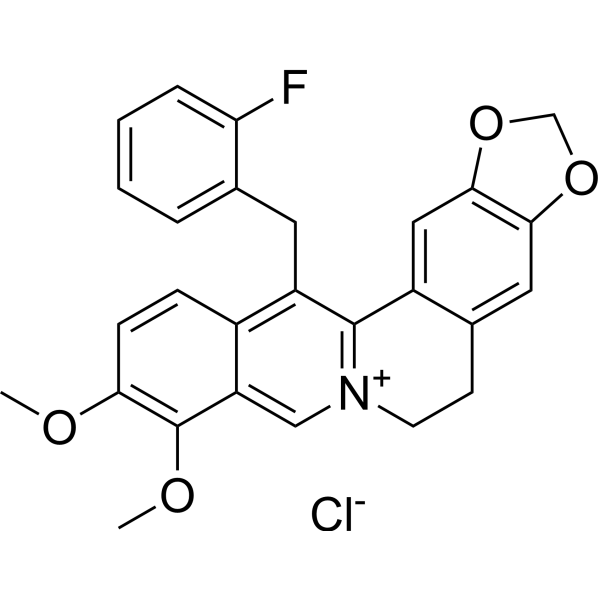
KRN2 is a selective inhibitor of nuclear factor of activated T cells (NFAT5), with an IC50 of 100 nM. KRN2 has potential to treat NFAT5-mediated Chronic Arthritis.
Nur für Forschungszwecke. Wir verkaufen nicht an Patienten.
- Reinheit : 98.04%
- CAS. Nr.: 248260-75-5
- Formel: C27H23ClFNO4
- Molecular Weight:479.93
-
Speicherung:
4°C, sealed storage, away from moisture
* In solvent : -80°C, 6 months; -20°C, 1 month (sealed storage, away from moisture)

To place orders, for customer services and technical support, please contact: MedChemExpress USA
Tel: 609-228-6898 E-mail: [email protected] [email protected]


-
 Biologische Aktivität
-
Chemical Information
-
Lösungsmittel & Löslichkeit
- Protokoll
- Reinheit & Dokumentation
- Verweise
-
 Help & FAQs


Publications Citing Use of MedChemExpress (MCE) KRN2
More

Biologische Aktivität
Beschreibung
IC50 & Target
IC50: 100 nM (NFAT5)[1].
In Vitro
KRN2 selectively suppresses the expression of pro-inflammatory genes, including Nos2 and Il6, without hampering high-salt-induced NFAT5 and its target gene expressions[1].
KRN2 dose-dependently inhibits the NF-κB p65 binding to Nfat5 promoter 1 and directly blocks the interaction between NF-κB p65 and its DNA binding sequence in the upstream site (base pairs -3000 to +1) of Nfat5 exon 1[1].
MedChemExpress (MCE) has not independently confirmed the accuracy of these methods. They are for reference only.
In Vivo
KRN2 (3 mg/kg, i.p., daily) effectively suppresses CIA as well as AIA in mice, decreasing the production of pro-inflammatory cytokines and autoantibodies as well as macrophage infiltration[1].
MedChemExpress (MCE) has not independently confirmed the accuracy of these methods. They are for reference only.
-
Animal Model:8-week-old C57BL/6 mice injected intradermally with 2 mg of complete Freund's adjuvant[1].
-
Dosage:3 mg/kg.
-
Administration:Peritoneally (i.p.) daily for 2 weeks.
-
Result:Effective in suppressing AIA.
-
Animal Model:8-week-old DBA/1Jmice immunized with bovine type II collagen[1].
-
Dosage:3 mg/kg.
-
Administration:Peritoneally (i.p.) daily.
-
Result:Effective in suppressing CIA as well as AIA in mice, decreasing the production of pro-inflammatory cytokines and autoantibodies as well as macrophage infiltration.


Chemical Information
-
CAS. Nr. 248260-75-5
-
Appearance Solid
-
Molecular Weight 479.93
-
Formel C27H23ClFNO4
-
Color Light yellow to yellow
-
SMILES
COC1=C(OC)C2=C[N+]3=C(C(C(CC3)=C4)=CC5=C4OCO5)C(CC6=CC=CC=C6F)=C2C=C1.[Cl-]
-
Versand
Room temperature in continental US; may vary elsewhere.
-
Speicherung
4°C, sealed storage, away from moisture
* In solvent : -80°C, 6 months; -20°C, 1 month (sealed storage, away from moisture)


Publications (4)
-
Journal Impact Factor
-
Most Recent
-
Nat Metab
SLC6A6 imports taurine into mitochondria to sustain mitochondrial translation and tumour growth. [Abstract]2026 Mar;8(3):704-721. PMID: 41652173 -
Biomolecules
Modulators of Alpha-2 Macroglobulin Upregulation by High Glucose in Glomerular Mesangial Cells. [Abstract]2024 Nov 13;14(11):1444. PMID: 39595620 -
J Immunol
NFAT5 Amplifies Antipathogen Responses by Enhancing Chromatin Accessibility, H3K27 Demethylation, and Transcription Factor Recruitment. [Abstract]2021 Jun 1;206(11):2652-2667. PMID: 34031145 -


Lösungsmittel & Löslichkeit
In Vitro:
DMSO : 50 mg/mL (104.18 mM; Need ultrasonic; Hygroscopic DMSO has a significant impact on the solubility of product, please use newly opened DMSO)
Please refer to the solubility information to select the appropriate solvent. Once prepared, please aliquot and store the solution to prevent product inactivation from repeated freeze-thaw cycles.
Storage method and period of stock solution: -80°C, 6 months; -20°C, 1 month (sealed storage, away from moisture). When stored at -80°C, please use it within 6 months. When stored at -20°C, please use it within 1 month.
Please refer to the solubility information to select the appropriate solvent. Once prepared, please aliquot and store the solution to prevent product inactivation from repeated freeze-thaw cycles.
Storage method and period of stock solution: -80°C, 6 months; -20°C, 1 month (sealed storage, away from moisture). When stored at -80°C, please use it within 6 months. When stored at -20°C, please use it within 1 month.
Konzentration (Stammlösung) × Volumen (Stammlösung) = Konzentration (Ziellösung) × Volumen (Ziellösung)
In Vivo:
Select the appropriate dissolution method based on your experimental animal and administration route.
- For the following dissolution methods, please ensure to first prepare a clear stock solution using an In Vitro approach and then sequentially add co-solvents:
- To ensure reliable experimental results, the clarified stock solution can be appropriately stored based on storage conditions. As for the working solution for In Vivo experiments, it is recommended to prepare freshly and use it on the same day.
- The percentages shown for the solvents indicate their volumetric ratio in the final prepared solution. If precipitation or phase separation occurs during preparation, heat and/or sonication can be used to aid dissolution.
Add each solvent one by one: 10% DMSO 40% PEG300 5% Tween-80 45% Saline
Solubility: ≥ 2.5 mg/mL (5.21 mM); Clear solution
This protocol yields a clear solution of ≥ 2.5 mg/mL (saturation unknown).
Taking 1 mL working solution as an example, add 100 μL DMSO stock solution (25.0 mg/mL) to 400 μL PEG300, and mix evenly; then add 50 μL Tween-80 and mix evenly; then add 450 μL Saline to adjust the volume to 1 mL.
Preparation of Saline: Dissolve 0.9 g sodium chloride in ddH₂O and dilute to 100 mL to obtain a clear Saline solution.
Add each solvent one by one: 10% DMSO 90% (20% SBE-β-CD in Saline)
Solubility: ≥ 2.5 mg/mL (5.21 mM); Clear solution
This protocol yields a clear solution of ≥ 2.5 mg/mL (saturation unknown).
Taking 1 mL working solution as an example, add 100 μL DMSO stock solution (25.0 mg/mL) to 900 μL 20% SBE-β-CD in Saline, and mix evenly.
Preparation of 20% SBE-β-CD in Saline (4°C, storage for one week): 2 g SBE-β-CD powder is dissolved in 10 mL Saline, completely dissolve until clear.
In Vivo Dissolution Calculator
Please enter the basic information of animal experiments:
-
-
-
-
Recommended: Prepare an additional quantity of animals to account for potential losses during experiments.
Please enter your animal formula composition:
-
%DMSO +
Recommended: Keep the proportion of DMSO in working solution below 2% if your animal is weak.
-
%+
-
+%Tween-80 + +
-
%Saline +
The co-solvents required include: DMSO, . All of co-solvents are available by MedChemExpress (MCE). , Tween 80. All of co-solvents are available by MedChemExpress (MCE).
Working solution concentration: 0.22 mg/mL
Method for preparing stock solution: mg drug dissolved in μL DMSO. Stock solution concentration: mg/mL. * In solvent : -80°C, 6 months; -20°C, 1 month (sealed storage, away from moisture)
1. Take μL DMSO stock solution;
2. Add μL .
μL , mix evenly;
3. Then add μL Tween 80, mix evenly;
4. Then add μL
Please ensure that the stock solution in the first step is dissolved to a clear state, and add co-solvents in sequence. You can use ultrasonic heating (ultrasonic cleaner, recommended frequency 20-40 kHz), vortexing, etc. to assist dissolution.


Reinheit & Dokumentation
-
Data Sheet (280 KB)
-
SDS (251 KB)
- English - EN (251 KB)
- Français - FR (251 KB)
- Deutsch - DE (251 KB)
- Norwegian - NO (251 KB)
- Español - ES (251 KB)
- Swedish - SV (251 KB)
- Italian - IT (251 KB)
- Korean - KR (251 KB)
- Portuguese - PT (251 KB)
-
Handling Instructions (2659 KB)
Verweise


Complete Stock Solution Preparation Table
Please refer to the solubility information to select the appropriate solvent. Once prepared, please aliquot and store the solution to prevent product inactivation from repeated freeze-thaw cycles.
Storage method and period of stock solution: -80°C, 6 months; -20°C, 1 month (sealed storage, away from moisture). When stored at -80°C, please use it within 6 months. When stored at -20°C, please use it within 1 month.
| Optional Solvent | Concentration Solvent Mass | 1 mg | 5 mg | 10 mg | 25 mg |
|---|---|---|---|---|---|
| DMSO | 1 mM | 2.0836 mL | 10.4182 mL | 20.8364 mL | 52.0909 mL |
| 5 mM | 0.4167 mL | 2.0836 mL | 4.1673 mL | 10.4182 mL | |
| 10 mM | 0.2084 mL | 1.0418 mL | 2.0836 mL | 5.2091 mL | |
| 15 mM | 0.1389 mL | 0.6945 mL | 1.3891 mL | 3.4727 mL | |
| 20 mM | 0.1042 mL | 0.5209 mL | 1.0418 mL | 2.6045 mL | |
| 25 mM | 0.0833 mL | 0.4167 mL | 0.8335 mL | 2.0836 mL | |
| 30 mM | 0.0695 mL | 0.3473 mL | 0.6945 mL | 1.7364 mL | |
| 40 mM | 0.0521 mL | 0.2605 mL | 0.5209 mL | 1.3023 mL | |
| 50 mM | 0.0417 mL | 0.2084 mL | 0.4167 mL | 1.0418 mL | |
| 60 mM | 0.0347 mL | 0.1736 mL | 0.3473 mL | 0.8682 mL | |
| 80 mM | 0.0260 mL | 0.1302 mL | 0.2605 mL | 0.6511 mL | |
| 100 mM | 0.0208 mL | 0.1042 mL | 0.2084 mL | 0.5209 mL |


KRN2 Related Classifications
HY-112125 Related Classifications
 Powered by Bioz