



Fabaceae Extract
-
- Guilandina minax (Hance) G. P. Lewis (5)
- Pongamia pinnata (L.) Pierre (5)
- Erythrina variegata L. (4)
- Styphnolobium japonicum (L.) Schott (4)
- Glycyrrhiza asymmetrica Hub.-Mor. (3)
- Grona styracifolia (Osbeck) H. Ohashi & K. Ohashi (3)
- Archidendron clypearia (Jack) I. C. Nielsen (2)
- Caesalpinia volkensiiHarms (2)
- Erythrina caffra Thunb. (2)
- Indigofera aspalathoides Vahl ex DC. (2)
- Lespedeza homoloba Nakai (2)
- Lotus corniculatus L. (2)
- Sophora davidii Kom. ex Pavol. (2)
- Vicia lens (L.) Coss. & Germ. (2)
- Abrus pulchellus subsp. cantoniensis (Hance) Verdc. (1)
- Acacia victoriae Benth. (1)
- Albizia gummifera (J. F. Gmel.) C. A. Smith. (1)
- Anadenanthera colubrina (Vell.) Brenan (1)
- Astragalus thracicus Griseb. (1)
- Callerya dielsiana (Harms) P. K. Loc ex Z. Wei & Pedley (1)
- Callerya nitida var. hirsutissima (Z. Wei) X. Y. Zhu (1)
- Caragana conferta Benth. ex Baker (1)
- Caragana liouana Zhao Y. Chang & Yakovlev (1)
- Caragana microphylla Lam. (1)
- Caragana rosea Turcz. ex Maxim. (1)
- Castanospermum australe A. Cunn. et Fraser (1)
- Colvillea racemosa Bojer (1)
- Crotalaria ferruginea Grah. ex Benth. (1)
- Dahlstedtia pinnata (Benth.) Malme (1)
- Dalbergia congesta Graham ex Wight & Arn. (1)
- Dalbergia hupeana Hance (1)
- Dalbergia obtusifolia(Baker) Prain (1)
- Dalbergia parviflora Roxb. (1)
- Dalbergia pinnata (Lour.) Merr. (1)
- Dalbergia variabilis (1)
- Eriosema montanum Baker f. (1)
- Erythrina addisoniae Hutch. & Dalziel (1)
- Erythrina × bidwillii Lindl. (1)
- Erythrophleum chlorostachys (F.Muell.) Baill. (1)
- Erythrophleum suaveolens (Guill. et Perr.) Brenan (1)
- Eysenhardtia platycarpa Pennell & Saff. (1)
- Haplormosia monophylla (Harms) Harms (1)
- Hedysarum polybotrys Hand.-Mazz. (1)
- Indigofera suffruticosa Mill. (1)
- Lathyrus odoratus L. (1)
- Lespedeza floribunda Bunge (1)
- Lonchocarpus araripensis Benth. (1)
- Lonchocarpus chiricanus Pittier (1)
- Lonchocarpus sericeus (Poir.) Kunth ex DC. (1)
- Lonchocarpus violaceus (1)
- Lupinus sulphureus Douglas (1)
- Machaerium vestitum (1)
- Medicago rugosa Desr. (1)
- Millettia brandisiana Kurz. (1)
- Millettia ferruginea (Hochst.) Hochst. ex Baker (1)
- Millettia pulchra (Benth.) Kurz (1)
- Millettia thonningii (Schumach. & Thonn.) Baker (1)
- Mucuna sempervirens Hemsl. (1)
- Neptunia oleracea Lour. (1)
- Phaseolus coccineus L. (1)
- Pueraria mirifica Airy Shaw & Suvat. (1)
- Securigera varia (L.) Lassen (1)
- Senegalia catechu (L. f.) P. J. H. Hurter & Mabb. (1)
- Senna garrettiana (Craib) H.S.Irwin & Barneby (1)
- Senna obtusifolia (L.) H. S. Irwin & Barneby (1)
- Senna occidentalis (L.) Link (1)
- Spatholobus parviflorus (Roxb. ex G. Don) Kuntze (1)
- Tephrosia egregia Sandwith (1)
- Tephrosia vogelii Hook. f. (1)
- Vicia sativaL. (1)
- Xanthocercis zambesiaca (Baker) Dumaz-le-Grand (1)
- Zuccagnia punctata Cav. (1)
-
Fabaceae Extract (108)


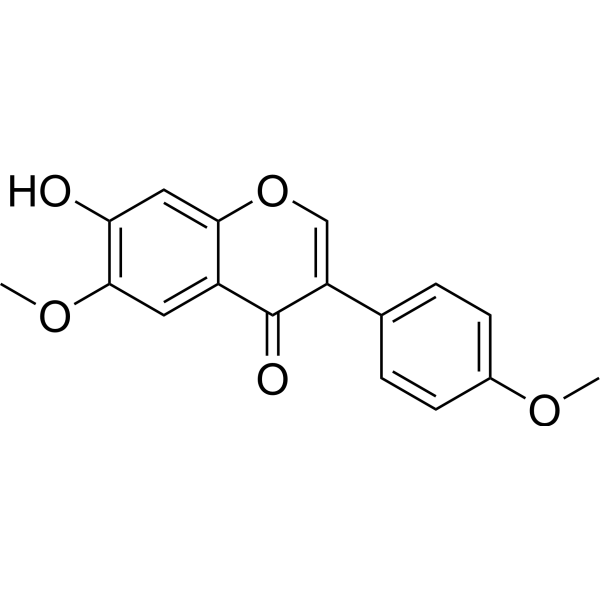
- Formula: C16H12O6
- Molecular Weight: 300.26
Koparin is a minor isoflavone constituent that can be isolated from the wood of Castanospermum austral.

- Formula: C16H12O6
- Molecular Weight: 300.26
Geraldol is a Flavonoids product that can be isolated from the herbs of Lotus corniculatus L..

- Formula: C3H9NO
- Molecular Weight: 75.11
2-(Methylamino) ethanol (N-Methylethanolamine) is an orally active Phospholipase D inhibitor and analog of Ethanolamine (HY-Y0524). 2-(Methylamino) ethanol reduces the mRNA levels of ACE, ppET-1 and ECE-1, and inhibits MMP-2 activity. 2-(Methylamino) ethanol inhibits Collagen synthesis. 2-(Methylamino) ethanol attenuates ventricular hypertrophy, prevents increased myocardial stiffness and hemodynamic deterioration. 2-(Methylamino) ethanol can capture industrial acid gases and react with carbon dioxide to form carbamates and bicarbonates. 2-(Methylamino) ethanol can be used in studies related to hypertensive heart failure (diastolic heart failure).

- Formula: C6H8O3
- Molecular Weight: 128.13
Sotolone (Dimethylhydroxyfuranone) is an activator of the human olfactory receptor OR8D1. Sotolone activates the human olfactory receptor OR8D1, with EC50 values of 84.98 μM and 167.2 μM for its S-enantiomer and R-enantiomer, respectively. Sotolone has unique aroma profiles: (R)-sotolone exhibits smoky, burnt, herbal and grassy notes; (S)-sotolone presents sweet, milky, sour and nutty notes. Sotolone also acts as an antifungal agent, showing moderate inhibitory activity against Magnaporthe oryzae in vitro.

- Formula: C24H39NO4
- Molecular Weight: 405.58
Cassaine (Nervocidine) is a Na+/K+-ATPase inhibitor. Cassaine stabilizes phosphorylated intermediates, slows spontaneous dephosphorylation and blocks potassium-stimulated dephosphorylation. Cassaine exhibits non-competitive inhibition with respect to K+, shows inhibition enhanced by Pi and antagonized by Na+. Cassaine induces positive inotropic effects in perfused hearts with faster inotropy offset. Cassaine can be used for research on cardiac arrhythmias.

- Formula: C16H14O3
- Molecular Weight: 254.28
Obtusaquinone is a blood-brain barrier-permeable Keap1 inhibitor with anticancer activity. Obtusaquinone covalently binds to cysteine residues of Keap1, promotes its ubiquitination and proteasomal degradation, and activates the Nrf2 pathway. Obtusaquinone induces endoplasmic reticulum stress and DNA damage through abnormal accumulation of ROS, and triggers apoptosis of cancer cells. Obtusaquinone prolongs survival in orthotopic xenograft models of pediatric high-grade glioma, and exhibits antitumor activity in glioblastoma and breast cancer models. Obtusaquinone can be used in studies related to glioma and breast cancer.

- Formula: C47H80O2
- Molecular Weight: 677.14

- Formula: C9H7NO4
- Molecular Weight: 193.16
4-Nitrocinnamic acid is a Phenylpropanoids product that can be isolated from the heartwoods of Cassia garrettiana.

- Formula: C15H10O4
- Molecular Weight: 254.24
3,7-Dihydroxyflavone (Resogalangin) is a flavonoid phytoestrogen, which can be isolated from Adenophora species. 3,7-Dihydroxyflavone is a modulator of estrogen receptors and an inhibitor of human progesterone metabolizing enzyme AKR1C1 and fungal 17β-hydroxysteroid dehydrogenase and a redox inhibitor (IC50=0.6 and 6.0 μM, respectively). 3,7-Dihydroxyflavone is a fluorescent binding substrate for human serum albumin (HSA) with excitation wavelengths of 370 nm (pH 7.4) and 350 nm (pH 3.5), respectively, and emission wavelength of 515 nm.
![6'',6''-Dimethylchromeno-[2'',3'':7,8]-flavone](https://file.medchemexpress.com/product_pic/hy-n19920.gif "Click to View 6'',6''-Dimethylchromeno-[2'',3'':7,8]-flavone Product Detail")
- Formula: C20H16O3
- Molecular Weight: 304.34
6'',6''-Dimethylchromeno-[2'',3'':7,8]-flavone (Compound 12) is a prenylated flavone that can be found in the roots of Dahlstedtia pentaphylla.

- Formula: C17H14O7
- Molecular Weight: 330.29
5,7,4'-Trihydroxy-3,8-dimethoxyflavone is a natural flavonoid.

- Formula: C15H12O4
- Molecular Weight: 256.25
Haginin D is an isoflavonoid phenolic compound found in the stems of Lespedeza homoloba. Haginin D suppresses lipid peroxidation in rat brain homogenates. Haginin D scavenges superoxide anion free radicals. Haginin D can be used in studies of oxidative damage and allergic reactions.

- Formula: C21H22O9
- Molecular Weight: 418.39
Cassialoin is an orally active anthrone-C-glucoside natural product with antitumor activity, which is found in the heartwood of Cassia garrettiana. Cassialoin is metabolized to the active substance Chrysophanol‑9‑anthrone. Cassialoin does not directly inhibit the activities of VEGFR‑2 and MMP‑9 in vitro, nor does it directly inhibit vascular lumen formation and cell migration in vitro. Cassialoin increases the number of IFN-γ-positive CD8+ T cells and natural killer cells in the small intestine or spleen, and enhances IFN-γ production by splenocytes induced by Concanavalin A (HY-P2149). Cassialoin inhibits tumor growth and peritoneal invasion in colon cancer xenograft models. Cassialoin can be used for research on colon cancer.

- Formula: C21H30O3
- Molecular Weight: 330.46
Deoxycaesaldekarin C (Methyl vouacapenate) is a naturally occurring, orally active cassane furanoditerpene with antibacterial, antioxidant, antiplasmodial, and analgesic effects. Deoxycaesaldekarin C inhibits bacterial growth and lipid peroxidation, and scavenges free radicals. Deoxycaesaldekarin C exhibits weak antiplasmodial activity and shows analgesic activity in mouse in vivo models. Deoxycaesaldekarin C can be used in research related to pain, bacterial infections, and Plasmodium infections.

- Formula: C20H28O4
- Molecular Weight: 332.44
Demethylcaesaldekarin C is a cassane-type diterpene. Demethylcaesaldekarin C can be isolated from the roots of Caesalpinia bonducella. Demethylcaesaldekarin C can be used for research on malaria.


- Formula: C18H21NO3
- Molecular Weight: 299.37

- Formula: C40H66N6
- Molecular Weight: 630.99
Ormosinine is a natural Ormosia alkaloid dimer consisting of a panamine unit and an ormosanine unit linked via a C21-C22 bond, and it can be converted to panamine by acid treatment or sublimation. Ormosinine serves as a tool molecule for natural product chemistry research.



