



Nemorubicin
Based on 1 publication(s) in Google Scholar
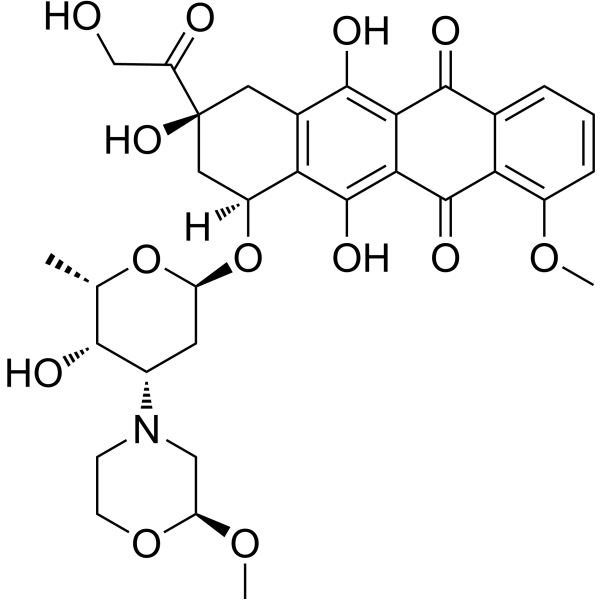
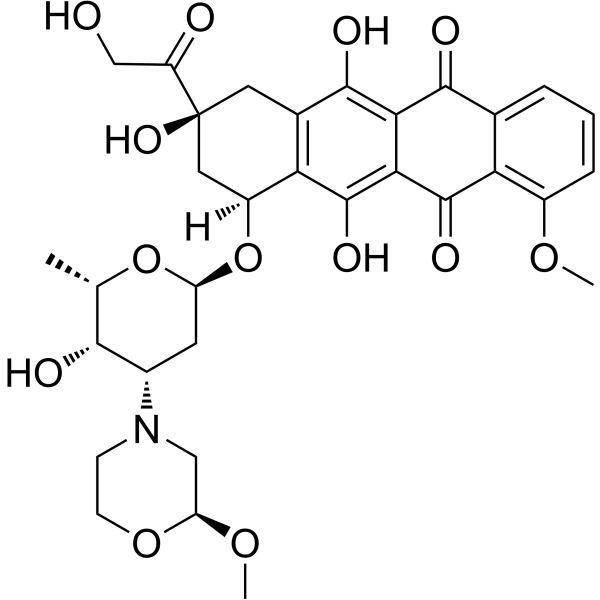
Nemorubicin (Methoxymorpholinyl doxorubicin) is a Doxorubicin derivative with potent antitumor activity. Nemorubicin is highly cytotoxic to a variety of tumor cell lines presenting a multidrug-resistant phenotype. Nemorubicin not only intercalate into the duplex DNA, but also result in significant ligands for G-quadruplex DNA segments, stabilizing their structure. Nemorubicin requirs an intact nucleotide excision repair (NER) system to exert its activity.
For research use only. We do not sell to patients.
- Purity : 97.01%
- CAS No.: 108852-90-0
- Formula: C32H37NO13
- Molecular Weight:643.64
-
Storage:
4°C, protect from light
* In solvent : -80°C, 6 months; -20°C, 1 month (protect from light)

To place orders, for customer services and technical support, please contact: MedChemExpress USA
Tel: 609-228-6898 E-mail: [email protected] [email protected]


-
 Biological Activity
-
Chemical Information
-
Solvent & Solubility
- Protocols
- Purity & Documentation
- References
-
 Help & FAQs



Publications Citing Use of MedChemExpress (MCE) Nemorubicin
More

Biological Activity
Description
Cellular Effect
|
Cell Line

|
Type | Value | Description | References |
|---|---|---|---|---|
| HeLa | IC50 |
0.08 μM
Compound: Nemorubicin
|
Cytotoxicity against human HeLa cells
Cytotoxicity against human HeLa cells
|
[PMID: 34124673] |
In Vitro
Nemorubicin has antitumor activity, with IC70s of 578 nM, 468 nM, 193 nM, 191 nM, 68 nM, and 131 ± 9 nM for HT-29, A2780, DU145, EM-2, Jurkat and CEM cell lines, respectively[1].
Nemorubicin is CYP3A-activated anticancer prodrug, which can produce a more cytotoxic metabolite, PNU-159682[1][2].
Nemorubicin acts through nucleotide excision repair (NER) system to exert its activity. Nemorubicin (0-0.3 μM) is more active in the L1210/DDP cells with intact NER than in the XPG-deficient L1210/0 cells. Cells resistant to nemorubicin show increased sensitivity to UV damage[3].
Nemorubicin is cytotoxic to 9L/3A4 cells, with an IC50 of 0.2 nM, 120-fold lower than that of P450-deficient 9L cells (IC50, 23.9 nM). Nemorubicin also potently inhibits Adeno-3A4 infected U251 cells with IC50 of 1.4 nM. P450 reductase overexpression enhances cytotoxicity of Nemorubicin[4].
MedChemExpress (MCE) has not independently confirmed the accuracy of these methods. They are for reference only.
In Vivo
MedChemExpress (MCE) has not independently confirmed the accuracy of these methods. They are for reference only.


Chemical Information
-
CAS No. 108852-90-0
-
Appearance Solid
-
Molecular Weight 643.64
-
Formula C32H37NO13
-
Color Orange to reddish brown
-
SMILES
COC1=C2C(C(C3=C(O)C(C[C@](C(CO)=O)(O)C[C@]4([H])O[C@H]5C[C@H](N6CCO[C@H](OC)C6)[C@H](O)[C@H](C)O5)=C4C(O)=C3C2=O)=O)=CC=C1
-
Synonyms
Methoxymorpholinyl doxorubicin; FCE 23762; PNU 152243
-
Shipping
Room temperature in continental US; may vary elsewhere.
-
Storage
4°C, protect from light
* In solvent : -80°C, 6 months; -20°C, 1 month (protect from light)


Publications (1)
-
Journal Impact Factor
-
Most Recent


Solvent & Solubility
In Vitro:
DMSO : 65 mg/mL (100.99 mM; Need ultrasonic; Hygroscopic DMSO has a significant impact on the solubility of product, please use newly opened DMSO)
Please refer to the solubility information to select the appropriate solvent. Once prepared, please aliquot and store the solution to prevent product inactivation from repeated freeze-thaw cycles.
Storage method and period of stock solution: -80°C, 6 months; -20°C, 1 month (protect from light). When stored at -80°C, please use it within 6 months. When stored at -20°C, please use it within 1 month.
Please refer to the solubility information to select the appropriate solvent. Once prepared, please aliquot and store the solution to prevent product inactivation from repeated freeze-thaw cycles.
Storage method and period of stock solution: -80°C, 6 months; -20°C, 1 month (protect from light). When stored at -80°C, please use it within 6 months. When stored at -20°C, please use it within 1 month.
Concentration (start) × Volume (start) = Concentration (final) × Volume (final)
In Vivo:
Select the appropriate dissolution method based on your experimental animal and administration route.
- For the following dissolution methods, please ensure to first prepare a clear stock solution using an In Vitro approach and then sequentially add co-solvents:
- To ensure reliable experimental results, the clarified stock solution can be appropriately stored based on storage conditions. As for the working solution for In Vivo experiments, it is recommended to prepare freshly and use it on the same day.
- The percentages shown for the solvents indicate their volumetric ratio in the final prepared solution. If precipitation or phase separation occurs during preparation, heat and/or sonication can be used to aid dissolution.
Add each solvent one by one: 10% DMSO 40% PEG300 5% Tween-80 45% Saline
Solubility: ≥ 3.25 mg/mL (5.05 mM); Clear solution
This protocol yields a clear solution of ≥ 3.25 mg/mL (saturation unknown).
Taking 1 mL working solution as an example, add 100 μL DMSO stock solution (32.5 mg/mL) to 400 μL PEG300, and mix evenly; then add 50 μL Tween-80 and mix evenly; then add 450 μL Saline to adjust the volume to 1 mL.
Preparation of Saline: Dissolve 0.9 g sodium chloride in ddH₂O and dilute to 100 mL to obtain a clear Saline solution.
In Vivo Dissolution Calculator
Please enter the basic information of animal experiments:
-
-
-
-
Recommended: Prepare an additional quantity of animals to account for potential losses during experiments.
Please enter your animal formula composition:
-
%DMSO +
Recommended: Keep the proportion of DMSO in working solution below 2% if your animal is weak.
-
%+
-
+%Tween-80 + +
-
%Saline +
The co-solvents required include: DMSO, . All of co-solvents are available by MedChemExpress (MCE). , Tween 80. All of co-solvents are available by MedChemExpress (MCE).
Working solution concentration: 0.22 mg/mL
Method for preparing stock solution: mg drug dissolved in μL DMSO. Stock solution concentration: mg/mL. * In solvent : -80°C, 6 months; -20°C, 1 month (protect from light)
1. Take μL DMSO stock solution;
2. Add μL .
μL , mix evenly;
3. Then add μL Tween 80, mix evenly;
4. Then add μL
Please ensure that the stock solution in the first step is dissolved to a clear state, and add co-solvents in sequence. You can use ultrasonic heating (ultrasonic cleaner, recommended frequency 20-40 kHz), vortexing, etc. to assist dissolution.


Purity & Documentation
-
Data Sheet (288 KB)
-
SDS (394 KB)
- English - EN (394 KB)
- Français - FR (394 KB)
- Deutsch - DE (394 KB)
- Norwegian - NO (394 KB)
- Español - ES (394 KB)
- Swedish - SV (394 KB)
- Italian - IT (394 KB)
- Korean - KR (394 KB)
- Portuguese - PT (394 KB)
-
Handling Instructions (2659 KB)
References
[1]. Quintieri L, et al. Formation and antitumor activity of PNU-159682, a major metabolite of nemorubicin in human liver microsomes. Clin Cancer Res. 2005 Feb 15;11(4):1608-17. [Content Brief]
[2]. Quintieri L, et al. In vitro hepatic conversion of the anticancer agent nemorubicin to its active metabolite PNU-159682 in mice, rats and dogs: a comparison with human liver microsomes. Biochem Pharmacol. 2008 Sep 15;76(6):784-95. [Content Brief]
[3]. Sabatino MA, et al. Down-regulation of the nucleotide excision repair gene XPG as a new mechanism of drug resistance in human and murine cancer cells. Mol Cancer. 2010 Sep 24;9:259. [Content Brief]
[4]. Lu H, et al. Potentiation of methoxymorpholinyl doxorubicin antitumor activity by P450 3A4 gene transfer. Cancer Gene Ther. 2009 May;16(5):393-404. [Content Brief]


Complete Stock Solution Preparation Table
Please refer to the solubility information to select the appropriate solvent. Once prepared, please aliquot and store the solution to prevent product inactivation from repeated freeze-thaw cycles.
Storage method and period of stock solution: -80°C, 6 months; -20°C, 1 month (protect from light). When stored at -80°C, please use it within 6 months. When stored at -20°C, please use it within 1 month.
| Optional Solvent | Concentration Solvent Mass | 1 mg | 5 mg | 10 mg | 25 mg |
|---|---|---|---|---|---|
| DMSO | 1 mM | 1.5537 mL | 7.7683 mL | 15.5366 mL | 38.8416 mL |
| 5 mM | 0.3107 mL | 1.5537 mL | 3.1073 mL | 7.7683 mL | |
| 10 mM | 0.1554 mL | 0.7768 mL | 1.5537 mL | 3.8842 mL | |
| 15 mM | 0.1036 mL | 0.5179 mL | 1.0358 mL | 2.5894 mL | |
| 20 mM | 0.0777 mL | 0.3884 mL | 0.7768 mL | 1.9421 mL | |
| 25 mM | 0.0621 mL | 0.3107 mL | 0.6215 mL | 1.5537 mL | |
| 30 mM | 0.0518 mL | 0.2589 mL | 0.5179 mL | 1.2947 mL | |
| 40 mM | 0.0388 mL | 0.1942 mL | 0.3884 mL | 0.9710 mL | |
| 50 mM | 0.0311 mL | 0.1554 mL | 0.3107 mL | 0.7768 mL | |
| 60 mM | 0.0259 mL | 0.1295 mL | 0.2589 mL | 0.6474 mL | |
| 80 mM | 0.0194 mL | 0.0971 mL | 0.1942 mL | 0.4855 mL | |
| 100 mM | 0.0155 mL | 0.0777 mL | 0.1554 mL | 0.3884 mL |


Nemorubicin Related Classifications
HY-15794 Related Classifications
 Powered by Bioz