



Senktide
Based on 3 publication(s) in Google Scholar
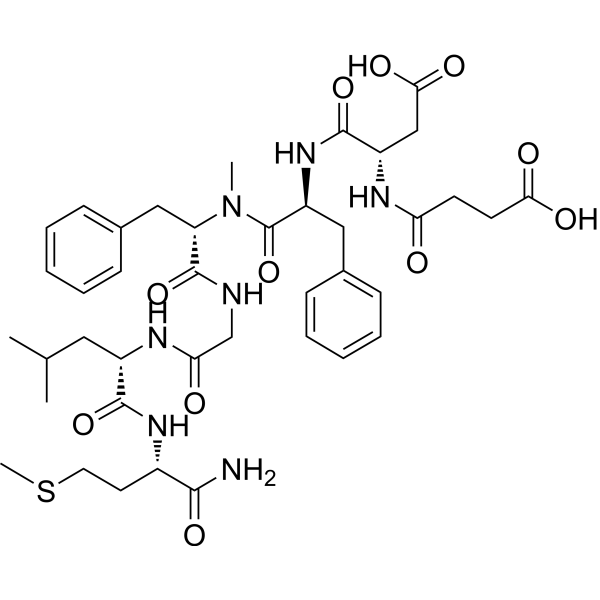
Senktide is a potent, selective agonist of the neuromedin K3 (NK3) receptor (EC50=0.5-3 nM). Senktide less potently agonizes the NK1 receptor (EC50=35 µM). Senktide is promising for research of neurological disease.
연구목적의 판매만을 진행합니다. 환자를 대상으로 한 판매는 하지 않습니다.
- Purity : 99.91%
- CAS No.: 106128-89-6
- 화학식: C40H55N7O11S
- 분자량:841.97
-
보관:
Sealed storage, away from moisture.
Powder -80°C, 2 years , -20°C, 1 year* In solvent : -80°C, 6 months; -20°C, 1 month (sealed storage, away from moisture)

To place orders, for customer services and technical support, please contact: MedChemExpress USA
Tel: 609-228-6898 E-mail: [email protected] [email protected]


-
 Biological Activity
-
Chemical Information
-
용액&용해도
- Protocol
- 순도&문서
- References
-
 Help & FAQs


-
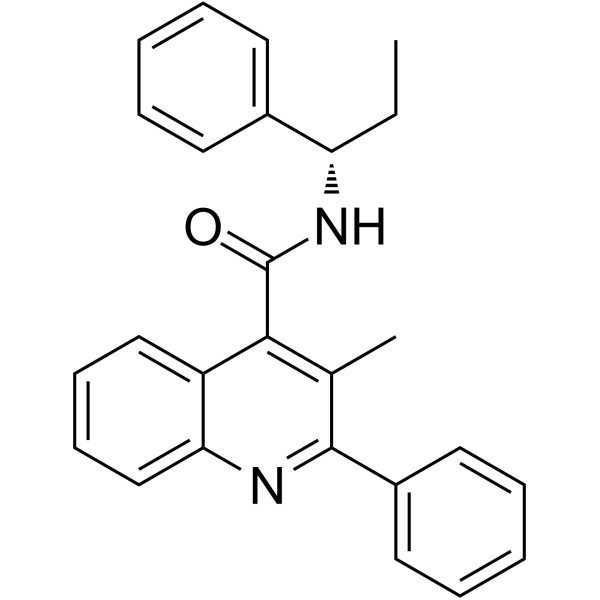
HY-15722
SB-222200NK-3 Receptor Antagonist -
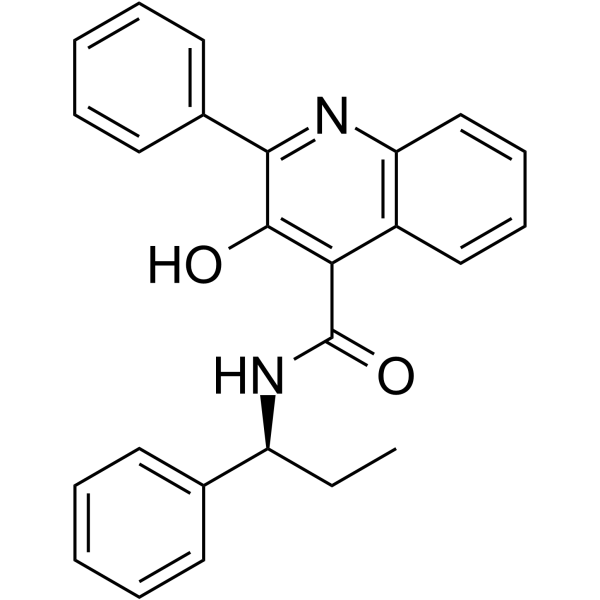
HY-14552
TalnetantNK3 Receptor Antagonist -
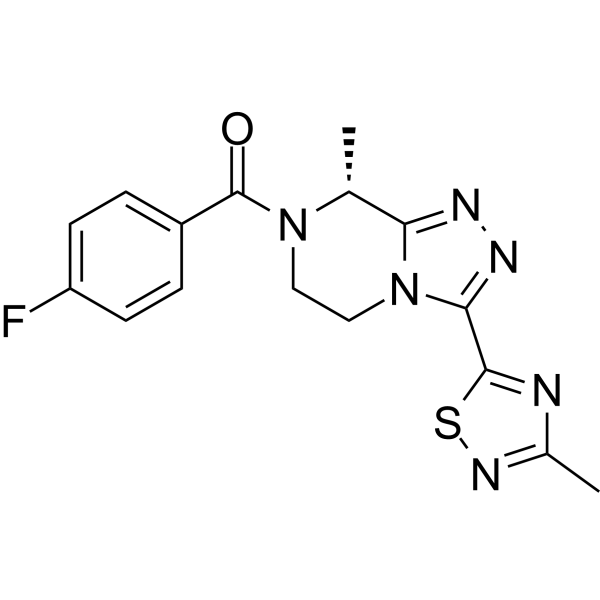
HY-19632
FezolinetantNK3R Antagonist -
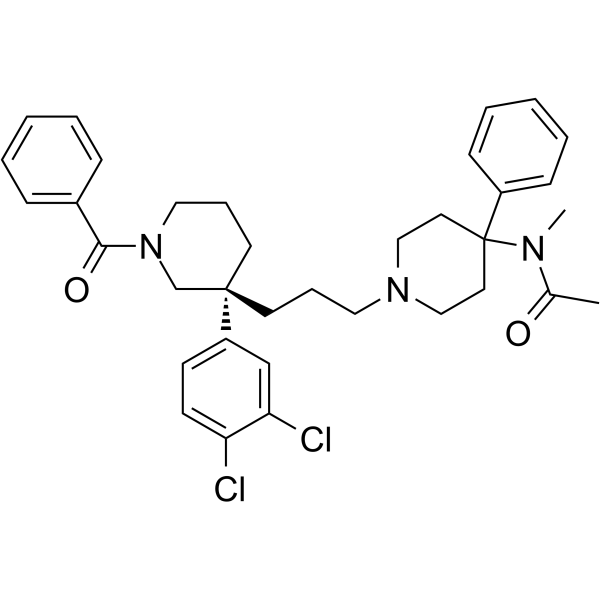
HY-14551
OsanetantNK3 Receptor Antagonist -
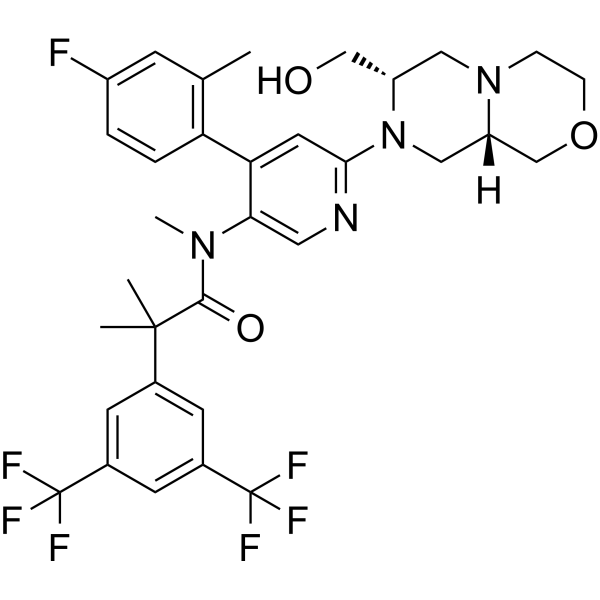
HY-109171
ElinzanetantNK-1/NK-3 Receptor Antagonist -
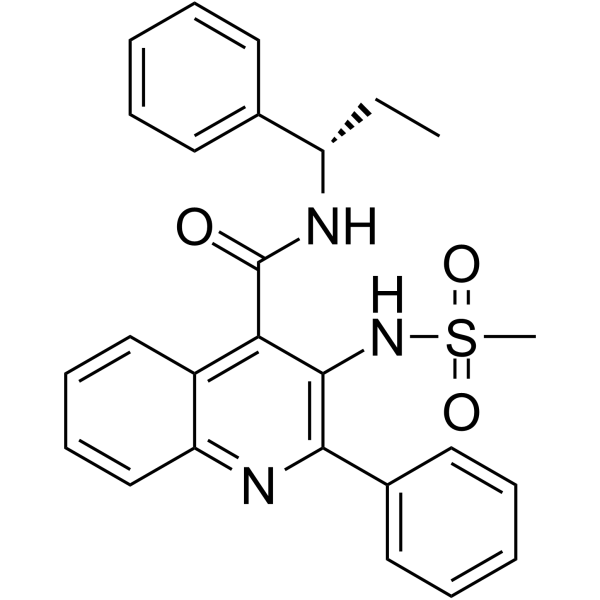
HY-14432
PavinetantNeurokinin Receptor Antagonist -
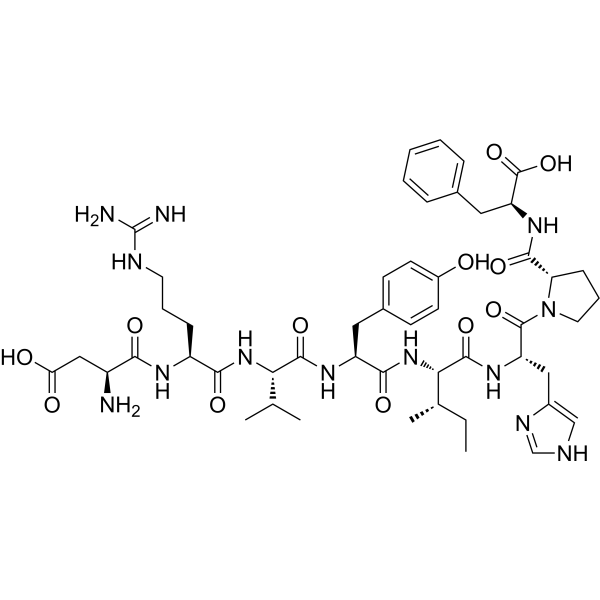
HY-13948
Angiotensin II humanVasoconstrictor -
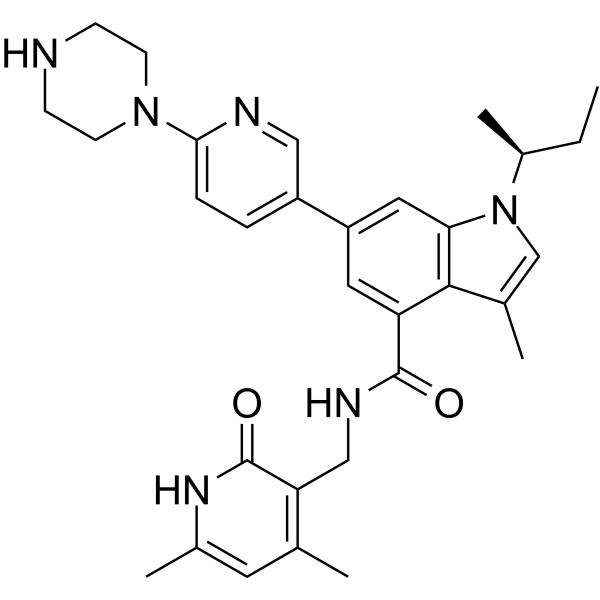
HY-13470
GSK126EZH2 Inhibitor -
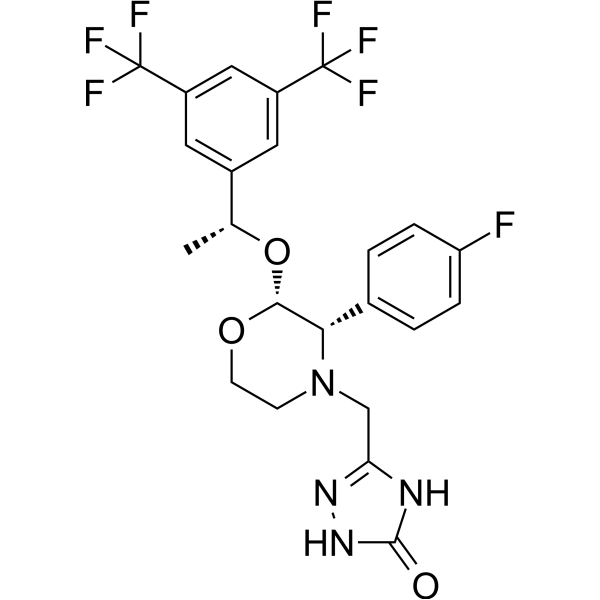
HY-10052
AprepitantNeurokinin 1 Receptor Antagonist -
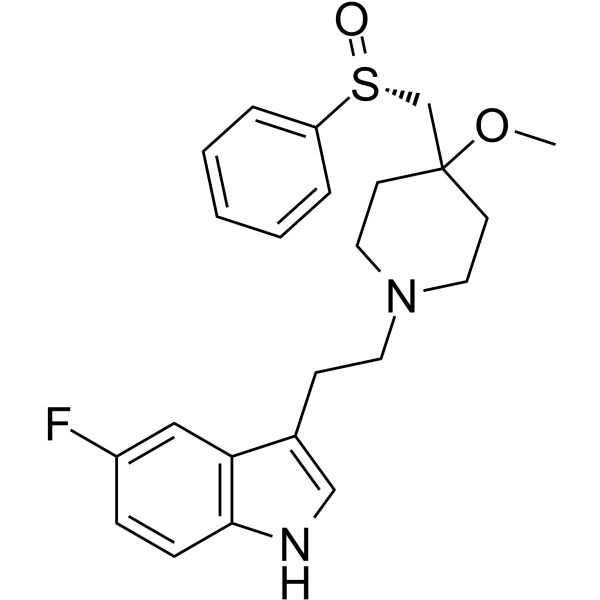
HY-107691
GR 159897Neurokinin 2 Receptor Antagonist -
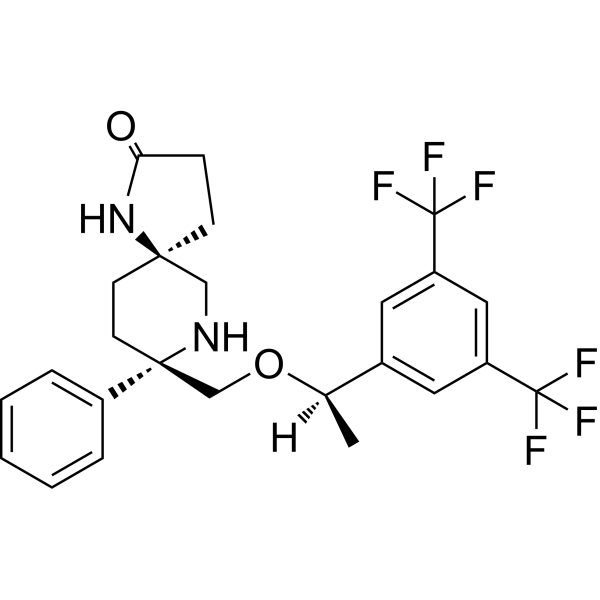
HY-14751
RolapitantNK1 Receptor Antagonist -
HY-B0367
LornoxicamCOX Inhibitor
Publications Citing Use of MedChemExpress (MCE) Senktide
More Customer Validation & Images

-
In Vivo Efficacy Study


Biological Activity
제품 설명
IC50 & Target
|
NK3R 0.5-3 nM (EC50) |
NK1R 35 nM (EC50) |
Cellular Effect
|
Cell Line

|
Type | Value | Description | References |
|---|---|---|---|---|
| CHO | EC50 |
3 nM
Compound: senktide
|
Activity at human NK3 receptor expressed in CHO cells assessed as increase in inositol phosphate generation
Activity at human NK3 receptor expressed in CHO cells assessed as increase in inositol phosphate generation
|
[PMID: 16950617] |
| CHO | EC50 |
0.011 μM
Compound: Senktide
|
Agonist activity at human NK3R expressed in CHO cells assessed as potentiation of senktide-induced effect
Agonist activity at human NK3R expressed in CHO cells assessed as potentiation of senktide-induced effect
|
[PMID: 25247671] |
| CHO | IC50 |
0.056 μM
Compound: Senktide
|
Displacement of [125I]His3, MePhe7 from human NK3R expressed in CHO cell membranes by scintillation counting
Displacement of [125I]His3, MePhe7 from human NK3R expressed in CHO cell membranes by scintillation counting
|
[PMID: 25247671] |
| CHO | IC50 |
11 nM
Compound: SENKTIDE
|
Inhibitory activity against cloned human Tachykinin receptor 3 in CHO cells labeled with [125I][MePhe7]-NKB
Inhibitory activity against cloned human Tachykinin receptor 3 in CHO cells labeled with [125I][MePhe7]-NKB
|
[PMID: 8648606] |
| CHO | EC50 |
7 nM
Compound: Senktide
|
Compound was evaluated for concentration-dependent and oscillatory increase in [Ca2+], caused by activation of hNK3 receptors in CHO cells
Compound was evaluated for concentration-dependent and oscillatory increase in [Ca2+], caused by activation of hNK3 receptors in CHO cells
|
[PMID: 9871763] |
| CHO | IC50 |
1 nM
Compound: Senktide
|
Compound was evaluated for its ability to displace [3H]NKB binding in hNK3 receptors expressed in CHO cells
Compound was evaluated for its ability to displace [3H]NKB binding in hNK3 receptors expressed in CHO cells
|
[PMID: 9871763] |
| CHO | IC50 |
21 nM
Compound: Senktide
|
Binding affinity towards human Tachykinin receptor 3 stably expressed in CHO cells using [125I][MePhe7]-NKB as radioligand
Binding affinity towards human Tachykinin receptor 3 stably expressed in CHO cells using [125I][MePhe7]-NKB as radioligand
|
10.1016/0960-894X(95)00313-I |
| CHO | IC50 |
21 nM
Compound: Senktide
|
Displacement of [125I][MePhe]-NKB from human NK3 receptor expressed in CHO cells
Displacement of [125I][MePhe]-NKB from human NK3 receptor expressed in CHO cells
|
10.1016/S0960-894X(00)80360-1 |
| CHO | EC50 |
19 pM
Compound: Senktide
|
Agonist activity at goat NK3 receptor expressed in CHO cells assessed as calcium influx relative to 100 nM senktide
Agonist activity at goat NK3 receptor expressed in CHO cells assessed as calcium influx relative to 100 nM senktide
|
10.1039/C4MD00514G |
| CHO | EC50 |
23 pM
Compound: Senktide
|
Agonist activity at rat NK3 receptor expressed in CHO cells assessed as calcium influx relative to 100 nM senktide
Agonist activity at rat NK3 receptor expressed in CHO cells assessed as calcium influx relative to 100 nM senktide
|
10.1039/C4MD00514G |
| CHO | EC50 |
3.4 pM
Compound: Senktide
|
Agonist activity at human NK3 receptor expressed in CHO cells assessed as calcium influx relative to 100 nM senktide
Agonist activity at human NK3 receptor expressed in CHO cells assessed as calcium influx relative to 100 nM senktide
|
10.1039/C4MD00514G |
| CHO | EC50 |
610 pM
Compound: Senktide
|
Agonist activity at cattle NK3 receptor expressed in CHO cells assessed as calcium influx relative to 100 nM senktide
Agonist activity at cattle NK3 receptor expressed in CHO cells assessed as calcium influx relative to 100 nM senktide
|
10.1039/C4MD00514G |
| CHO | IC50 |
>10000 nM
Compound: Senktide
|
Displacement of [125I]-NKA from NK2 receptor (unknown origin) expressed in CHO cells by scintillation counter
Displacement of [125I]-NKA from NK2 receptor (unknown origin) expressed in CHO cells by scintillation counter
|
10.1039/C4MD00514G |
| CHO | IC50 |
29 nM
Compound: Senktide
|
Displacement of ([125I]His3-MePhe7)-NKB from NK3 receptor (unknown origin) expressed in CHO cells by scintillation counter
Displacement of ([125I]His3-MePhe7)-NKB from NK3 receptor (unknown origin) expressed in CHO cells by scintillation counter
|
10.1039/C4MD00514G |
| CHO | IC50 |
>10000 nM
Compound: Senktide
|
Displacement of [125I]-BH-SP from NK1 receptor (unknown origin) expressed in CHO cells by scintillation counter
Displacement of [125I]-BH-SP from NK1 receptor (unknown origin) expressed in CHO cells by scintillation counter
|
10.1039/C4MD00514G |
| IM-9 | IC50 |
>10000 nM
Compound: SENKTIDE
|
Inhibitory activity against Tachykinin receptor 1 in human lymphoma IM9 cells labeled with [125I]Bolton-Hunter substance P
Inhibitory activity against Tachykinin receptor 1 in human lymphoma IM9 cells labeled with [125I]Bolton-Hunter substance P
|
[PMID: 8648606] |
In Vitro
The selective NK3 receptor agonist Senktide excites 24 of 31 dopaminergic neurons in the substantia nigra pars compacta in a concentration-dependent manner. The effective concentration range is between 3 to 3000 nm. The mean EC50 for Senktide is 41.2±9 nm (n=5)[2].
MedChemExpress (MCE) has not independently confirmed the accuracy of these methods. They are for reference only.
In Vivo
MedChemExpress (MCE) has not independently confirmed the accuracy of these methods. They are for reference only.


Chemical Information
-
CAS No. 106128-89-6
-
Appearance Solid
-
분자량 841.97
-
화학식 C40H55N7O11S
-
Color White to off-white
-
Sequence
Suc-Asp-Phe-{Me-Phe}-Gly-Leu-Met-NH2
-
Sequence Shortening
Suc-DF-{Me-Phe}-GLM-NH2
-
선적
Room temperature in continental US; may vary elsewhere.
-
보관
Sealed storage, away from moisture
Powder -80°C 2 years -20°C 1 year * In solvent : -80°C, 6 months; -20°C, 1 month (sealed storage, away from moisture)


Publications (3)
-
Journal Impact Factor
-
Most Recent
-
Protein Cell
Senktide blocks aberrant RTN3 interactome to retard memory decline and tau pathology in social isolated Alzheimer's disease mice. [Abstract]2024 Apr 1;15(4):261-284. PMID: 38011644 -
Neuron
2026 Jan 8:S0896-6273(25)00927-4. PMID: 41512855
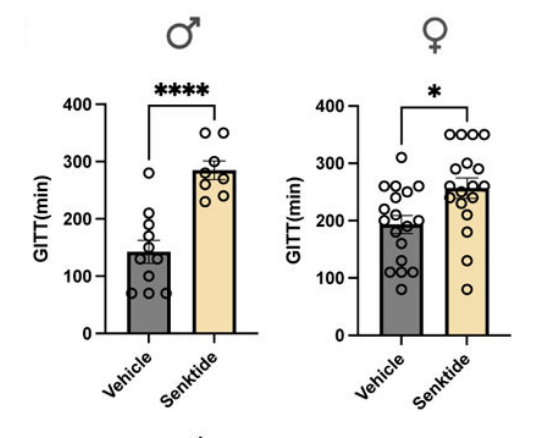
Senktide purchased from MedChemExpress. Usage Cited in: Neuron. 2026 Jan 8:S0896-6273(25)00927-4. [Abstract]
GITT in adult males (n = 8–11/group) and females (n = 18/group) following administration of TACR3 agonist senktide (5 mg/kg) or vehicle.
-
FASEB J
Neurokinin 3 receptor agonist senktide stimulates GnRH release in isolated hypogonadotropic hypogonadism mice. [Abstract]2025 Mar 31;39(6):e70498. PMID: 40135619


용액&용해도
In Vitro:
DMSO : 100 mg/mL (118.77 mM; Need ultrasonic; Hygroscopic DMSO has a significant impact on the solubility of product, please use newly opened DMSO)
Please refer to the solubility information to select the appropriate solvent. Once prepared, please aliquot and store the solution to prevent product inactivation from repeated freeze-thaw cycles.
Storage method and period of stock solution: -80°C, 6 months; -20°C, 1 month (sealed storage, away from moisture). When stored at -80°C, please use it within 6 months. When stored at -20°C, please use it within 1 month.
Please refer to the solubility information to select the appropriate solvent. Once prepared, please aliquot and store the solution to prevent product inactivation from repeated freeze-thaw cycles.
Storage method and period of stock solution: -80°C, 6 months; -20°C, 1 month (sealed storage, away from moisture). When stored at -80°C, please use it within 6 months. When stored at -20°C, please use it within 1 month.
Concentration (start) × Volume (start) = Concentration (final) × Volume (final)
In Vivo:
Select the appropriate dissolution method based on your experimental animal and administration route.
- For the following dissolution methods, please ensure to first prepare a clear stock solution using an In Vitro approach and then sequentially add co-solvents:
- To ensure reliable experimental results, the clarified stock solution can be appropriately stored based on storage conditions. As for the working solution for In Vivo experiments, it is recommended to prepare freshly and use it on the same day.
- The percentages shown for the solvents indicate their volumetric ratio in the final prepared solution. If precipitation or phase separation occurs during preparation, heat and/or sonication can be used to aid dissolution.
Add each solvent one by one: 10% DMSO 40% PEG300 5% Tween-80 45% Saline
Solubility: ≥ 2.5 mg/mL (2.97 mM); Clear solution
This protocol yields a clear solution of ≥ 2.5 mg/mL (saturation unknown).
Taking 1 mL working solution as an example, add 100 μL DMSO stock solution (25.0 mg/mL) to 400 μL PEG300, and mix evenly; then add 50 μL Tween-80 and mix evenly; then add 450 μL Saline to adjust the volume to 1 mL.
Preparation of Saline: Dissolve 0.9 g sodium chloride in ddH₂O and dilute to 100 mL to obtain a clear Saline solution.
Add each solvent one by one: 10% DMSO 90% (20% SBE-β-CD in Saline)
Solubility: ≥ 2.5 mg/mL (2.97 mM); Clear solution
This protocol yields a clear solution of ≥ 2.5 mg/mL (saturation unknown).
Taking 1 mL working solution as an example, add 100 μL DMSO stock solution (25.0 mg/mL) to 900 μL 20% SBE-β-CD in Saline, and mix evenly.
Preparation of 20% SBE-β-CD in Saline (4°C, storage for one week): 2 g SBE-β-CD powder is dissolved in 10 mL Saline, completely dissolve until clear.
In Vivo Dissolution Calculator
Please enter the basic information of animal experiments:
-
-
-
-
Recommended: Prepare an additional quantity of animals to account for potential losses during experiments.
Please enter your animal formula composition:
-
%DMSO +
Recommended: Keep the proportion of DMSO in working solution below 2% if your animal is weak.
-
%+
-
+%Tween-80 + +
-
%Saline +
The co-solvents required include: DMSO, . All of co-solvents are available by MedChemExpress (MCE). , Tween 80. All of co-solvents are available by MedChemExpress (MCE).
Working solution concentration: 0.22 mg/mL
Method for preparing stock solution: mg drug dissolved in μL DMSO. Stock solution concentration: mg/mL. * In solvent : -80°C, 6 months; -20°C, 1 month (sealed storage, away from moisture)
1. Take μL DMSO stock solution;
2. Add μL .
μL , mix evenly;
3. Then add μL Tween 80, mix evenly;
4. Then add μL
Please ensure that the stock solution in the first step is dissolved to a clear state, and add co-solvents in sequence. You can use ultrasonic heating (ultrasonic cleaner, recommended frequency 20-40 kHz), vortexing, etc. to assist dissolution.


순도&문서
-
Data Sheet (286 KB)
-
SDS (252 KB)
- English - EN (252 KB)
- Français - FR (252 KB)
- Deutsch - DE (252 KB)
- Norwegian - NO (252 KB)
- Español - ES (252 KB)
- Swedish - SV (252 KB)
- Italian - IT (252 KB)
- Korean - KR (252 KB)
- Portuguese - PT (252 KB)
-
Handling Instructions (2659 KB)
References
[1]. Nordquist RE, et al. The tachykinin NK3 receptor agonist senktide induces locomotor activity in male Mongolian gerbils. Eur J Pharmacol. 2008 Dec 14;600(1-3):87-92. [Content Brief]
[2]. Keegan KD, et al. The selective NK3 receptor agonist senktide excites a subpopulation of dopamine-sensitiveneurones in the rat substantia nigra pars compacta in vitro. Br J Pharmacol. 1992 Jan;105(1):3-5. [Content Brief]
[3]. Byk G, et al. Synthesis and biological activity of NK-1 selective, N-backbone cyclic analogs of the C-terminal hexapeptide of substance P. J Med Chem. 1996 Aug 2;39(16):3174-8. [Content Brief]
[4]. Sarau HM, et al. Nonpeptide tachykinin receptor antagonists: I. Pharmacological and pharmacokinetic characterization of SB 223412, a novel, potent and selective neurokinin-3 receptor antagonist. J Pharmacol Exp Ther. 1997 Jun;281(3):1303-11. [Content Brief]
[5]. Harrison T, et al. High affinity, selective neurokinin 2 and neurokinin 3 receptor antagonists from a common structural template. Bioorg Med Chem Lett. 1998 Jun 2;8(11):1343-8. [Content Brief]


Complete Stock Solution Preparation Table
Please refer to the solubility information to select the appropriate solvent. Once prepared, please aliquot and store the solution to prevent product inactivation from repeated freeze-thaw cycles.
Storage method and period of stock solution: -80°C, 6 months; -20°C, 1 month (sealed storage, away from moisture). When stored at -80°C, please use it within 6 months. When stored at -20°C, please use it within 1 month.
| Optional Solvent | Concentration Solvent Mass | 1 mg | 5 mg | 10 mg | 25 mg |
|---|---|---|---|---|---|
| DMSO | 1 mM | 1.1877 mL | 5.9385 mL | 11.8769 mL | 29.6923 mL |
| 5 mM | 0.2375 mL | 1.1877 mL | 2.3754 mL | 5.9385 mL | |
| 10 mM | 0.1188 mL | 0.5938 mL | 1.1877 mL | 2.9692 mL | |
| 15 mM | 0.0792 mL | 0.3959 mL | 0.7918 mL | 1.9795 mL | |
| 20 mM | 0.0594 mL | 0.2969 mL | 0.5938 mL | 1.4846 mL | |
| 25 mM | 0.0475 mL | 0.2375 mL | 0.4751 mL | 1.1877 mL | |
| 30 mM | 0.0396 mL | 0.1979 mL | 0.3959 mL | 0.9897 mL | |
| 40 mM | 0.0297 mL | 0.1485 mL | 0.2969 mL | 0.7423 mL | |
| 50 mM | 0.0238 mL | 0.1188 mL | 0.2375 mL | 0.5938 mL | |
| 60 mM | 0.0198 mL | 0.0990 mL | 0.1979 mL | 0.4949 mL | |
| 80 mM | 0.0148 mL | 0.0742 mL | 0.1485 mL | 0.3712 mL | |
| 100 mM | 0.0119 mL | 0.0594 mL | 0.1188 mL | 0.2969 mL |


Senktide Related Classifications
HY-P0187 Related Classifications
 Powered by Bioz