



Calicheamicins
Calicheamicins are enediyne natural products that bind the DNA minor groove and induce double-strand DNA breaks, making them potent DNA-damaging agents for cancer research[1]. Mechanistically, their activity supports antibody-drug conjugate design because unconjugated calicheamicin shows non-discriminatory cytotoxicity toward cancer and healthy cells[2]. In leukemia and lymphoma models, calicheamicin derivatives have been delivered through CD33-targeted gemtuzumab ozogamicin and CD22-targeted inotuzumab ozogamicin, linking DNA cleavage to antigen-directed cytotoxicity[2][3]. Compared with microtubule-disrupting ADC payload classes such as maytansinoids and auristatins, calicheamicin functions as a DNA-targeting antibiotic payload rather than a tubulin inhibitor[4]. For experimental applications, linker chemistry and site-specific conjugation directly affect aggregation, circulation stability, and tolerability of calicheamicin ADCs[5]. Resistance studies further identify DNA damage sensing, TP53, MDM2, and ATM as modulators of calicheamicin sensitivity in acute leukemia cells[6].
References:
- [1]. Damle NK. Tumour-targeted chemotherapy with immunoconjugates of calicheamicin. Expert Opin Biol Ther. 2004 Sep;4(9):1445-52. [Content Brief]
- [2]. Damle NK. Tumour-targeted chemotherapy with immunoconjugates of calicheamicin. Expert Opin Biol Ther. 2004 Sep;4(9):1445-52. doi: 10.1517/14712598.4.9.1445. PMID: 15335312. et al. Tumour-targeted chemotherapy with immunoconjugates of calicheamicin. Expert Opin Biol Ther. 2004 Sep;4(9):1445-52. [Content Brief]
- [3]. Adhikari A, et al. Challenges and Opportunities to Develop Enediyne Natural Products as Payloads for Antibody-Drug Conjugates. Antib Ther. 2021 Jan;4(1):1-15. [Content Brief]
- [4]. DiJoseph JF, et al. Antibody-targeted chemotherapy with CMC-544: a CD22-targeted immunoconjugate of calicheamicin for the treatment of B-lymphoid malignancies. Blood. 2004 Mar 1;103(5):1807-14. [Content Brief]
- [5]. Lambert JM, et al. Antibody-Drug Conjugates (ADCs) for Personalized Treatment of Solid Tumors: A Review. Adv Ther. 2017 May;34(5):1015-1035. [Content Brief]
- [6]. Vollmar BS, et al. Calicheamicin Antibody-Drug Conjugates with Improved Properties. Mol Cancer Ther. 2021 Jun;20(6):1112-1120. [Content Brief]
- [7]. Pettenger-Willey CM, et al. DNA Damage Sensing and TP53 Function as Modulators of Sensitivity to Calicheamicin-Based Antibody-Drug Conjugates for Acute Leukemia. Cancers (Basel). 2025 Dec 25;18(1):67. [Content Brief]
-
Calicheamicins Related Products (1)
Related Products (1)

-
Calicheamicin
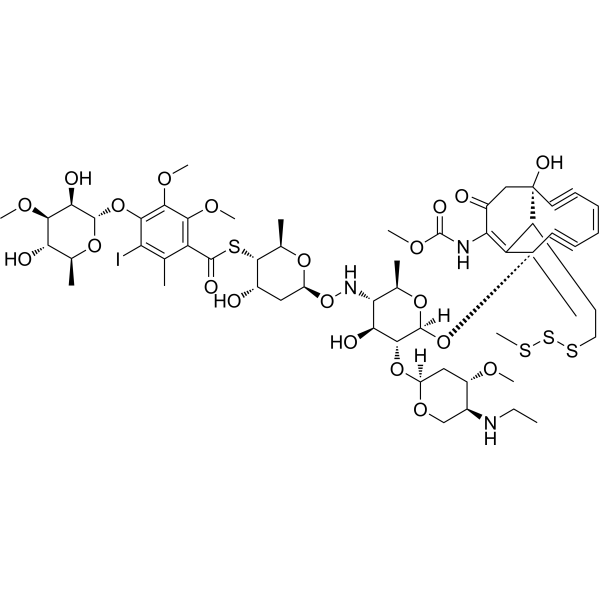 0 ImagesSynonyms: Calicheamicin γ1Calicheamicin, an antitumor antibiotic, is a cytotoxic agent that causes double-strand DNA breaks. Calicheamicin is a DNA synthesis inhibitor.



