



Cathepsin S Protein, Human (HEK293, His)
Based on 4 publication(s) in Google Scholar
Cathepsin S Protein, Human (HEK293, His) is potent cysteine protease which can promote degradation of damaged or unwanted proteins in the endo-lysosomal pathway.
- Species: Human
- Source: HEK293
-
Storage:Stored at -80°C for 1 year from date of receipt. It is stable at -20°C for 3 months after opening. It is recommended to freeze aliquots at -80°C for extended storage. Avoid repeated freeze-thaw cycles.

To place orders, for customer services and technical support, please contact: MedChemExpress USA
Tel: 609-228-6898 E-mail: [email protected] [email protected]


-
 Biological Activity
-
Technical Parameters
-
Product Properties
- Documentation
- References
- Help & FAQs


-

HY-P7993A
Cathepsin B Protein, Human (HEK293, His) -
HY-P7754A
Cathepsin L1 Protein, Human (HEK293, His) -
HY-P73300
MMP-9 Protein, Human (HEK293) -
HY-P7757
Cathepsin S Protein, Mouse (HEK293, His) -
HY-15533
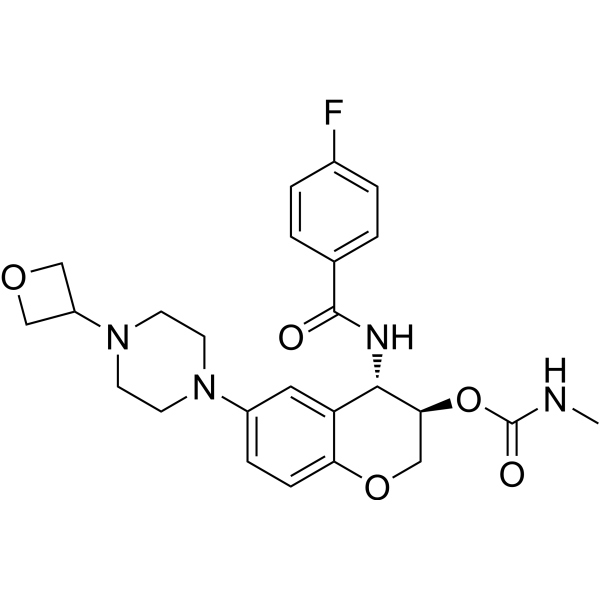
LY 3000328Cathepsin S Inhibitor -
HY-P73296
MMP-2 Protein, Human (HEK293) -

HY-P1748
Thermolysin, Bacillus thermoproteolyticus rokkoThermostable Metalloproteinas -
HY-P7747
Cathepsin B Protein, Mouse (HEK293, His) -
HY-P7753
Cathepsin L1 Protein, Mouse (HEK293, His) -
HY-P70250
MMP-1 Protein, Human (HEK293, His, solution) -

HY-137367
Z-Val-Val-Arg-AMCFluorescent Peptide Substrate -
HY-P7750
Cathepsin E Protein, Human (HEK293, His)


Biological Activity
Description
Cathepsin S Protein, Human (HEK293, His) is potent cysteine protease which can promote degradation of damaged or unwanted proteins in the endo-lysosomal pathway.
Background
Cathepsin S is a member of the cysteine cathepsin protease family. Cathepsin S has specific roles such as MHC class II antigen presentation, where it is important in the degradation of the invariant chain. Cathepsin S is involved in a variety of pathological processes including arthritis, cancer, and cardiovascular disease, where it becomes secreted and can act on extracellular substrates. Cathepsin S has uniquely restricted tissue expression and is more stable at a neutral pH. Cathepsin S is unique amongst the cysteine cathepsin family due to restricted tissue expression, associated with antigen presenting cells localised in lymph and spleen, as well as other immune cells such as macrophages. Cathepsin S is thought to be a particularly potent cysteine protease cleaving elastin and generating bioactive elastin peptides, leading to the promotion of cardiovascular inflammation and calcification. Cathepsin S is also released by smooth muscle cells and macrophages as a systemic response to inflammation in a continuous recursive feedback loop[1][2].
Verified Bioactivity
Measured by its ability to cleave a fluorogenic peptide substrate, (7-methoxycoumarin-4-yl) acetyl-Arg-Pro-Lys-Pro-Val-Glu-Nva-Trp-Arg-Lys (2, 4-dinitrophenyl)-NH2 (R&D Systems, Catalog#ES002). Cleavage of ES002 can be measured using excitation and emission wavelength at 320 nm and 405 nm, respectively.The specific activity is >300 pmoles/min/μg. (Activation description: The enzyme needs to be activated in acid buffer for an activated form.)

Assay Procedure
Materials
Assay buffer:50 mM NaOAc, 5 mM DTT, 250 mM NaCl, pH 4.5.
Test protein: Cathepsin S Protein, Human (HEK293, His) (HY-P7756)
Substrate: (7-methoxycoumarin-4-yl) acetyl-Arg-Pro-Lys-Pro-Val-Glu-Nva-Trp-Arg-Lys (2, 4-dinitrophenyl)-NH2
Standard: MCA-Pro-Leu-OH
Procedure
1. Dilute Human Cathepsin S to 100 μg/mL in assay buffer.
2. Incubate at room temperature for 2 hours.
3. Dilute Human Cathepsin S to 2 ng/μL in assay buffer.
4. Dilute Substrate to 20 μM in assay buffer.
5. Load 50 μL of the 2 ng/μL Human Cathepsin S into a black well plate, and start the reaction by adding 50 μL of 20 μM substrate. Include a Substrate Blan k containing 50 μL assay buffer and 50 μL of 20 μM.
Substrate without any rh Cathepsin S.
6. Read at excitation and emission wavelengths of 320 nm and 405 nm (top read), respectively, in kinetic
mode for 5 minutes.
7. Prepare a curve of standard MCA-Pro-Leu-OH in assay buffer. Make the following serial dilutions: 4
μM, 2 μM, 1 μM, 0.5 μM, 0.25 μM, 0.125 μM, 0.0625 μM mM and 0 μM. Then transfer 100 μL serial
standards to the plate.
8. Read at excitation and emission wavelengths of 320 nm and 405 nm (top read), respectively, in endpoint mode.
9. Calculate the specific activity:
| Specific Activity (pmol/min/μg) = |
Adjusted Vmax (RFU/min) × Conversion Factor (pmol/RFU)
amount of enzyme (μg)
|
*Adjusted for Control
**Derived using calibration standard


Publications (4)
-
Journal Impact Factor
-
Most Recent
-
Adv Sci (Weinh)
Lysosomal Cathepsin S Escape Facilitates Near Infrared Light-Triggered Pyroptosis Via an Antibody-Indocyanine Green Conjugate. [Abstract]2025 Sep;12(34):e04851. PMID: 40539828 -
Microbiol Spectr
Cathepsin S contributes to influenza-induced lung injury by driving inflammation, promoting apoptosis, and disrupting epithelial barrier integrity. [Abstract]2025 Nov 19:e0112825. PMID: 41258714 -
-


Technical Parameters
-
Species Human
-
Source HEK293
-
Tag C-His
-
Accession
NP_004070.3 (Q17-I331)
-
Molecular Construction
-
N-term
-
Cathepsin S (Q17-I331)
Accession # NP_004070.3 -
6*His
-
C-term
-
-
Protein Length
Full Length of Mature Protein (with Propeptide)
-
Synonyms
CTSS; Cathepsin S
-
AA Sequence
QLHKDPTLDHHWHLWKKTYGKQYKEKNEEAVRRLIWEKNLKFVMLHNLEHSMGMHSYDLGMNHLGDMTSEEVMSLMSSLRVPSQWQRNITYKSNPNRILPDSVDWREKGCVTEVKYQGSCGACWAFSAVGALEAQLKLKTGKLVSLSAQNLVDCSTEKYGNKGCNGGFMTTAFQYIIDNKGIDSDASYPYKAMDQKCQYDSKYRAATCSKYTELPYGREDVLKEAVANKGPVSVGVDARHPSFFLYRSGVYYEPSCTQNVNHGVLVVGYGDLNGKEYWLVKNSWGHNFGEEGYIRMARNKGNHCGIASFPSYPEI
-
Predicted Molecular Mass
37.3 kDa
-
Glycosylation
Yes
-
Purity
≥ 90%, as determined by reducing SDS-PAGE.


Product Properties
Solution
1. Supplied as a 0.2 μm filter solution of 20 mM MES, 150 mM NaCl, 10% Glycerol, pH 5.5.
2. Supplied as a 0.2 μm filter solution of 12.5 mM MES, 75 mM NaCl, 10% Glycerol, 400 nM Leupeptin, 16 nM Aproteinin, pH 6.5.
3. Supplied as a 0.2 μm filter solution of 12.5 mM MES, 75 mM NaCl, pH 6.5 with 50% glycerol.
Please refer to the lot-specific COA for specific buffer information.
<1 EU/μg, determined by LAL method.
Stored at -80°C for 1 year from date of receipt. It is stable at -20°C for 3 months after opening. It is recommended to freeze aliquots at -80°C for extended storage. Avoid repeated freeze-thaw cycles.
Shipping with dry ice.


Documentation
-
Data Sheet (264 KB)
-
SDS (251 KB)
- English - EN (251 KB)
- Français - FR (251 KB)
- Deutsch - DE (251 KB)
- Norwegian - NO (251 KB)
- Español - ES (251 KB)
- Swedish - SV (251 KB)
- Italian - IT (251 KB)
- Korean - KR (251 KB)
- Portuguese - PT (251 KB)
-
Handling Instructions (2659 KB)


References
[1]. Richard D A Wilkinson, et al. Cathepsin S: therapeutic, diagnostic, and prognostic potential. Biol Chem. 2015 Aug;396(8):867-82. [Content Brief]
[2]. Brena F Sena, et al. Cathepsin S As an Inhibitor of Cardiovascular Inflammation and Calcification in Chronic Kidney Disease. Front Cardiovasc Med. 2018 Jan 5;4:88. [Content Brief]

Calculators
Concentration (start) × Volume (start) = Concentration (final) × Volume (final)


 Powered by Bioz

